26 works in this view — arrow keys or swipe to move between them.
Dance in Art · 1850
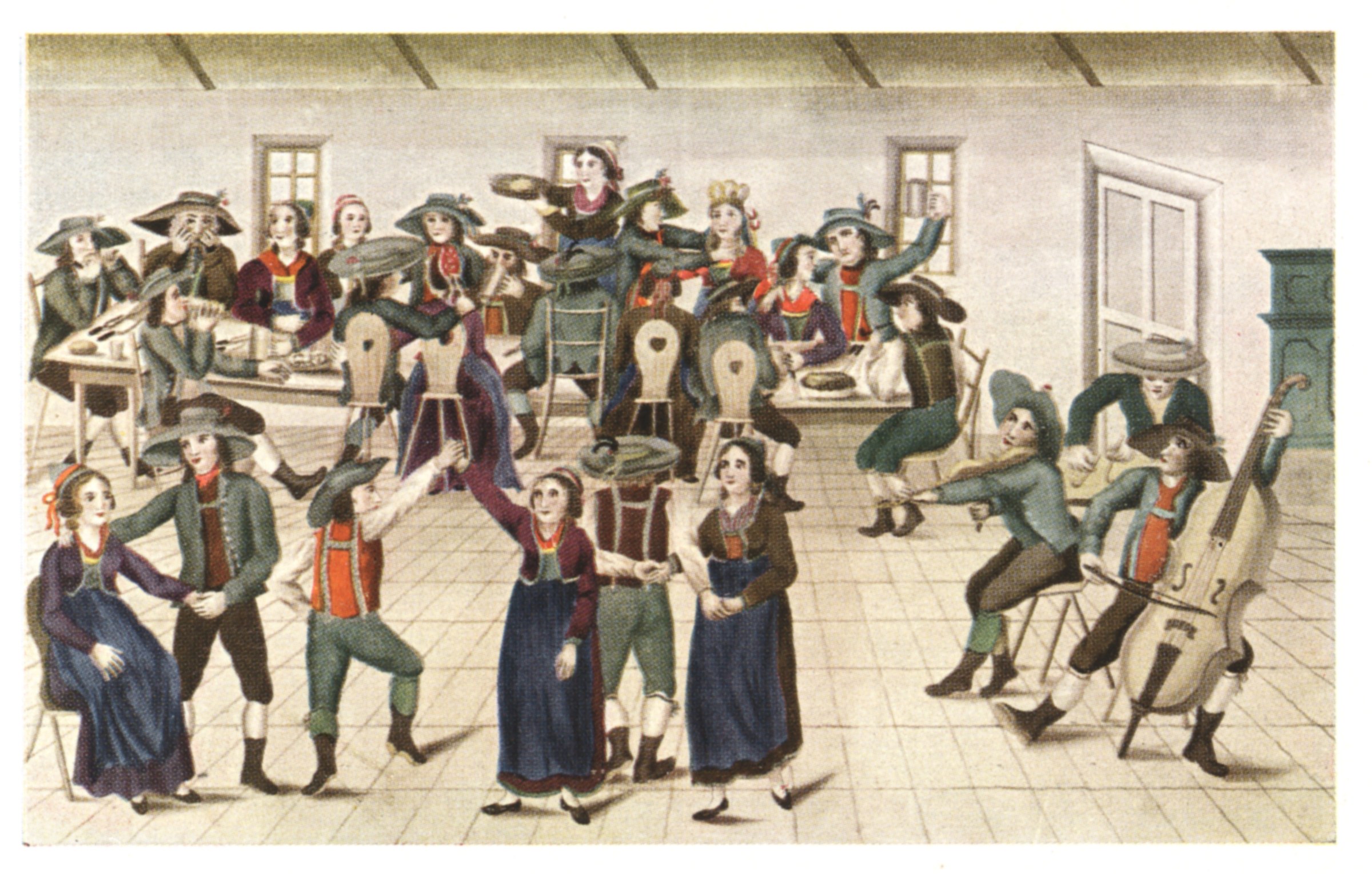
055 Hochzeit-Gastmahl und Tänze im Bezirk Zell - 1811
Scan and postprocessing by Hubertl
- Medium:
- Oil Painting
- Era:
- Mid 1800s (Polka Era)
- Source:
- Wikimedia Commons
- Rights:
- Public domain — free to use, share and adapt.
- Recorded as:
- Public Domain
This image preserves a documentary record of how Ländler and Alpine circle dances were actually performed and dressed in the early 1800s—not through written description, but through visual representation of multiple dancers in their full social context. For historians of ballroom dance, it shows the transition between folk and courtly forms at the moment when the waltz was emerging from rural tradition.
What you are looking at
A large indoor gathering in a timber-roofed hall, crowded with figures in early 19th-century Alpine costume engaged in dancing and music-making. The floor is tiled in a regular pattern; windows and doors pierce the whitewashed walls. In the center and background, musicians play: a man with a stringed instrument (possibly a zither or violin) sits at a table on the left, while others hold what appear to be brass or wind instruments. Dancers occupy the middle ground and foreground in various configurations—some in pairs, some in small groups, some in loose lines. The costumes are consistent throughout: men wear dark breeches, waistcoats, and broad-brimmed hats in shades of green and brown; women wear long dark skirts with red or rust-colored front panels or aprons, and most wear hats or headdresses. The color palette is muted—ochres, dark greens, reds, and browns dominate. The mood is festive but orderly, with no sense of wildness or abandon; this is a formal community gathering or celebration rather than a street carnival.
The dancing
The dancers display an upright carriage throughout. Several pairs are visible in what appears to be a closed or semi-closed ballroom hold—partners facing each other or side-by-side with arms engaged. Other figures stand in looser formations, some with arms raised or extended as if clapping or gesturing in time to music. The weight appears grounded; there is no evidence of jumping, turning, or acrobatic movement. The men's posture is stiff and formal; the women's skirts move minimally, suggesting controlled, walking-based steps rather than high kicks or spinning. The overall impression is of a structured social dance with prescribed patterns, not improvisation.
The dance depicted
This is Alpine folk dance, almost certainly from the Styrian (Austrian) tradition of the early 19th century, as indicated by the costume and the catalogue reference to Steirisches Trachtenbuch (Styrian costume book). The dress, setting, and movement are consistent with Ländler, a precursor to the waltz that was widespread in rural Austria and Bavaria. The mixed-gender couples, the upright posture, and the apparent use of a walking step with partners in close contact all align with Ländler practice. The presence of musicians with string instruments reinforces this identification. This is a peasant or rural community celebration, likely a wedding feast or holiday gathering, rather than court or urban ballroom dancing.
How it was made
This is an oil painting or hand-colored engraving/lithograph—the record states oil painting, but the image quality, the even fill of flat colors, and the precise outlines suggest it may be a hand-colored print. The technique allows sharp delineation of individual figures and costume detail, which is clearly the artist's priority; faces are schematic, but the red apron panels, hat styles, and waistcoat cuts are carefully rendered. The regular grid of the floor tiles emphasizes the formal, documented quality of the work, as if recording a specific tradition rather than capturing a fleeting moment. This is a work of ethnographic or costume documentation as much as genre painting.
About this work
This painting or colored print documents a Styrian community dance gathering in the early 19th century, capturing the costume, formation, and social context of Alpine folk dance at a moment when such traditions were beginning to be recorded and celebrated as markers of regional identity. The work belongs to a broader 19th-century interest in peasant life and folk custom, particularly in the Austrian and German territories. It is a visual record of the Ländler and related circle and couple dances that would shape European ballroom practice for the century to come.
How to look at it
Attend to the formal arrangement of the figures: they are not scattered at random but seem to follow a dance pattern or formation that the artist has chosen to freeze mid-motion. Notice how the couples and small groups relate to the music-makers; the line of sight and body orientation suggest a coordinated performance to live music. Look at the costume detail—the red apron panels and hat styles are rendered with precision, indicating this is a record of a specific regional tradition, not a generic 'folk dance.' The regularity of the floor tiles and the rectangular frame of the hall create a sense of documentary recording, as if the artist is showing us how a real event looked, not an imagined or theatrical scene.
The artist
The artist is attributed to 'Hubertl' (artist name recorded as 'Scan and postprocessing by Hubertl,' suggesting Hubertl may be a cataloguer or digitizer rather than the original painter). The work is likely part of a broader documentation of Styrian or Alpine costume and custom, possibly drawn from or relating to the Steirisches Trachtenbuch (Styrian Costume Book), a regional record of dress and tradition. The original artist and date of composition are not clearly established in the record.
The period
The early 19th century saw a surge of romantic interest in folk culture and peasant life across Europe, driven partly by nationalism and the development of ethnography as a discipline. In Austria and Bavaria, Alpine costume and dance were increasingly documented and celebrated as authentic expressions of regional identity, even as urbanization and industrialization were transforming rural life. The Ländler, which dominates this scene, was simultaneously becoming fashionable in middle-class ballrooms as the waltz, shedding its folk associations. The formal, almost anthropological tone of this painting reflects the era's dual impulse: nostalgia for a vanishing rural world and pride in the authentic culture it represented.
Where it lives
The work is recorded as sourced from Wikimedia Commons with attribution to 'Steirisches Trachtenbuch' (Styrian Costume Book). The catalogue gives the date as 1850 with the note that it depicts a wedding feast and dances in the Zell district from 1811—suggesting either that the painting was executed in 1850 to document or commemorate an event from 1811, or that these dates refer to different objects. The holding collection is not recorded.
Dance in this work
Questions about this work
What is the Ländler and why should I care?
The Ländler is a couple dance in 3/4 time that emerged in rural Austria and Bavaria in the 18th century and became fashionable in urban ballrooms by the early 19th century as the waltz. This painting shows Ländler being danced in its original social context—a village celebration—before it was refined into the ballroom waltz that would dominate 19th-century European dance. Understanding the Ländler's folk origins helps explain how a peasant dance became the defining dance of the ballroom.
Is this a painting or a print?
The record states it is an oil painting, but the image shows characteristics of a hand-colored engraving or lithograph: flat color fills, sharp outlines, and a regular compositional grid. It may be that the original was a print that was hand-colored, or the record may be imprecise. Without access to the object itself, a definitive answer is not possible.
How do I know this is the Ländler and not some other Alpine dance?
The costume (Alpine dress from Styria), the couple configuration with close partnership, the upright posture, the presence of string musicians, and the indoor formal setting are all consistent with Ländler as documented in historical sources. The catalogue attribution to the Styrian Costume Book supports this. However, other similar circle or couple dances were danced in the Alpine region; the painting does not preserve footwork or detailed body mechanics that would allow absolute certainty.
More dance artwork