25 works in this view — arrow keys or swipe to move between them.
Dance in Art
The Dance of the Almeh
Jean-Léon Gérôme
- Medium:
- oil on canvas
- Era:
- Mid 1800s (Polka Era)
- Source:
- Wikimedia Commons
- Rights:
- Public domain — free to use, share and adapt.
- Recorded as:
- public_domain
This work is central to understanding how Western art history has visualized non-European dance traditions and how that visualization has shaped perceptions of both the dance and the dancer. It demonstrates the gap between artistic interpretation and lived practice: Gérôme's composition reflects European Romantic aesthetics and Orientalist fantasy more than authentic performance context, yet it became a canonical image that continues to influence how *Raqs Sharqi* is understood in Western culture. For scholars and practitioners of Middle Eastern dance, it is essential historical material for decolonizing the narrative of the form itself.
What you are looking at
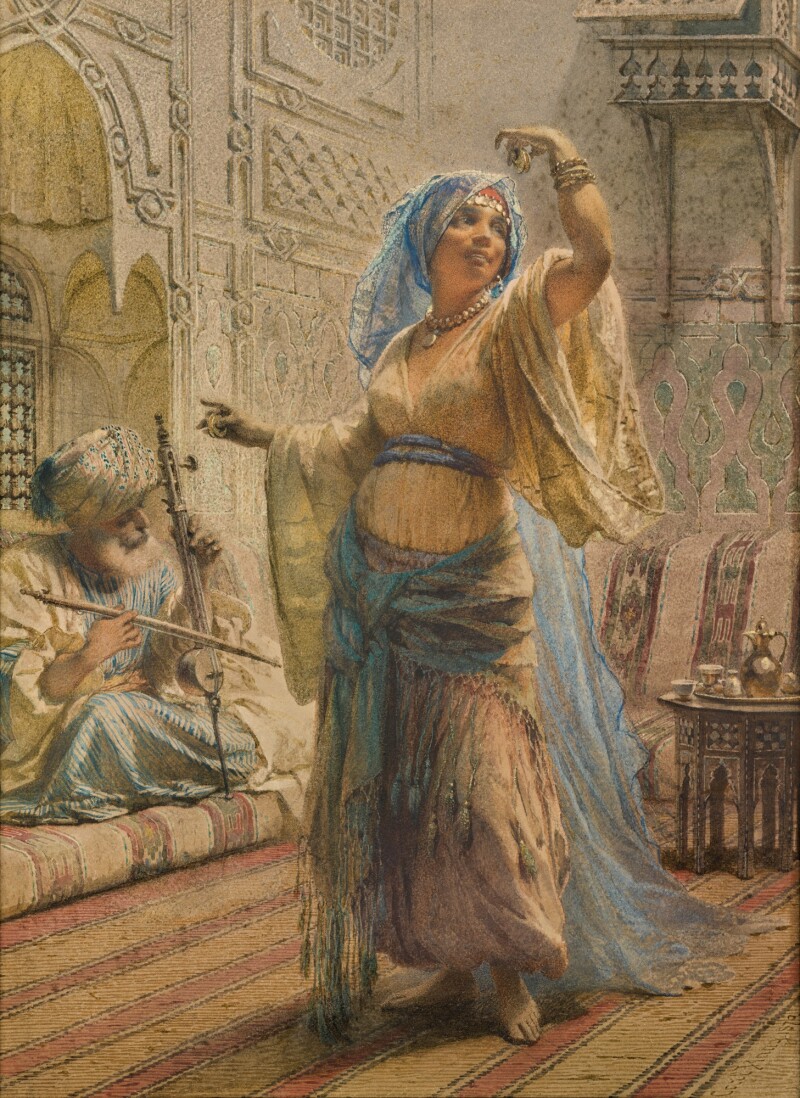
A woman dances alone in an ornately decorated interior, her body caught mid-movement in a pose of theatrical abandon. She wears a sheer yellow-gold draped garment that falls to her ankles, with a blue veil wrapped around her head and shoulders; her left arm is raised and slightly bent, her right arm extended downward. A young male musician or attendant sits to the left on a cushioned platform, playing a stringed instrument (possibly a oud or similar), his gaze directed toward the dancer. The architectural setting is richly detailed with Islamic geometric patterns, carved stonework, arched doorways, and decorative tilework in muted earth tones and reds. A low table with vessels sits to the right. The light is warm and diffused, creating soft shadows across the figured walls and floor. The entire composition suggests an intimate performance within a palace or wealthy household.
The dancing
The dancer's posture is one of fluid, upward extension—her torso is lifted and slightly arched, her raised left arm curves gracefully overhead, and her head tilts back, eyes gazing upward in an expression of trance or ecstasy. Her right arm hangs loosely, hand positioned near her hip. Her legs appear straight, weight settled into a standing position, with no visible footwork articulation. The musician sits in a grounded, stable position, fully focused on his instrument. The spatial relationship suggests a formal performance dynamic: the dancer commands the central space while the musician provides accompaniment from the side.
The dance depicted
This is almost certainly *Raqs Sharqi* (belly dance), the solo female dance form widely performed in 19th-century Cairo and other Ottoman-era urban centers. The private indoor setting, the presence of a live instrumentalist, the solitary female dancer, and the pose of uplifted arms and extended body are all consistent with historical accounts and depictions of this tradition. The veil and yellow drapery are period-appropriate costuming for the era. The artist has captured a moment of what appears to be emotional release or spiritual transport rather than a technically intricate step—a characteristic of certain *Raqs Sharqi* performance styles that emphasized fluidity and emotional expression over precision footwork.
How it was made
Oil on canvas, painted with the academic precision and romantic Orientalist aesthetic typical of mid-19th-century European salon painting. The technique allows Gérôme to render the textile surfaces with luminous detail—the translucency of the veil, the fall and weight of the draped garment, the carved relief of the architectural elements—and to capture a moment of stillness that reads as movement. The warm, theatrical lighting and the meticulous attention to decorative detail are hallmarks of Orientalist painting and signal this work as a product intended for educated European collectors and exhibition audiences.
About this work
This 1863 oil painting depicts a solitary female dancer performing before a musician in a richly decorated interior space. The work is a quintessential example of European Orientalism—a cultural and artistic fascination with the Eastern Mediterranean and Middle East that dominated mid-Victorian visual culture. The painting condenses several layers of 19th-century attitudes: the exoticization of non-European dance traditions, the eroticization of the female body through the Western gaze, and the artistic celebration of architectural and textile surfaces as markers of cultural otherness. For a history of dance representation, it is significant not because it documents *Raqs Sharqi* with ethnographic fidelity—it does not—but because it reveals how European artists and their audiences understood, fantasized about, and consumed images of Middle Eastern performance.
How to look at it
Observe the dancer's face and gaze first: she is not looking outward to acknowledge a viewer or external audience, but upward in a state of internal focus or trance. This gesture—common in European Romantic painting—transforms the dance into an expression of emotion rather than a social or technical performance. Notice the asymmetry of her arms: the raised arm is active and lifted, the lowered arm is passive and relaxed, creating a sense of movement frozen at a precise instant. The architectural surround—the arches, the carved patterns, the distant doorways—creates depth and suggests a space of privilege and privacy, not a public stage. Finally, attend to the veil: it is not in motion but draped across the dancer's body, functioning as part of her costume rather than as a prop in active play, which was common in some *Raqs Sharqi* styles.
The artist
Jean-Léon Gérôme (1824–1904) was a dominant figure in French academic art and a prolific painter of Orientalist subjects. He studied under Paul Delaroche and became known for his historical scenes, classical subjects, and above all his romanticized depictions of the Ottoman world, North Africa, and the Near East. Gérôme traveled to Egypt and the Levant in the 1850s, and these journeys supplied him with visual material—architectural details, textiles, landscapes, and figure studies—that he deployed in studio paintings created for the European market. His Orientalist works sold widely and influenced both collectors and other artists; he was also a powerful teacher and administrator who shaped taste at the École des Beaux-Arts. Gérôme's approach to Orientalism was theatrical and sensual rather than documentary, and his female nudes and dancers were particularly popular despite—or because of—their exoticizing premise.
The period
In 1863, the year this painting was exhibited, European Orientalism was at its cultural peak. The colonial expansion of France, Britain, and other European powers into North Africa and the Eastern Mediterranean had created both literal access to these regions and intense cultural appetite for their visual representation. In the realm of dance, *Raqs Sharqi* and other Middle Eastern performance forms had begun to circulate in European consciousness through travel accounts, colonial administration, and occasional live performances by touring ensembles. The form was simultaneously stigmatized (associated with lower-class street performance and commercial sex work in Ottoman cities) and glamorized (celebrated in European art and literature as an expression of sensuality and exoticism). Academic painters like Gérôme mediated this contradiction by elevating the subject into fine art while preserving the charge of exotic eroticism. The painting's theatrical setting and the musician's presence evoke the private performances that European travelers had witnessed or imagined in elite households, rather than the street or coffeehouse contexts where much *Raqs Sharqi* actually occurred.
Where it lives
The work is documented in Wikimedia Commons; the current holding collection is not recorded in the catalogue. The cataloguing era label lists the painting under 'Late 1800s (Victorian Ballroom)', which is a significant misdating and miscategorization—the work is from 1863 and depicts a Middle Eastern private performance, not a Victorian ballroom context.
Dance in this work
Questions about this work
Is this an accurate depiction of Raqs Sharqi as it was actually performed?
No. Gérôme has recomposed the dance through a European Romantic lens, emphasizing emotional expression, physical beauty, and theatrical pose over the actual footwork, rhythmic complexity, and musical engagement of the form. The private, intimate setting may reflect some elite Ottoman performance contexts, but the overall aesthetic—the lighting, the composition, the dancer's upward gaze—is shaped by European artistic convention. This is a fantasy of the dance, not a document of it.
Why was Gérôme painting Middle Eastern dancers in 1863?
Orientalist painting was a major market and cultural obsession in mid-Victorian Europe. France's colonial expansion into Algeria and ongoing interests in Egypt and the Ottoman territories fueled European appetite for images of these regions. Dancers, particularly female performers, were popular subjects because they allowed artists to combine exoticism, sensuality, and the aesthetic appeal of movement and fabric—all marketable to wealthy collectors.
Did Gérôme travel to see this dance performed?
Gérôme did travel to Egypt in the 1850s and collected visual reference material, but this painting was created in his Paris studio. He worked from sketches, memory, architectural details, and artistic imagination. The specificity of the setting—the carved arches and tilework—may derive from observed or documented sources, but the composition and the dancer's pose are artistic inventions.
What was the social context of Raqs Sharqi in the 19th century Ottoman world?
Raqs Sharqi was performed by professional female dancers (*almeh* or *bayyarat*) in coffeehouses, at private celebrations, and in street performances. It was socially complex: it was respected as a skilled craft and could confer status, but dancers were also often viewed with suspicion by conservative segments of society and were subject to legal and social restrictions. The private, elite household setting that Gérôme depicts—with a musician in attendance—represents one particular context, but only one.
More dance artwork