32 works in this view — arrow keys or swipe to move between them.
Dance in Art · 1630
Anonymous - Krishna Revels with the Gopis, Page from a Dispersed Gita Govinda (Song of the Cowherds) - 2003.165 - Metropolitan Museum of Art
anonymous
- Medium:
- Oil Painting
- Era:
- Pre-1700 (Renaissance/Baroque)
- Source:
- Wikimedia Commons
- Rights:
- Public domain — free to use, share and adapt.
- Recorded as:
- Public Domain
The Gita Govinda and its illustrations became foundational to classical Indian dance traditions, particularly Manipuri dance, which takes its narrative arc and emotional vocabulary directly from this text. Understanding this image is essential for tracing how literary devotion becomes bodily practice: the gopis' postures here anticipate the tribhanga and mudra of classical Indian dance. The work also documents an early moment in the Mughal-era synthesis of Persian and Indian aesthetic traditions, showing how devotional narrative circulated across religious and artistic communities.
What you are looking at
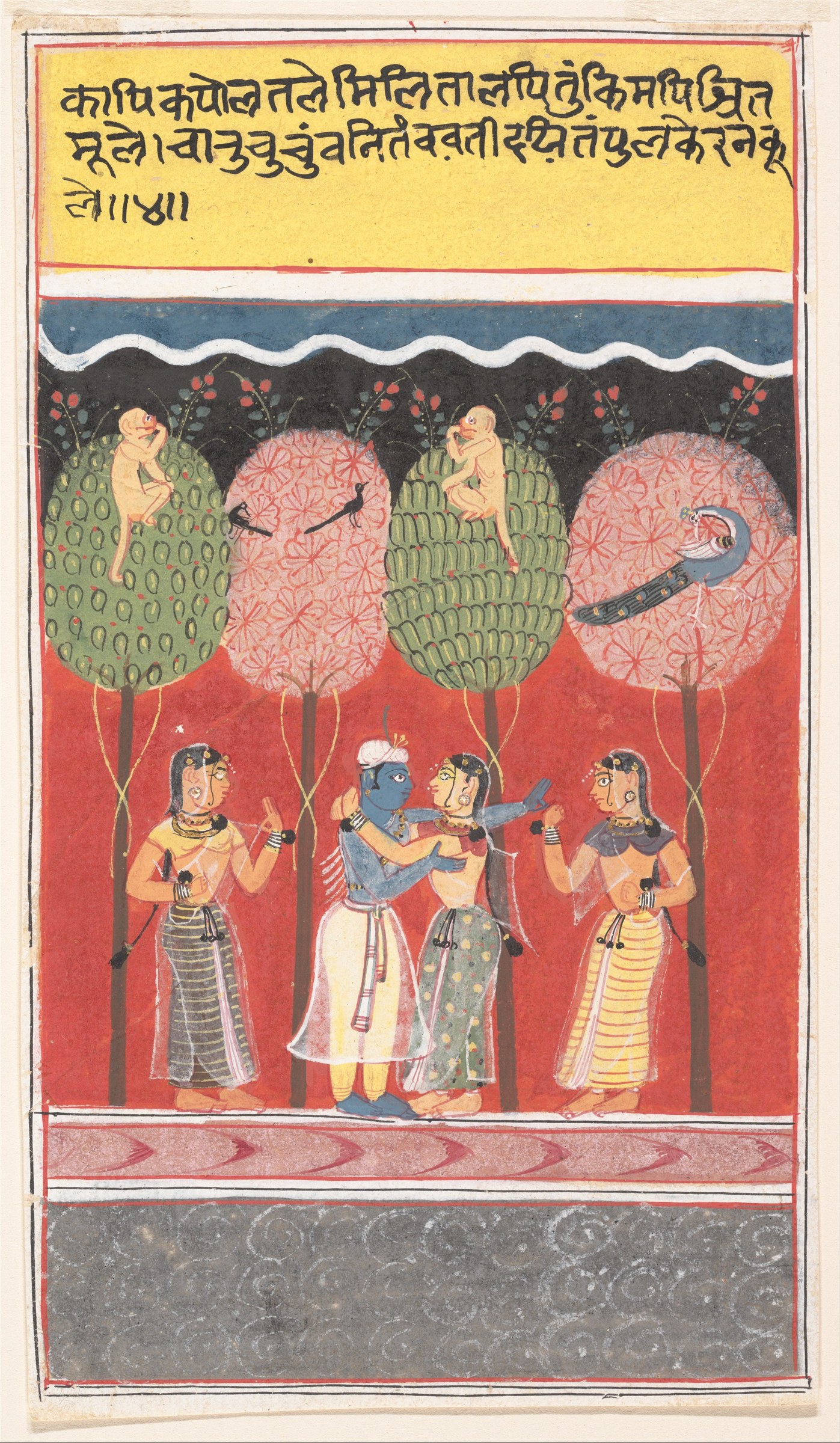
This is a manuscript page from a Gita Govinda (Song of the Cowherd), a Sanskrit devotional poem of the 12th century that celebrates Krishna's love for the gopis (cowherd women). The composition is divided into upper and lower registers. Above, against a dark ground, two nude or semi-nude figures (likely celestial beings or Krishna companions) sit perched within flowering trees—one in a pink-flowered tree on the left, another in a green-leaved tree on the right—while small birds move between them. A broad band of blue represents water or sky. Below, on a warm rust-red ground, five figures in profile move in a scene of courtship and revelation: a blue-skinned Krishna in the center, recognizable as the deity, wears a jeweled headdress and holds what appears to be a flute. He is flanked by three women in yellow and patterned garments, their bodies angled toward him in attitudes of attention and devotion. A fourth figure on the left, rendered in cooler tones, stands slightly apart. Flowering trees with schematized blossoms frame the scene. Sanskrit text fills the yellow panel at the top, identifying the episode and verse.
The dancing
The five figures below are arranged in an informal but purposeful spatial logic rather than a rigid line. The three gopis nearest Krishna angle their bodies inward, their arms hanging naturally or bent at the elbow in gestures of offering or supplication; their weight appears distributed evenly on both feet, suggesting a stillness of rapt attention rather than active movement. Krishna stands with weight centered, one hand raised (holding or gesturing with the flute), his body upright and frontal despite the profile orientation. The poses are contemplative rather than kinetic—these are moments of encounter rather than steps or traveling patterns. The two figures in the upper trees are seated in attitudes of ease, their limbs relaxed.
The dance depicted
This depicts a rasa lila (divine play) scene from the Gita Govinda tradition, specifically a moment of Krishna's revelation to or communion with the gopis. The Gita Govinda was composed as a devotional poem meant to be sung and acted, and became the basis for the Manipuri dance tradition (Chhabi Bilas and Lasa Bilas forms) and influenced Kathak and other classical Indian dance practices. This manuscript page is illustrating a text-based spiritual narrative rather than documenting a dance performance per se, but the scene itself encodes the dramatic and emotional content that would be realized through classical Indian dance vocabulary—the gopis' postures of longing, the central figure of Krishna, the enclosed garden setting all became conventions in Manipuri and Kathak dramatization of this beloved text. The painting captures the narrative moment that dancers would interpret through mudra (hand gesture), tribhanga (three-fold body bend), and rasa (emotional essence).
How it was made
This is a page from an illustrated manuscript, executed in opaque watercolor (gouache) and ink on paper, with a yellow ground for the text panel and a layered composition space below. The technique allows for flat, bold color fields—the rust red, deep blue, vibrant greens and pinks—and fine linear detail in the faces, jewelry, and tree patterns. The style is characteristic of Mughal or Rajasthani manuscript painting of the 16th–17th centuries, which employed Persian and Indian conventions in tandem. The technique of manuscript illumination implies this was a luxury object, possibly commissioned for a royal or wealthy merchant patron, and circulated within elite circles as both a spiritual text and a work of visual refinement. The page format and integration of text and image suggests this was meant to be read and contemplated in intimate settings, not displayed publicly.
About this work
This manuscript page illustrates the Gita Govinda, a 12th-century Sanskrit poem celebrating Krishna's divine love play with the gopis (cowherd women), rendered in the opaque watercolor and ink technique characteristic of 16th–17th-century Indian manuscript production. The image captures a moment of encounter and devotion: Krishna, identifiable by his blue skin and flute, stands at the center of a garden scene surrounded by three attendant women whose bodies are angled toward him in attitudes of longing and reverence. The composition merges narrative illustration with the visual language of classical Indian dance, encoding gestures and emotional states (rasa) that would later become formal choreographic vocabulary in Manipuri, Kathak, and related traditions. This work belongs in a dance collection because it documents the visual genealogy of how this beloved sacred narrative has been embodied in movement, and because the manuscript format itself was designed to be performed—sung, recited, and danced in courtly and devotional settings.
How to look at it
Attend first to the centered blue figure of Krishna and the three women's bodies turning inward toward him—this is the emotional and compositional pivot of the scene. Notice how the artist has rendered their faces in profile but angled their torsos and limbs to suggest three-dimensionality and inner feeling, a technique that anticipates how classical Indian dancers would use tribhanga (the three-fold body bend) to convey both physical presence and emotional state. The flowering trees that frame the figures are not naturalistic landscape but a schematized garden convention, emphasizing the scene's spiritual rather than literal setting. The Sanskrit text above is not decoration but the source material itself—this page is meant to be read as well as viewed, and a performer or devotee would move between text and image as guides to the narrative.
The period
This manuscript was produced during the height of the Mughal Empire in India (16th–17th century), when the synthesis of Persian artistic traditions with Indian subject matter created a distinctive visual culture. The Gita Govinda had been composed in the 12th century but gained renewed prominence during this period as a text of bhakti (devotional) Hinduism, which emphasized emotional and personal connection to the divine. The painting technique reflects the cross-cultural exchange between Persian miniature painting (brought by Mughal courts) and Indian traditions. Simultaneously, the classical Indian dance forms that would draw directly on the Gita Govinda—Manipuri, Kathak, and others—were developing their codified gesture systems and dramatic vocabularies. This manuscript page sits at the intersection of these traditions, capturing the moment when sacred narrative was being visualized for elite consumption and prepared to be danced.
Where it lives
This is a page from a dispersed Gita Govinda manuscript, indicating that the original bound volume has been separated and its pages scattered across collections. The work is held at the Metropolitan Museum of Art (accession 2003.165) and was sourced through Wikimedia Commons.
Dance in this work
Questions about this work
What is the Gita Govinda and why does it matter for dance?
The Gita Govinda is a 12th-century Sanskrit devotional poem by Jayadeva celebrating Krishna's divine love play with the gopis. It became the foundational narrative text for Manipuri classical dance and influenced Kathak and other Indian dance traditions. Dancers perform the verses and emotions of this text through codified gesture systems (mudra) and emotional vocabularies (rasa), so understanding the literary and visual sources is essential to understanding the dance.
Why is Krishna depicted with blue skin?
In Hindu iconography, Krishna's blue skin is a divine marker, often representing his infinite nature and his connection to the sky and the divine realm. The blue is not a naturalistic color but a symbolic one, making him immediately recognizable as a deity rather than a human figure.
What are the gopis doing in this scene?
The gopis are attending to Krishna in a moment of divine encounter. Their inward-angled bodies and downward gazes suggest devotion, longing, and emotional surrender. This emotional state—rasa—is precisely what classical Indian dancers embody through movement and gesture when performing the Gita Govinda.
How does this manuscript page relate to performance?
This page is both an illustration and a prompt for performance. The text at the top would be sung, and the image provides both a narrative key and a visual model for how the scene might be embodied in gesture and posture. Wealthy patrons would commission such manuscripts for recitation and performance in private, courtly, or devotional settings.
More dance artwork