49 works in this view — arrow keys or swipe to move between them.
Dance in Art · 1872
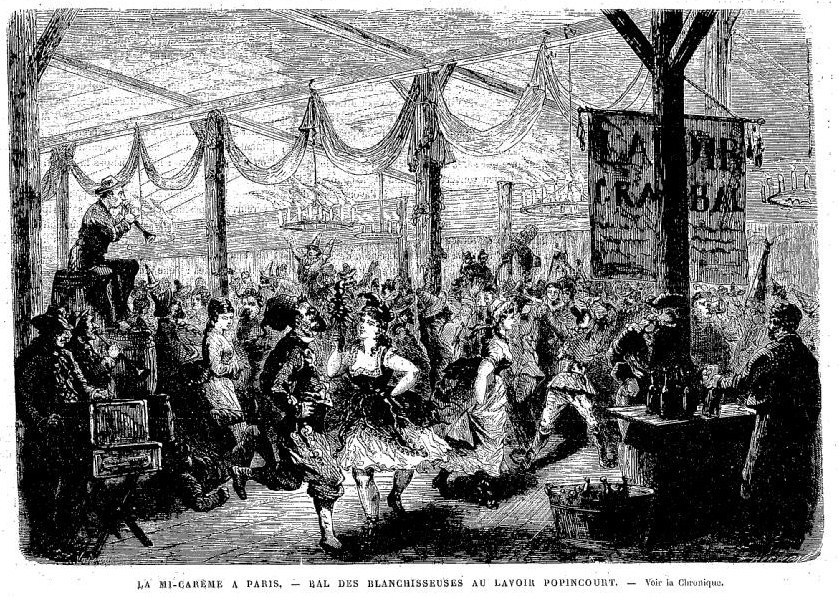
Bal des blanchisseuses au lavoir Popincourt 1872
Georges Redon ?
- Medium:
- Oil Painting
- Era:
- Late 1800s (Victorian Ballroom)
- Source:
- Wikimedia Commons
- Rights:
- Public domain — free to use, share and adapt.
- Recorded as:
- Public Domain
This engraving is a rare contemporary depiction of working-class ballroom dancing in the nineteenth century. Most dance imagery from this period documents either theatrical ballet or elite ballroom culture; images of how ordinary Parisians actually danced are scarce. The work shows that by the 1870s, the waltz and polka were no longer elite forms but had become the popular dances of choice for all social classes.
What you are looking at
This is a wood engraving depicting a crowded indoor dance hall during the Mi-Carême (mid-Lent) carnival celebration of 1872 at the Popincourt lavoir (public washing house) in Paris. The scene is dense with figures: working-class Parisians—laundresses and their companions—fill the space in a mixture of dancers and spectators. The setting is a large covered hall strung with elaborate swags and garlands of fabric draped from tall wooden posts, creating a festive canopy overhead. The floor is packed with bodies in motion; couples dance while others stand watching, sitting on benches, or moving through the crowd. The dress is mixed: women in full skirts and bonnets or hats, men in dark suits and hats. The lighting is even and bright, rendered through the fine cross-hatching characteristic of wood engraving, which picks out the texture of clothing and the energy of movement across the entire composition. The moment captures not a single choreographed moment but the lived chaos of a popular social dance—simultaneous groups in different states of movement, conversation, and observation.
The dancing
The dancers visible in the composition are in closed holds typical of the period's ballroom dances, with couples at various distances across the floor. No single couple dominates; instead, the artist has distributed figures of different scales throughout the space, creating depth and a sense of many simultaneous interactions. Skirts are full and in motion; one woman's dress is caught mid-swing in the foreground. The poses suggest waltzing or polka—a turning, spinning embrace rather than processional or figured movement. Bodies are upright and formal despite the popular setting; there is no jig-dancing or folk posture here. The spectators at the edges lean in with interest, and standing figures occupy spaces between the dancing couples.
The dance depicted
This depicts the Mi-Carême ball (mid-Lent carnival dance), a working-class Parisian tradition where laundresses and their friends gathered in public spaces to dance. The dances shown are the period ballroom dances—waltz and polka—adapted for popular street-level use. The lavoir was both a community workplace and social venue; the event captures the democratization of ballroom dancing that had occurred by the 1870s. What marks this as *not* elite ballroom is the scale, density, and social mix of the crowd, and the outdoor or semi-outdoor (covered hall) setting rather than a formal salon. The image is a document of how middle and working-class Parisians danced in their own spaces.
How it was made
This is a wood engraving, a technique that uses the end-grain of a wooden block cut with fine burins to produce a detailed black-and-white image. Wood engraving allowed for much finer detail and smaller scale than woodcut, making it ideal for newspaper and periodical reproduction. The work was likely published as an illustration in a Parisian newspaper or magazine covering the carnival season—the title inscription below the image and the journalistic composition suggest this context. The technique's capacity for dense cross-hatching made it well suited to rendering crowds and complex interior scenes. This means the image circulated widely in printed form among literate Parisians, not as a unique object but as a reproducible record of a newsworthy social event.
About this work
This wood engraving documents a specific moment in Parisian popular culture: the Mi-Carême ball held at a public lavoir in 1872. It shows working-class Parisians—principally laundresses and their companions—dancing waltz and polka in a festively decorated hall. The image is both a document of social history and a record of how ballroom dance had penetrated working-class leisure by the late nineteenth century. It belongs in a gallery of dance imagery because it captures the lived reality of social dancing outside the academy or the elite ballroom, and because it is a primary source for understanding what dance meant to ordinary people in this era.
How to look at it
Attend to the density and distribution of figures across the frame—the artist's choice to show many simultaneous couples rather than a single focal pair emphasizes the communal, egalitarian nature of the event. Note how the swags of fabric create a sense of enclosure and festivity despite the building's utilitarian origin. Look at the poses: the couples are dancing in the closed ballroom hold, not in any folk or processional formation, yet they do so in a crowded, informal space. The engraver has captured movement through the slight tilt and lean of bodies and the catch of flying skirts, not through exaggerated gesture.
The artist
The attribution to Georges Redon is marked with a question mark in the catalogue record, and the image does not clearly bear a signature. Redon (1841–1916) was primarily known as a painter and lithographer working in the Symbolist and later modernist modes, not principally as a journalistic illustrator. If this attribution is correct, it represents an atypical work in his practice—a straightforward documentary illustration rather than imaginative or symbolic imagery. Without confirmation, the authorship remains uncertain.
The period
The 1870s in Paris saw the consolidation of the waltz and polka as the dominant social dances across all classes. The early-century elite monopoly on ballroom dance had broken down by mid-century. Popular balls and carnival celebrations like the Mi-Carême had ancient roots but were increasingly organized and attended in the nineteenth century as a form of working-class leisure. The lavoir itself was a key social space in working-class Paris, particularly for women, and events hosted there had community significance. Journalistic interest in such scenes reflects a broader nineteenth-century documentary impulse to record the life of the city and its people.
Where it lives
The work is recorded as sourced from Wikimedia Commons, suggesting it is held in a public collection but the specific institution is not documented in the provided record. It appears to have been a periodical illustration, likely published in a Parisian newspaper or magazine covering carnival events in 1872, and may later have been collected or archived as a document of Parisian social history.
Dance in this work
Questions about this work
What is the Mi-Carême?
The Mi-Carême (mid-Lent) was a carnival celebration held in Paris at the midpoint of Lent, traditionally associated with festivity, costume, and street celebration. By the nineteenth century, organized balls and dances were held in various popular venues, including public laundries (lavoirs), making it a working-class as well as an elite tradition. The event allowed working people, especially women, a rare opportunity for public dancing and socializing.
Why would laundresses gather at their workplace to dance?
The lavoir was more than a workplace: it was a social hub where women gathered daily and formed community bonds. Hosting a ball there made it accessible to the working women who used it and their friends and families, and required no separate venue. The space was already familiar and held communal significance, making it an ideal location for a popular celebration.
How do we know they are dancing waltz and polka?
The closed-position couples visible throughout the composition are in the characteristic hold of waltz and polka—face-to-face, with the man's right hand on the woman's back and their other hands joined at the side. These were the dominant ballroom dances of the period and were danced at all social levels by the 1870s. The turning, spinning motion suggested by the posed bodies and flying skirts is typical of these dances rather than any other contemporary form.
Is this a unique artwork or a reproduction?
This is a wood engraving, a technique designed for reproductive printing. The original block was carved to be printed many times, likely for a newspaper or illustrated magazine. Multiple impressions would have been made and distributed; the image is not a unique object but a reproducible document intended to circulate widely among readers.
More dance artwork