28 works in this view — arrow keys or swipe to move between them.
Dance in Art · 1920
Berlin Casanova 3
Martin Frost
- Medium:
- Oil Painting
- Era:
- 1920-1950 (Swing Era)
- Source:
- Wikimedia Commons
- Rights:
- Public domain — free to use, share and adapt.
- Recorded as:
- Public Domain
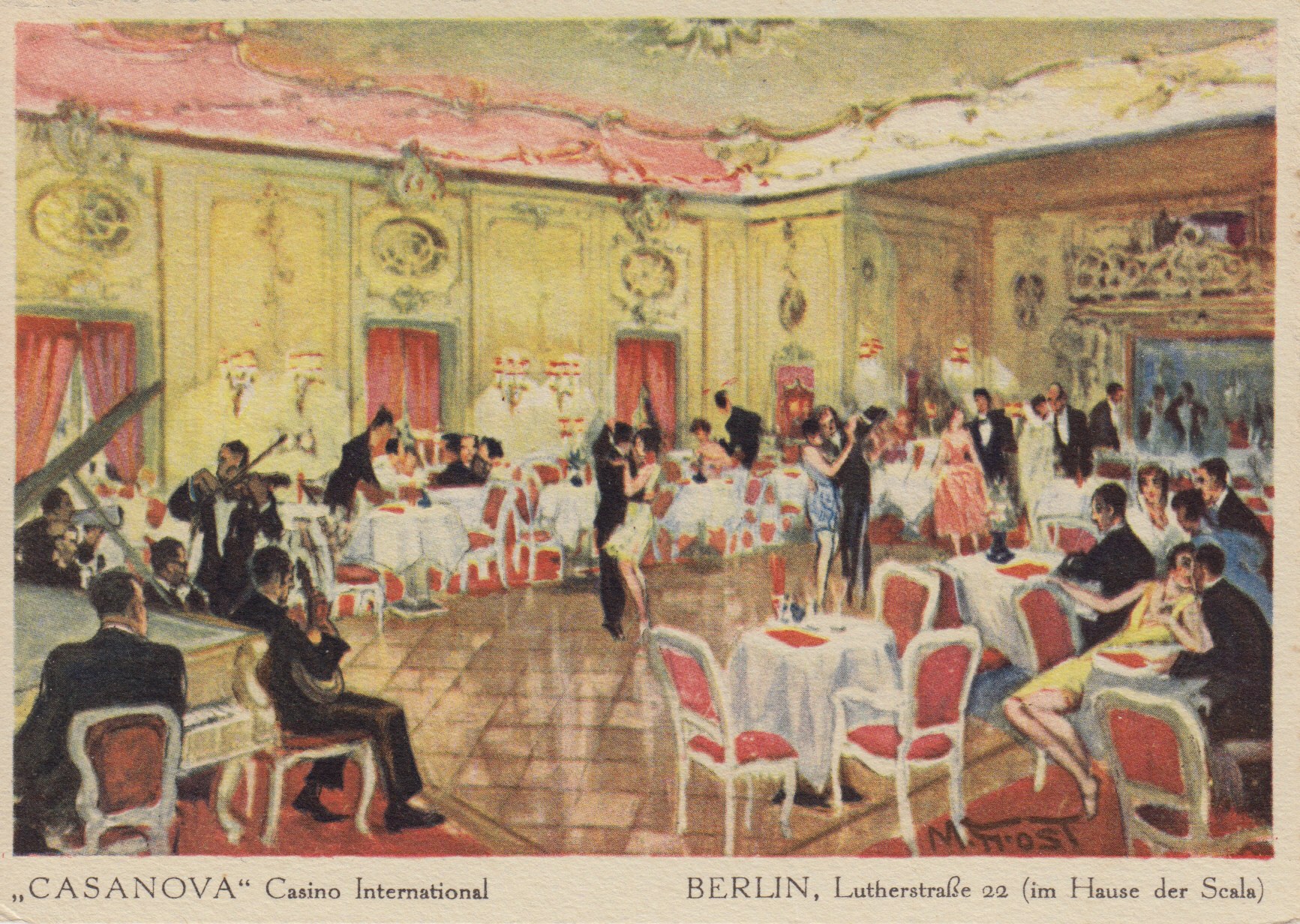
This work documents a specific venue and moment when ballroom dancing was at the center of metropolitan social life, and shows how commercial dance establishments created environments designed to facilitate and display partner dancing. For dance historians, it is evidence of the closed-position ballroom frame and formal dress codes that defined social dancing in the 1920s, and of how modernist Berlin positioned itself as a center of sophisticated cosmopolitan leisure.
What you are looking at
A grand ballroom filled with formally dressed diners and dancers at the Casanova Casino International in Berlin. The room is decorated in ornate Rococo style with pale yellow-green walls, elaborate gilt ornamental panels, red damask doors, and a painted ceiling in soft pink and green tones. Multiple round tables dressed in white linens with red accents are scattered throughout, occupied by men in dark suits and women in fashionable 1920s evening wear. In the center and background, couples move through a social dance, while servers and attendants circulate. The perspective draws the eye toward the rear of the space, where the architectural detail intensifies and additional dancers are visible. The overall impression is of sophisticated leisure and cosmopolitan nightlife at the height of the Weimar era.
The dancing
The dancers visible in the middle distance adopt the upright closed-position frame typical of ballroom dancing in this period—men and women facing each other in formal embrace, moving across the floor. Most figures are static or seated at tables, indicating this is a moment in social dancing where not all guests are dancing simultaneously. The women wear drop-waisted dresses reaching the knee or mid-calf, consistent with 1920s fashion. The men are uniformly in tailcoats or dark evening jackets. No specific footwork is legible, but the posture and proximity suggest partner ballroom dances of the period rather than solo or group choreography.
The dance depicted
This image documents the ballroom dancing culture of 1920s Berlin, specifically at an upmarket dance hall. The closed-position ballroom frame and the formal evening dress suggest Foxtrot, Waltz, or Tango—the dominant partner dances of the era. The Casanova was marketed as "die schönste Tanzstätte des Kontinents" (the most beautiful dance venue on the continent), indicating it catered to a wealthy clientele seeking fashionable social dancing. The mix of dancers and diners reflects the dual function of such establishments as both dining venues and dance floors, where entertainment and social mixing were intertwined. The specific dances cannot be identified from the figures visible, but the setting and period strongly suggest American Smooth or historic ballroom styles current in Weimar Berlin.
How it was made
This appears to be an oil painting, executed in a commercial illustration style typical of 1920s tourism and hospitality marketing. The artist (identified in the catalogue as Martin Frost) worked in a soft, impressionistic manner that captures the ambient light and ornamental detail of the interior without photographic precision. The technique is suited to reproduction—the work was likely distributed as a postcard or promotional image, as suggested by the printed caption and reverse text. The soft color palette and loose brushwork convey luxury and elegance while remaining accessible to a general audience, making it an effective promotional tool for the venue.
About this work
This is a documentary painting of the Casanova Casino International, a premier Berlin nightclub of the 1920s, showing the ballroom dancing and dining culture of the Weimar era. The work captures a specific moment in European social dance history when ballroom dancing was central to urban entertainment and courtship rituals for the middle and upper classes. It documents not just the dance itself but the venue, the dress codes, the mixed-gender social mixing, and the role of commercial establishments in mediating social life during the interwar period.
The painting is historically valuable as evidence of 1920s Berlin nightlife and the professionalization of entertainment spaces. It shows how dance venues functioned as total aesthetic and social environments, where architecture, decoration, fashion, and movement were carefully orchestrated to create an experience of modern sophistication. The Casanova's international marketing and the quality of its design indicate the competitive luxury market for dance halls in major European cities.
How to look at it
Attend first to the composition and lighting: the painter has positioned the viewer as if standing in the ballroom, looking toward the rear, creating a sense of spatial depth and social activity. Notice how the dancers are scattered throughout the scene rather than concentrated on a single floor—this reflects the social function of ballrooms, where dancing and dining coexist. Look at the frame and posture of the visible dancers: the men's and women's positions relative to each other, the upright carriage, and the distance maintained between partners are all markers of the ballroom dancing conventions of the period. The ornamental interior is as much the subject as the dancers—the venue itself is part of the attraction and the dance.
The artist
Martin Frost is identified in the catalogue record as the artist. Little is documented about his practice in the available sources. The style and subject matter suggest he was a commercial illustrator or painter working in Berlin during the 1920s, specializing in interior scenes and hospitality marketing imagery. The technical competence and promotional function of the work indicate he was producing commissioned art for venue owners seeking to attract clientele through attractive visual representations of their establishments.
The period
The painting dates to 1920, the very beginning of the Weimar Republic and the Golden Twenties—a period of rapid cultural modernization and urban nightlife expansion in Berlin. Commercial dance halls and cabarets flourished as sites of social mixing, modern music, and fashionable entertainment. Ballroom dancing had evolved during the 1910s and 1920s from a Victorian formal practice into a more energetic social activity; venues like the Casanova catered to a newly affluent middle class seeking modern leisure. Simultaneously, Berlin was becoming known internationally as a center of avant-garde culture, and its nightlife scene—both high and low—attracted global attention. The Rococo-revival interior design of the Casanova suggests a deliberate cultivation of elegance and historical sophistication to distinguish it from more bohemian or experimental venues.
Where it lives
The work was sourced from Wikimedia Commons. The reverse inscription indicates it was likely issued as a promotional postcard or venue advertisement by the Casanova Casino, distributed to potential patrons or used in tourism materials. The printed captions in German on both sides confirm its function as promotional material for the specific venue at Lutherstraße 22 in Berlin.
Dance in this work
Questions about this work
What was the Casanova Casino International in Berlin?
The Casanova was a high-end ballroom and restaurant located at Lutherstraße 22 in Berlin, operating during the Weimar era. According to its marketing, it was "die schönste Tanzstätte des Kontinents" (the most beautiful dance venue on the continent). It catered to an affluent clientele and featured live music, dining, and ballroom dancing in an ornately decorated Rococo-revival interior.
What dances would people have done in this venue?
Based on the 1920 date and the formal ballroom setting, guests would have primarily danced Foxtrot, Waltz, and Tango—the dominant partner dances of the era. These were social dances performed in a closed position by couples moving across the floor. The formal dress codes and upright posture visible in the painting are consistent with these ballroom styles.
Is this a photograph or a painting?
This is an oil painting, executed in an impressionistic style by Martin Frost. It was created as a promotional image for the venue, likely distributed as a postcard or used in hospitality marketing. The soft brushwork and color palette are suited to capturing the luxury and elegance of the interior without photographic precision.
What does the interior design tell us about the venue?
The Rococo-revival decoration—pale yellow-green walls, gilt ornamental panels, red damask doors, and an ornate painted ceiling—was deliberate brand positioning. Rococo aesthetics suggested historical elegance and sophistication, distinguishing upmarket dance halls from more experimental or bohemian venues. This classical aesthetic appealed to wealthy patrons seeking refined leisure.
More dance artwork