40 works in this view — arrow keys or swipe to move between them.
Dance in Art · 1812
Blythsome bridal - Title
Artist unknown
- Medium:
- Oil Painting
- Era:
- Early 1800s (Waltz Revolution)
- Source:
- Wikimedia Commons
- Rights:
- Public domain — free to use, share and adapt.
- Recorded as:
- Public Domain
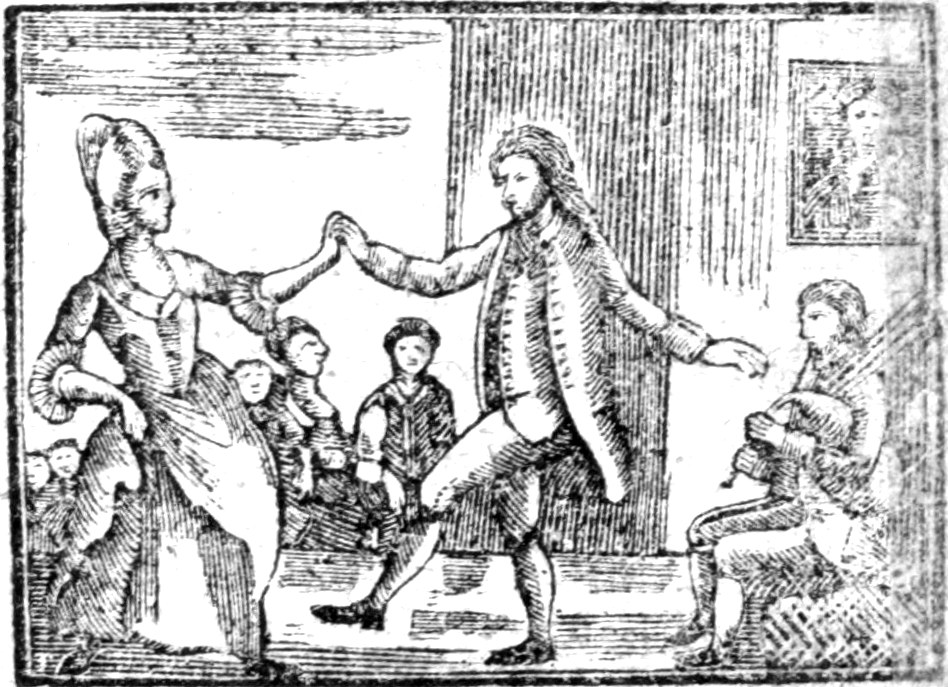
This engraving is rare visual evidence of how ballroom dance was performed outside the public assembly room—in the family drawing room, on the bride's wedding day, and at a scale intimate enough to include children. It shows that Regency dance steps and manners were not confined to the ballroom but were central to the ritual and display of courtship and marriage, making the dance a key text for understanding both the social history of marriage and the embodied practice of Regency-era dance.
What you are looking at
An engraving depicts a bridal dance in an intimate domestic interior, likely early 19th century. A woman in a white muslin gown with an elaborate headdress stands at center-left, one hand held by a man in a dark coat and breeches; she extends her other arm in a graceful arc. Two small children, dressed formally, stand between the couple—a boy and girl in dark clothing. To the right, a second woman sits or reclines in shadow, observing the scene. The setting is spare but refined: striped wallpaper and a framed picture on the wall establish an upper-middle-class domestic space. The engraving technique creates fine linear detail throughout, with cross-hatching for shadow. The moment captures a courtship or wedding celebration among family, the bride's posture and raised arm suggesting the opening gesture of a partnered dance.
The dancing
The principal female figure stands with her weight centered, one arm raised and slightly curved as though beginning an allemande or cotillion step; her partner holds her opposite hand at roughly chest height. Their frame is open—not in closed ballroom hold—and permits the turning motion her elevated arm suggests. The two children occupy the spatial middle, suggesting they are part of the household witnessing the occasion rather than participants. The seated or reclining woman at right, watching from a distance, observes the action as might a chaperone or elder. The engraver has rendered the bride's body with particular attention to the grace and extension of her raised arm.
The dance depicted
This is almost certainly a Regency-era social dance, most likely a cotillion or country dance, danced to celebrate a wedding or betrothal. The open frame, the hand-hold, and the raised arm are consistent with the formation and opening movements of a cotillion or quadrille as practiced in upper-middle-class British households in the 1810s. The title 'Blythsome bridal' (blithesome/merry bridal) confirms the occasion. The dance would have been performed by the bride and groom, often with witnesses from the immediate family; the presence of children and a seated observer supports this domestic scale. This is not a public ballroom scene but a private celebration, suggesting the dance was understood as both intimate family ritual and fashionable social practice.
How it was made
The work is a line engraving, recognizable by the fine parallel hatching used to create shadow and texture, the crisp outlines, and the even black-and-white tonality. The technique allowed for precise rendering of dress and domestic detail, and the print was likely hand-colored after printing (the woman's gown appears to be watercolor white). Engravings of this period were reproduced and circulated as satirical or sentimental domestic vignettes, often published individually or in series. The technical precision suggests a professional engraver, and the subject—a genteel bridal dance—indicates the audience was literate, prosperous, and interested in fashionable courtship rituals. Such prints were displayed in homes and sold as sheets.
About this work
This engraving documents a private bridal dance from the Regency era, when such moments were both intimate family occasions and opportunities to display fashionable social knowledge. The composition—the bride's raised arm, the open hand-hold, the formal dress—shows the engraver's understanding of contemporary ballroom steps and the decorum surrounding courtship celebration. The work captures a fleeting moment of courtship ritual, frozen in the moment of salutation or the opening step, when the bride's body is displayed at full grace and the household witnesses the formal union. It belongs to a rich tradition of satirical and sentimental prints documenting British domestic life in the early 1800s.
How to look at it
Notice the bride's arm: raised and extended in a graceful curve that is neither the tight frame of a modern waltz nor the low, controlled arm of a stiff country dance, but rather the open, expansive gesture of an allemande or the opening salutation of a cotillion. The engraver has chosen the instant of greeting or the first gesture of the dance, not mid-step. Observe also the formal, upright posture of both dancers and the precision with which their clothing is rendered—the woman's muslin gown, her headdress, his coat with its buttons and lapels. This precision tells us the engraver cared about fashion and decorum as much as motion. The presence of children and the intimate scale of the room suggest this was understood as a private ceremony, not a public exhibition.
The period
This engraving dates to the Waltz Revolution era (early 1800s), when English society was becoming fascinated by and anxious about the new close-hold waltz from the Continent, even as country dances, cotillions, and quadrilles remained the standard entertainment in country houses and among the gentry. Private dance lessons and dance manuals were proliferating; dance was understood as essential to accomplishment and courtship. The engraving's subject—a respectable, domestic bridal dance—represents the conservative, family-centered side of this world, at the moment when fashionable dance was becoming both more formalized (through printed instructions) and more transgressive (through the advent of the waltz). The print was likely created for sale to a middle-class audience eager to see their own domestic rituals reflected in refined imagery.
Where it lives
The work is held in Wikimedia Commons and the catalogue record offers no holding institution or accession number. It is typical of early 19th-century English satirical and domestic prints, likely published separately or as part of a series, and hand-colored for sale.
Dance in this work
Questions about this work
Was the waltz acceptable in 1812?
No—not yet in most English drawing rooms. This print shows a cotillion or country dance, which remained the standard for respectable bridal celebrations. The waltz was considered scandalous for its close hold and was not widely adopted in England until the 1820s, though it was known and debated from the 1790s onward.
Why are the children present at the dance?
In Regency domestic life, children were often present at family celebrations and could watch dancing from the margins. This print shows a private family occasion, not a public ball, so children would naturally be in the household. Their presence also adds a sentimental note typical of prints celebrating domestic virtues.
What does the raised arm tell us about the step?
The raised arm with a gracefully curved hand is characteristic of the allemande or the opening salutation of a cotillion, in which partners often raised their inside arms in a mirrored gesture. It is not the closed frame of later ballroom dance, but rather the open, turning frame of the earlier country dances and cotillions.
More dance artwork