49 works in this view — arrow keys or swipe to move between them.
Dance in Art · 1882
Bock beer advertising, 1882
Calvert Lithographing Co., Detroit, Michigan
- Medium:
- Oil Painting
- Era:
- Late 1800s (Victorian Ballroom)
- Source:
- Wikimedia Commons
- Rights:
- Public domain — free to use, share and adapt.
- Recorded as:
- Public Domain
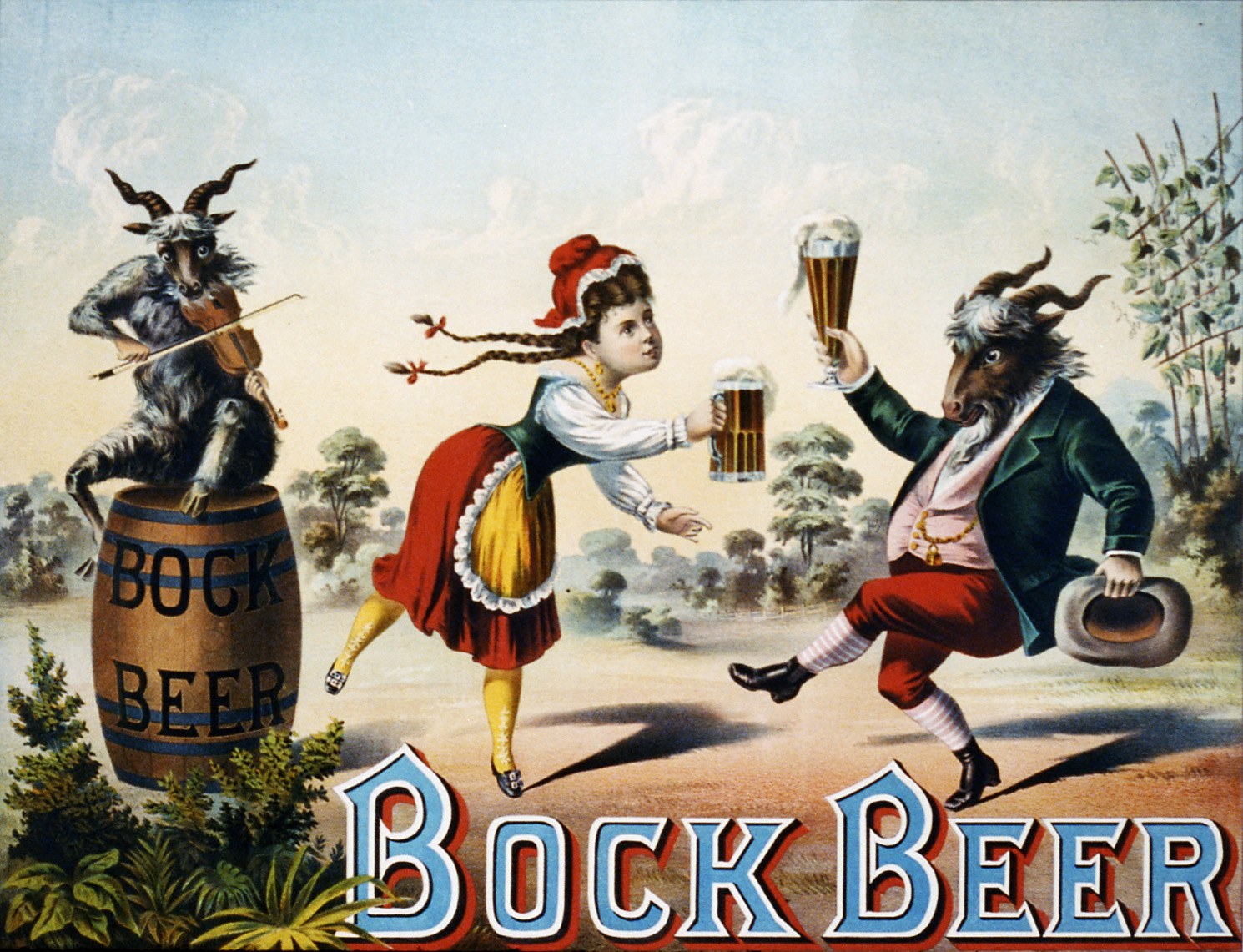
This is a rare document of how dance-like movement was visualized in advertising and popular commercial culture of the 1880s. The dancing goat's posture and gestures suggest the artist's familiarity with stage performance and folk stepping, and the image shows how movement and liveliness functioned as a visual metaphor for pleasure, consumption, and social transgression. For dancers and historians, it illustrates the broader cultural associations between alcohol, festivity, and bodily expression that shaped entertainment and public life in the late Victorian era.
What you are looking at
A whimsical beer advertisement depicts an outdoor gathering centered on revelry and consumption. A young woman in a red cap and yellow skirt holds aloft a foaming stein of Bock beer, her body angled in an animated pose as though presenting the drink to two anthropomorphic goats. On the left, a goat with prominent curved horns sits astride a wooden barrel labeled "BOCK BEER," cradling a violin and bow. On the right, a second goat dressed in formal attire—a green jacket, pink waistcoat, and red trousers—strikes a dancing posture, one leg extended and raised, holding a glass of beer in one hand while gesturing expressively. The setting is a pastoral landscape with trees and vegetation in soft greens and browns. The composition is rendered in the bright, detailed chromolithographic style typical of 1880s commercial printing, with careful attention to costume and character but the peculiar, carnival-like logic of advertising spectacle.
The dancing
The woman's pose is that of a server or presenter: her upper body twists forward, arms extended outward with the steins held at shoulder height, suggesting motion and offering. The dancing goat on the right displays a single-leg extension in what might suggest a folk or comic stepping pattern—the raised leg is bent at the knee, the torso is upright, and the free arm gestures openly. Both goats possess human musculature and posture; the violin-player sits with formal upright carriage while the dancer exhibits the lightness and lift of an active performance. The scene contains no romantic couple or formal ballroom hold; instead, these are anthropomorphic performers and a human attendant arranged in an asymmetrical composition that reads as a moment of peak festive activity.
The dance depicted
This is not a depiction of a recognizable social or theatrical dance form, but rather a comic fantasy prompted by beer advertising and the German folklore surrounding Bock beer. The goat is the traditional emblem of Bock beer—derived from the name "Bock" itself, which likely originates from the city of Einbeck—and appears in contemporary advertising as a figure of transgressive appetite and revelry. The 'dancing goat' on the right mimics the postures and gestures of human performers: the raised leg and open arm suggest either folk stepping (such as the German Schottische or Polka in vogue at the time) or the broad physical comedy of music-hall and vaudeville entertainment. The woman's animated presentation posture aligns her with the tradition of the barmaid or tavern attendant. No actual dance technique is depicted; rather, the image uses dance-like movement—liveliness, gesture, the elevation of limbs—as a visual vocabulary for exuberance and commercial enticement.
How it was made
This is a chromolithograph, a color printing process that allowed the Calvert Lithographing Company to produce bright, detailed commercial imagery at scale. The technique involves sequential hand-drawn stone plates, one for each color, which enabled both fine detail (the expression on the woman's face, the texture of the goat's fur) and vivid, saturated hues (the blood-red cap and barrel lettering, the golden skirt). Chromolithography was the dominant advertising medium of the 1880s, enabling beer, tobacco, and patent medicine companies to distribute branded fantasy images to saloons, shops, and collectors. The survival of such prints in quantity has made them a key source for understanding late-Victorian visual culture, popular taste, and the anthropomorphic and folkloric conventions of the era. The style shows no concern for anatomical naturalism in the goats' human postures; instead, the goal is visual spectacle and memorable incongruity.
About this work
This 1882 chromolithograph is a beer advertisement that stages a comic fantasy of transgressive revelry: a young woman presents foaming steins to two goats dressed and postured as human musicians and dancers. The dancing goat on the right adopts the exaggerated, upright posture and raised-leg gesture characteristic of European folk and vaudeville entertainment of the period. The image belongs to the tradition of anthropomorphic advertising and the German folk mythology of Bock beer, where the goat figure (the Bock) embodies appetite, fertility, and festive excess. While it is not a document of actual dance practice, it employs dance-like gestures and the vocabulary of movement and liveliness as a commercial language. The print circulated widely in saloons and homes, reinforcing through repeated visual encounter the association between beer consumption and uninhibited pleasure.
For historians of dance and visual culture, the image is valuable as evidence of how movement and bodily gesture were understood and deployed in popular commercial imagery. The animator's attention to the posture, weight, and extension of the dancing goat suggests an artist familiar with stage movement and acrobatic performance. The print also documents a moment when chromolithography was enabling breweries and distilleries to fashion elaborate visual identities and to position their products within a register of folk tradition, human appetite, and transgressive joy.
How to look at it
Attend to the posture of the dancing goat: the raised leg is bent at the knee, the torso remains upright and dignified, the free arm gestures openly, and the overall frame suggests neither ballet nor ballroom but rather the broad, vigorous stepping of folk or vaudeville performance. The chromolithographic technique gives the image a flat, brightly colored quality that emphasizes silhouette and gesture over anatomical detail, making the goat's pose readable at a glance. Notice also the woman's asymmetrical, animated posture—her body weight shifts forward, her arms extend in offering—which echoes the goat's energy and creates a visual rhythm of transgressive pleasure. The artist has frozen a moment not of formal dance instruction but of festive, uninhibited movement.
The artist
The Calvert Lithographing Company was a major commercial printing firm based in Detroit, Michigan, active from the 1870s through the early 20th century. The company specialized in chromolithographed advertisements, theatrical posters, and trade cards for breweries, patent medicines, and consumer goods. Calvert produced thousands of designs, the majority unsigned or credited to in-house designers whose names are now lost. The Bock Beer print is typical of Calvert's approach: bright, detailed, imaginative imagery that combined humor, folkloric reference, and commercial persuasion. The company's archive and surviving prints are a major source for American advertising history and the visual conventions of the Gilded Age.
The period
In the 1880s, chromolithography was transforming popular visual culture and enabling breweries—especially German and German-American firms—to create branded fantasy worlds. Bock beer, a strong lager style associated with spring and winter festivals, carried German folk and mythological associations that American brewers eagerly exploited. The dancing, music-making goat drew on a long European tradition of the goat as a figure of appetite, festivity, and transgression (visible in carnival, folklore, and the devil-goat of medieval and Renaissance art). In the same period, American vaudeville and music-hall entertainment were at their peak, and the exaggerated postures and physical comedy of stage performance were becoming visual language familiar to a broad urban audience. The image sits at the intersection of imported German beer culture, American advertising innovation, and the performance traditions of the late-Victorian stage.
Where it lives
This chromolithograph was registered by the Calvert Lithographing Company on 24 January 1882 and survives in multiple copies. The print was commercial ephemera, produced in quantity for distribution to saloons, grocers, and consumers; it is now held in digital collections and archives devoted to advertising history and American material culture.
Dance in this work
Questions about this work
What is Bock beer and why is there a goat on the label?
Bock is a strong lager style that originated in Germany (the city of Einbeck) and was imported to America by German breweries in the 19th century. The 'Bock' name was anglicized from Einbeck, but it also evoked the German word 'Bock' (goat), and brewers adopted the goat as a mascot. The goat carried folkloric associations with appetite, potency, and transgressive joy—qualities breweries wanted to attach to their strong, festive product.
Is the dancing goat performing a real dance?
No. The goat's raised leg and open gesture mimic the vocabulary of human performance—folk stepping, vaudeville, and acrobatics were all popular in the 1880s—but the image is a comic fantasy, not a document of actual dance practice. The artist has used dance-like movement and liveliness as visual language for excess and pleasure, not to teach or record a specific technique.
What is a chromolithograph and how was it made?
Chromolithography is a color printing process in which multiple (often 5–10) stone plates are hand-drawn and inked in different colors and layered on top of each other to produce a full-color image. The Calvert company used this technique to produce bright, detailed advertisements in quantity. Each print is technically a reproduction, but each required skilled hand work and was not mechanically identical to every other.
Who designed this print?
The Calvert Lithographing Company registered the design, but the individual artist or designer is not named. Most chromolithographs of this era were produced by in-house design teams whose names went unrecorded. The skill and humor of the composition suggest a trained artist familiar with figure drawing and stage performance.
More dance artwork