30 works in this view — arrow keys or swipe to move between them.
Dance in Art · 1861
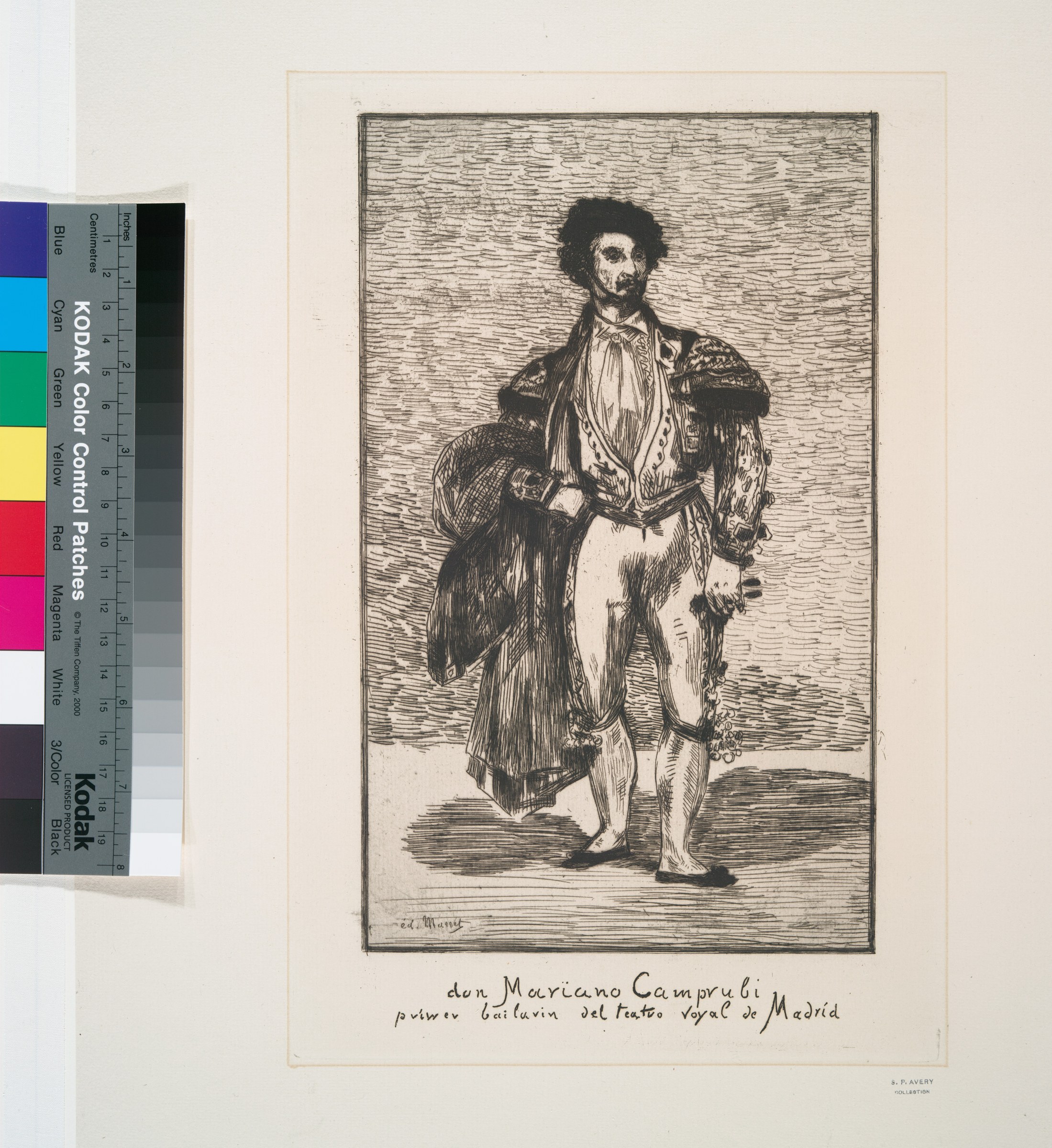
Don Mariano Camprubi, primer bailarin del teatro royal de Madrid (NYPL b13472280-483363)
Unknown (NYPL collection)
- Medium:
- Oil Painting
- Era:
- Mid 1800s (Polka Era)
- Source:
- Wikimedia Commons
- Rights:
- Public domain — free to use, share and adapt.
- Recorded as:
- Public Domain
This print is primary evidence of who danced at the Spanish court and national theatre in the mid-19th century, and of how male dancers were costumed and presented to the public. It documents the professionalization and celebrity of ballet in Spain during the romantic period, and shows that prominent male dancers were subjects worthy of formal engraved portraiture—a marker of cultural status. The image also reveals the theatricality of male dress in this era: elaborate embroidered jackets and cloaks that contrast sharply with the severe lines of modern ballet costume.
What you are looking at
A single male dancer stands in three-quarter view against a finely hatched background, his body weight shifted onto his left leg. He wears the dress of a Spanish court dancer or nobleman: a fitted jacket with elaborate embroidered or jeweled decoration across the chest and sleeves, paired with white breeches that reach to mid-calf. Over one shoulder hangs a cape or cloak, draped asymmetrically. His right arm hangs naturally; his left arm extends slightly forward. His head tilts slightly upward with a composed expression. The figure occupies the full height of the composition and stands on a narrow base line, positioned as if for formal presentation rather than captured mid-movement. The engraving's linear hatching creates volume and texture, emphasizing the richness of his costume against the uniform background. The inscription below identifies him as a premier bailarín (first dancer) of the Royal Theatre of Madrid.
The dancing
A single dancer is shown in a standing pose with most weight on the left leg and the right leg slightly extended or relaxed. The posture is upright and formal, the arms positioned naturally rather than in an active dance frame. The body alignment suggests a moment of rest or presentation rather than the middle of a phrase. There is no partner, no closed or open hold, and no visible footwork or turn. The dancer's face and upper body are rendered with considerable attention to the costume and bearing rather than to dynamic movement.
The dance depicted
This is a portrait of a professional dancer rather than a representation of dance in action. Mariano Camprubi was the premier bailarín (first or principal dancer) of the Teatro Real (Royal Theatre) in Madrid, likely during the mid-19th century. The engraving documents his status and costume, showing the formal court or theatrical dress worn by a leading male dancer of the era. The pose and costume suggest a training in neoclassical or romantic ballet, which dominated European theatres in this period, but the image captures presentation rather than choreography. The print appears designed as a souvenir or publicity image, a genre common in the 19th century for celebrated performers.
How it was made
This is an engraving (or possibly an etching, though the fine parallel hatching suggests steel engraving), as indicated by the linear mark-making and the formal frame border. The signature 'e.d.Maura' appears in the lower left, identifying the printmaker. The technique allowed for wide circulation—engravings could be printed repeatedly and distributed as theatrical souvenirs or promotional material. The medium itself conveys the seriousness and permanence of the subject: the engraved line suggests sculpture and classical permanence, elevating the dancer to high cultural status. The precision of the hatching and the refined frame indicate this was a professional commission, likely for theatrical audiences in Madrid or beyond.
About this work
This engraving depicts Mariano Camprubi, the principal male dancer of Madrid's Royal Theatre, in formal dress and at rest. It is a portrait-document of a professional dancer's status and costume rather than a narrative of dance in action. The work belongs in a dance gallery because it records the appearance and social position of a celebrated dancer of the romantic era, and because the costume and bearing reveal what professional male ballet dress and presentation looked like in 1860s Madrid—information that cannot be read from movement alone. It is a specimen of the widespread 19th-century practice of engraving celebrity performers for public sale and remembrance.
How to look at it
Note the formality of the pose and the prominence of costume. This is not a moment of dance but a presentation image—the dancer is shown as he would appear to an audience, but frozen in a dignified stance rather than in movement. Attend to the richness of the embroidered jacket and the drape of the cape: these details are rendered with as much care as the face and body, indicating that costume was central to the dancer's identity and appeal. The full-length format, the careful hatching that creates volume, and the inscribed frame all follow the conventions of formal portraiture. This is how a celebrated dancer was immortalized and circulated in the 19th century: not through action, but through presentation.
The artist
The printmaker 'e.d.Maura' (possibly Eugenio de Maura or a similar name) was a Spanish engraver working in the mid-19th century. The style and technique place this as a professional theatrical commission. The signature and refined execution suggest this was created specifically for publication and sale to theatre audiences, as part of the thriving market in celebrity dancer engravings that existed across Europe in this period. Beyond this attribution, little is documented in readily available sources.
The period
The romantic era of ballet (roughly 1830–1870) saw the rise of celebrated male as well as female dancers, and the development of the star system. Dancers became celebrities whose images were sold and collected. Madrid's Teatro Real, founded in 1850, was a centre of operatic and balletic performance in Spain. The costume depicted here—the jacket, cape, and breeches—reflects the romantic-era convention of dressing male ballet dancers in aristocratic or military dress rather than in the tunic-and-tights of classical Greek style. This engraving was created when ballet was a major form of public entertainment and when celebrity performers were documented through portraiture as a matter of course.
Where it lives
This engraving is held in the New York Public Library's collections (ID b13472280-483363) and is available through Wikimedia Commons. It is catalogued as a work from 1861, though the catalogue record is sparse. The print is a document of the performer and the Madrid theatre rather than a narrative artwork, and sits within the broader 19th-century genre of celebrity dancer engravings.
Dance in this work
Questions about this work
Is this actually a painting or an engraving?
This is an engraving, a printmaking technique using parallel lines (hatching) to create tone and volume. The catalogue record lists it as an oil painting, which appears to be an error. The fine parallel lines, the black ink on a white ground, and the formal frame border are all characteristic of 19th-century steel or copper engraving. The printmaker has signed it 'e.d.Maura' in the lower left, as was conventional.
Who was Mariano Camprubi?
Mariano Camprubi was the premier bailarín (principal male dancer) of the Teatro Real (Royal Theatre) in Madrid, likely during the mid-19th century. Little is documented about his life beyond this title and this image. The engraving was created to commemorate and publicize him, suggesting he was a celebrated performer of the era.
What kind of dance did he perform?
The costume and formal presentation suggest training in neoclassical or romantic ballet, which dominated European theatres in the 1860s. The jacket, cape, and breeches were typical romantic-era dress for male ballet dancers. The image itself shows a moment of rest or presentation rather than choreography, so it does not reveal his technique or movement style.
Why is he wearing that costume?
In the romantic era of ballet, male dancers were often costumed as aristocrats, soldiers, or noblemen rather than in classical Greek dress. The elaborate embroidered jacket, cape, and knee breeches suggest a character of rank and station. This was the standard presentation for male dancers in narrative ballets and court performances of the period.
More dance artwork