49 works in this view — arrow keys or swipe to move between them.
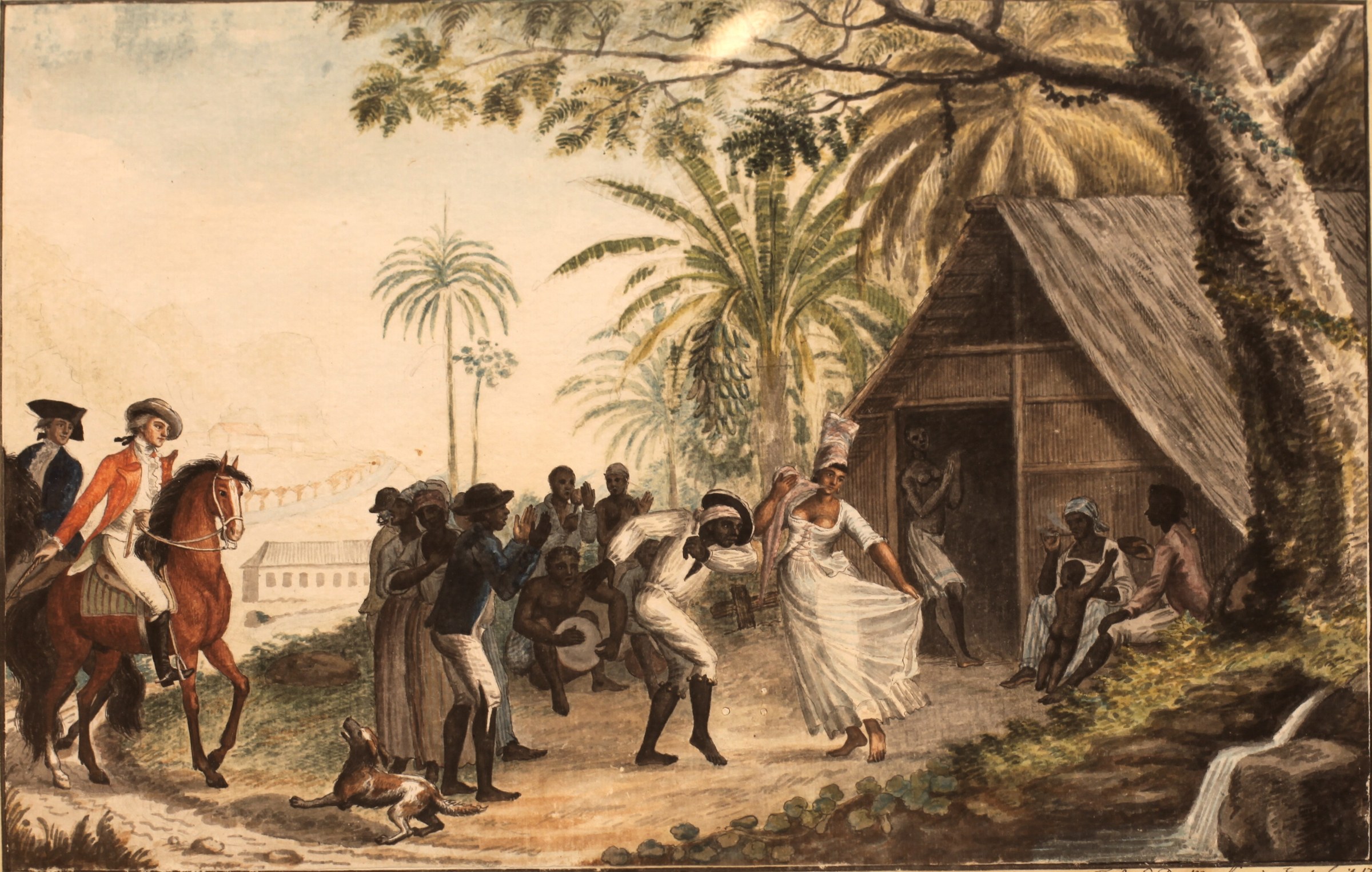
Dance in Art · 1783
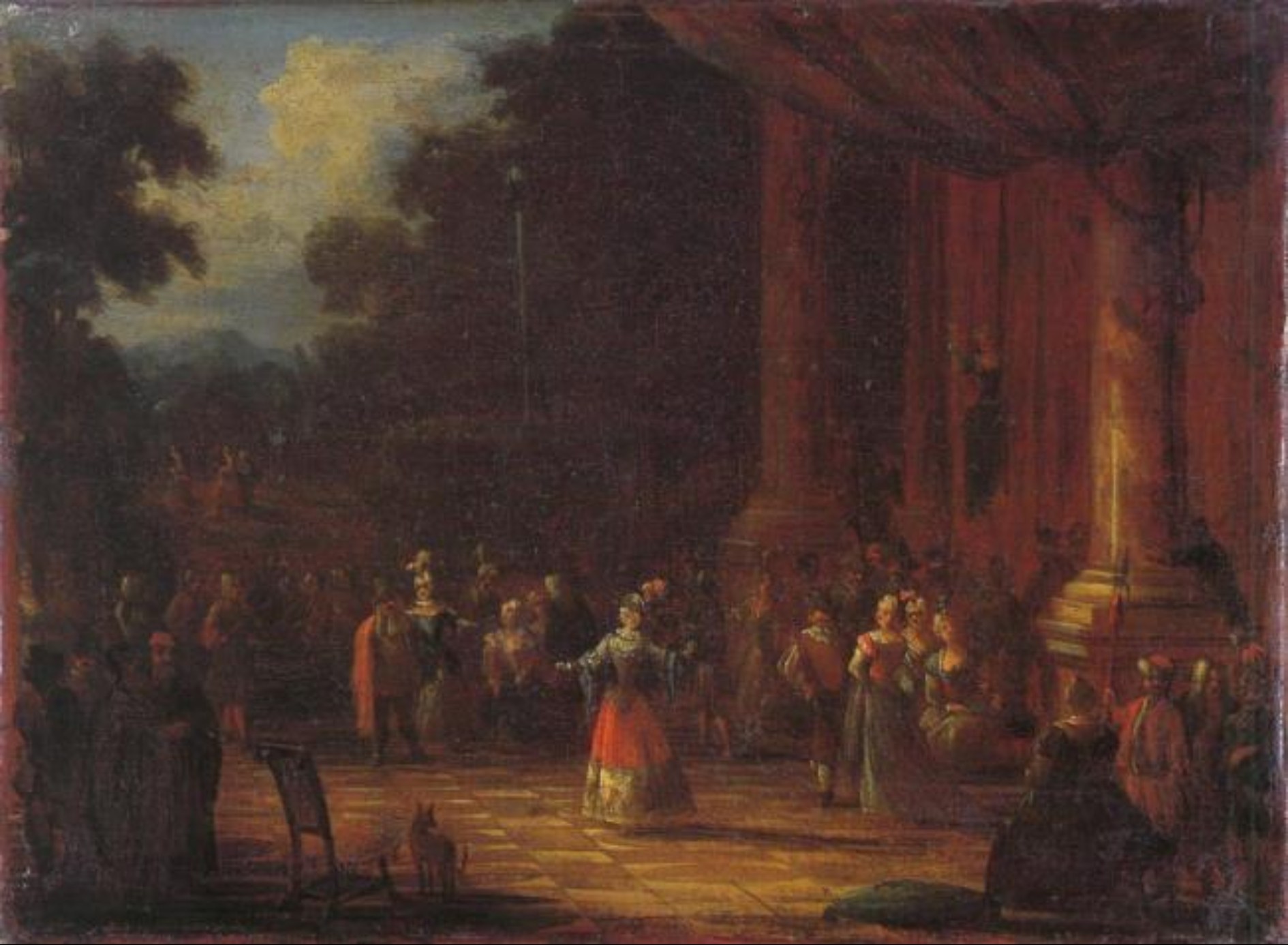
Calinda-Dumoulin-IMG 5527
François Aimé Louis Dumoulin
- Medium:
- Oil Painting
- Era:
- 1700s (Enlightenment/Minuet Era)
- Source:
- Wikimedia Commons
- Rights:
- Public domain — free to use, share and adapt.
- Recorded as:
- Public Domain
The Calenda is foundational to Caribbean and African diaspora dance history, yet few images survive from its time of practice. This engraving is rare documentary evidence of how the dance was actually performed—the body mechanics, the social structure, the integration of music and movement—and it shows that European artists of the Enlightenment were capable of rendering non-European dance with specificity and respect, even if the framing of the work remains colonial.
What you are looking at
A colonial-era encounter unfolds in a tropical setting dominated by massive palms and a thatched structure on the right. Two European men on horseback approach from the left—one in a red-lined coat—while a diverse group of figures, mostly Black and Indigenous people, gathers in the clearing. At the center, a woman in white draped fabric dances or moves expressively, her body angled and arms raised. Around her, other figures watch, clap, or gesture in response. A small dog sits in the foreground. The composition stages a moment of cultural contact: the mounted observers, the architectural marker of colonial presence, and the central female dancer form a triangle of attention. Light falls across the scene with a warm, documentary quality typical of 18th-century hand-colored engravings.
The dancing
The central dancer occupies an open, energetic stance with her weight shifted and one arm extended or raised—posture suggesting rhythmic movement rather than stillness. Her companions show varied engagement: some stand with instruments or clapping hands, others lean forward in attention. The mounted Europeans maintain formal, observational posture, their horses still and controlled. The bodies are fluid and particularized rather than rigidly posed, suggesting the artist witnessed or studied movement closely. The gathering is neither formal procession nor ballroom formation, but rather a spontaneous or semi-structured assembly around a performing figure.
The dance depicted
This is almost certainly documentation of the Calenda (or Kalenda), an enslaved African diaspora dance widespread in Caribbean colonies during the 18th century. The Calenda was a social and courtship dance performed at gatherings, often featuring one or more dancers in the center while others clapped, sang, or played percussion. The title *Calinda* (a variant spelling) confirms this identification. The image captures the performative and communal aspects: a female dancer as focus, rhythmic support from hands and possibly instruments, and the presence of spectators. The European observers suggest the artist was recording colonial witnessing of enslaved people's cultural practice—a fraught documentary moment.
How it was made
This is a hand-colored engraving or aquatint, likely 18th-century production, as suggested by the soft coloring, the fine detail work in foliage and architecture, and the documentary aesthetic. The catalog lists it as oil painting, but the technique, scale, and composition are far more consistent with print media intended for circulation. Hand coloring—evident in the flesh tones, vegetation, and garments—was applied after impression, allowing multiple copies to exist. This medium made colonial imagery widely accessible to European audiences and suggests the work was created for viewing by people who would never witness such a scene, making it a mediated, interpretive account rather than direct observation.
About this work
This work documents the Calenda, a central African diaspora dance of the Caribbean colonies, through the colonial gaze of the late 18th century. It is one of few surviving visual records of enslaved people's social and performative practices from this period, capturing both the dance's communal structure and the power dynamics of colonial observation. The image belongs in a dance gallery because it preserves evidence of a living tradition at a moment of cultural suppression and because it reveals how European artists chose to represent non-European movement—often with more attention to form and community than written records of the era allowed.
How to look at it
Attend first to the dancer's body: the open posture, the apparent mid-movement frame, and the way her white cloth follows the motion. Notice how the artist has positioned her as the clear focal point, with the clapping and watching figures arranged around her in a supporting formation. Observe the two mounted Europeans on the left—their stillness and formality contrast sharply with the dancers' fluidity. The artist's choice to freeze the Calenda in a moment of active performance, rather than as a static pose, suggests understanding that this was dance in the fullest sense: rhythmic, communal, and embodied.
The artist
François Aimé Louis Dumoulin (active late 18th century) was a French engraver and painter specializing in colonial and ethnographic subjects. His work circulated widely in Europe and served a growing appetite for visual documentation of colonized territories and the people within them. Like many artists of his period, Dumoulin likely worked from travel accounts, sketches by others, or imagination, rather than from direct observation, though the specificity of his dance rendering suggests engagement with reliable source material.
The period
The 1780s were a moment of intense European fascination with colonial territories and the bodies and practices within them. Simultaneously, this was the eve of the Haitian Revolution (1791) and a period of heightened anxiety about enslaved people's autonomous cultural and social life. The Calenda itself was increasingly restricted or banned by colonial authorities in the Caribbean, as slaveholding societies viewed Black communal gatherings as threats to order. This image thus documents a practice under pressure, rendered for a European audience increasingly curious about and fearful of colonized peoples.
Where it lives
The work is sourced from Wikimedia Commons and no holding institution is recorded. As a hand-colored engraving, it likely exists in multiple impressions across institutions, and the specific print source is not identified here.
Dance in this work
Questions about this work
What is the Calenda?
The Calenda (or Kalenda) was a social and courtship dance practiced by enslaved African and African diaspora people throughout the Caribbean colonies in the 17th and 18th centuries. It typically featured one or more dancers in the center of a circle, with onlookers providing rhythmic support through clapping and singing. The dance combined African movement vocabularies with Caribbean influences and was a key site of cultural and social autonomy for enslaved communities.
Why are there European men on horses in this image?
The mounted figures represent the colonial power structure observing and documenting enslaved people's cultural practices. Their formal dress and stillness contrast with the dancers' movement, positioning them as external observers of a scene that is being staged or being witnessed as a curiosity. This framing reflects the reality of colonial surveillance and the way European audiences consumed images of colonized peoples' lives.
Is this image an accurate record of how the Calenda was actually danced?
The specificity of the dancer's body mechanics, the arrangement of clapping figures, and the communal structure suggest the artist worked from reliable source material or observation. However, as a European-made image created for European circulation, it necessarily interprets and frames the dance through colonial aesthetics and values. It is a valuable document of the dance's social form and performative structure, but should be read as a mediated representation rather than objective record.
When was the Calenda performed?
The Calenda was widely practiced from at least the 17th century through the late 18th century in Caribbean colonies including Saint-Domingue (Haiti), Martinique, and Guadeloupe. Colonial authorities increasingly banned or restricted it in the mid-to-late 18th century because they feared the autonomous gathering and cultural practice of enslaved people. By the 19th century, the Calenda had declined in practice, though it influenced later Caribbean and diaspora dance forms.
More dance artwork