34 works in this view — arrow keys or swipe to move between them.
Dance in Art · 1600
Caroso 1600
Fabritio Caroso
- Medium:
- Oil Painting
- Era:
- Pre-1700 (Renaissance/Baroque)
- Source:
- Wikimedia Commons
- Rights:
- Public domain — free to use, share and adapt.
- Recorded as:
- Public Domain
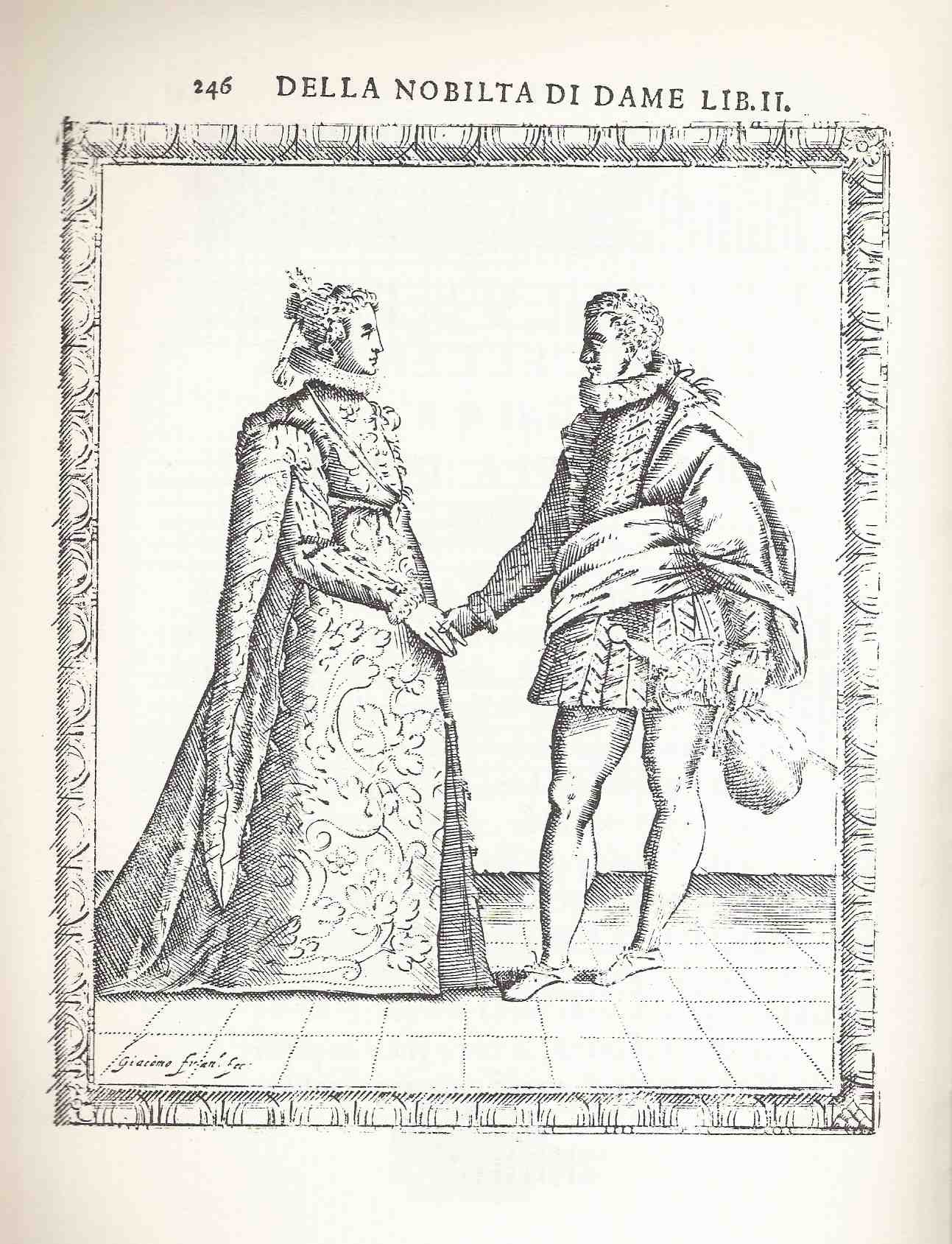
This is one of the very few visual documents that shows us how Renaissance court dances actually looked, with anatomically accurate guidance on posture, hand position, and spacing. For historians and dancers trying to reconstruct Renaissance dance practice from period sources, Caroso's illustrations are as important as written notation—they show the ideal body and its relationship to its partner. The manual's widespread circulation and influence across European courts makes it essential to understanding how dance functioned as a marker of nobility, education, and courtship in the Renaissance.
What you are looking at
Two figures in Renaissance court dress stand facing each other with joined right hands in a formal courtship gesture. The woman on the left wears an elaborate long gown with patterned brocade, a stiff bodice, and a ruffled collar; her hair is gathered up with ornamental pins. The man on the right stands in hose and a short slashed doublet with a broad ruff collar, his left hand resting on his hip in a posture of ease and gallantry. The floor beneath them is rendered in perspective, suggesting a palazzo interior or court space. The engraving is contained within a decorative border typical of printed dance manuals. The image captures the moment of formal greeting or opening gesture in a courtly dance, with both figures poised and balanced, presenting the idealized decorum of Renaissance court life.
The dancing
Both dancers maintain an upright, composed carriage. Their right hands are clasped at roughly waist height, the primary connection between them. The woman's weight appears centered, her body aligned vertically beneath her elaborate skirts. The man stands with his left hip tilted slightly forward, his free hand placed on his hip in the courtly pose typical of male dancers in this period. Both heads are turned slightly toward one another. The distance between them—perhaps eighteen inches at the shoulder—is consistent with the formal spacing of Renaissance court dances, where close embrace was not the norm.
The dance depicted
This depicts the opening or a moment within a Renaissance courtly dance, most likely an allemande, pavane, or galliard based on the formal hand-joined position and upright posture. The image is from Fabritio Caroso's *Nobiltà di Dame* (Venice, 1600), one of the two most important dance manuals of the late Renaissance, and it serves as an instructional illustration of proper deportment and hand position for paired dancing in the Italian court. The dress of both figures is consistent with late 16th-century court fashion, and the gesture shown here—the joined right hands with formal distance—is characteristic of the opening or progression of dances such as the pavane. The fact that this appears in a published manual indicates this was a standardized, teachable form of dance for the nobility.
How it was made
This is an engraving, a fine-line intaglio print produced for reproduction and wide circulation. The technique allows for crisp detail in the costume, the cross-hatching that models form, and the decorative printed border, all hallmarks of Renaissance print culture. Engravings were the preferred medium for instructional dance manuals because they could be mass-produced and distributed to courts and noble households across Europe. The medium itself signals that this was not a one-off artwork but a teaching tool intended for repeated consultation and copying by dancing masters and their pupils.
About this work
This engraving is one of the foundational documents of Renaissance dance history, drawn from Fabritio Caroso's *Nobiltà di Dame*, published in Venice in 1600. It depicts two idealized court dancers—a woman and a man—in the moment of a formal paired dance, their right hands joined, their bodies held in the upright, dignified posture prescribed by courtly decorum. As an instructional illustration, it is neither a scene of spontaneous movement nor a portrait of actual performers, but rather a codified diagram of how noble bodies were meant to move and relate to one another in the presence of their peers.
The work belongs to the tradition of dance notation and instruction that emerged in the 15th century and reached its most refined expression in the 16th and 17th centuries. Caroso's manual, like Thoinot Arbeau's *Orchésographie* (1588), was one of very few sources that captured in any form the actual choreography and technique of Renaissance court dance. These images are therefore irreplaceable evidence of how Renaissance nobility danced, how they dressed while dancing, what the dancing master considered proper form, and what values—formality, restraint, elegance, mutual respect—the dance embodied.
How to look at it
Observe the careful spacing and hand position—this is not an embrace but a formal, measured contact designed to guide movement while maintaining dignity and distance. Notice the alignment of the bodies: both dancers are plumb-line vertical, with no slouching, swaying, or forward lean. The man's pose, with his free hand on his hip, establishes the male dancer's role as the guide and initiator of the movement pattern. The woman's composed stance and direct gaze suggest equal standing and full participation. This moment captures not the movement itself but the readiness to move—the courtly pause before the next step, a convention that allows the dancing master to show the proper starting position.
The artist
Fabritio Caroso (c. 1530–c. 1605) was a Neapolitan dancer and dancing master who served at Italian and foreign courts. He published two editions of *Nobiltà di Dame*: the first in 1581 (Venice) and a revised edition in 1600 (Venice). This manual, along with a companion work, *Il Ballarino* (1581), represents the most comprehensive and influential codification of Italian Renaissance court dance. Caroso's approach was to provide not just choreography but detailed instruction in the proper bearing, footwork, and partnering of courtly dances. His work shaped dance practice across Europe and was consulted by dancing masters well into the 17th century.
The period
By 1600, the Renaissance court dance was at the height of its refinement and influence. The late 16th and early 17th centuries saw dance elevated to a crucial marker of nobility and courtly accomplishment—a well-educated noble was expected to dance with grace and precision. The fading of the more acrobatic galliard and the rise of the slower, more stately pavan and allemande reflected a shift toward dignity and restraint in court culture. Caroso's manual, published at the very end of the Renaissance period, captures this codification at its moment of greatest systematization. Within a generation, the court ballet of the 17th century would begin to evolve toward professional performance, but Caroso's world was still one in which dancing served as direct social practice among the nobility themselves.
Where it lives
The record indicates the source is Wikimedia Commons and identifies this as drawn from *Nobiltà di Dame* (Venice, 1600), with a note on a reprint edition (Bologna, 1980). This is a page from a published dance manual, reproduced from the original printed book. The work has entered the public domain and is widely accessible as a historical document.
Dance in this work
Questions about this work
How do I know this is Renaissance and not Baroque?
The dress is late Renaissance—note the woman's elaborate brocade gown with the high waist and fitted bodice characteristic of the 1580s–1600s, and the man's short doublet and hose rather than the longer coat of the Baroque. The dance posture, upright and with formal distance between partners, is also typical of Renaissance court dance before the Baroque shift toward frame and frame-based partnering. Caroso's publication date (1600) places it at the Renaissance's end.
What dance are they doing?
The manual does not inscribe the figure with a specific dance name, but the posture—upright, hands joined, formal distance—is consistent with the opening or a movement within a pavane or allemande, the two most prestigious Renaissance court dances. Without the full choreographic context, we cannot name the exact dance, but Caroso would have taught this position as part of his core curriculum for noble dancers.
Was this manual actually used to teach dance?
Yes. Caroso's *Nobiltà di Dame* was one of the two most influential dance manuals of the Renaissance (the other being Arbeau's *Orchésographie*), and it was widely owned and consulted by dancing masters and noble amateurs across Europe. The illustrations served as visual instruction alongside written choreographic notation.
Why does the image look so formal and stiff?
This is intentional. Renaissance court dance valued dignity, control, and restraint. The stiffness you observe—the vertical carriage, the measured spacing, the composed hands—is not a limitation of the artist but a faithful rendering of the aesthetic ideal. Noble dancers were taught to move with as much formality and composure as possible, and this engraving shows what proper decorum looked like.
More dance artwork