32 works in this view — arrow keys or swipe to move between them.
Dance in Art · 1868
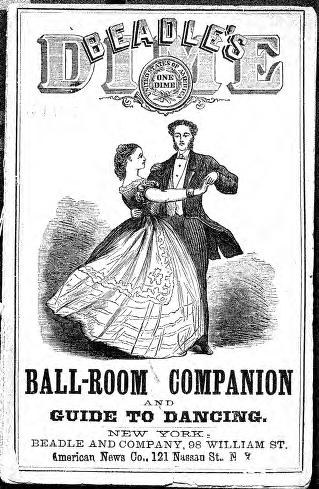
Beadle's dime ball-room companion and guide to dancing. Comprising rules of etiquette, hints on priv
Unknown artist
- Medium:
- Illustration
- Era:
- Late 1800s (Victorian Ballroom)
- Source:
- Library of Congress
- Rights:
- Public domain — free to use, share and adapt.
- Recorded as:
- public_domain
This image is a direct window into what the American ballroom looked like at street level: not elite performance or artistic innovation, but the social dances of ordinary people as they were taught and understood. For historians of dance technique and pedagogy, it documents the frame and posture that defined correct dancing in this era—information that photographs and written descriptions alone cannot convey. For readers interested in the social history of dance, it shows that by the 1860s, formal ballroom instruction was commercial, accessible, and aimed at the expanding urban middle class.
What you are looking at
A wood engraving titled page from Beadle's Dime Ball-Room Companion, a mid-19th-century American dance instruction manual. The composition is split between text and image: the elaborate title sprawls across the top in ornamental letterpress, and below it stands a couple mid-dance, frozen in the formal posture of ballroom dancing. The man, in dark frock coat and light trousers, supports his partner with his right arm extended; the woman wears a full-skirted dress with a fitted bodice, the skirt's voluminous layers caught in motion, suggesting a turn or pivot. Their bodies maintain considerable distance—the formal frame of genteel Victorian ballroom dancing. The engraving is finely detailed, with careful crosshatching to render fabric texture and shadow. Behind and around the couple, the background is left largely blank, focusing all attention on the dancing pair as exemplars of proper technique.
The dancing
The couple demonstrates the closed position of formal ballroom dance: the man's right hand on the woman's back, his left arm raised to hold her right hand at approximately shoulder height. Both dancers stand nearly upright, their bodies aligned in parallel but not pressed together—a significant detail, as this distance was essential to Victorian propriety. The woman's weight appears poised on her feet, her frame extended rather than collapsed into her partner. The artist has captured the instant of rotation or forward movement, with the woman's skirt swinging to suggest the momentum of the dance. Their posture is controlled and symmetrical, emphasizing the formal training such a couple would have received.
The dance depicted
This is ballroom dance in the formal Victorian tradition, almost certainly depicting either the waltz or the polka—the two dominant couple dances of the 1860s-1870s American ballroom. The closed position, upright frame, and the woman's full skirt are consistent with waltzing, though the exact style cannot be determined from posture alone. The manual itself is a teaching document: its purpose was to codify and spread the rules of ballroom etiquette and technique to the expanding American middle class. The couple shown here is demonstrating not entertainment or display but rather the *correct* way to dance—a model for readers to learn from.
How it was made
This is a wood engraving, a technique that dominated illustrated book production in the 19th century. The fine lines and detailed crosshatching are characteristic of wood-engraved work, which allowed for high-quality reproduction and circulation in print media. The technique's precision made it ideal for technical and instructional subjects, where clarity and reproducibility mattered. Beadle and Company, the publisher, was a major American house specializing in affordable popular literature; this object circulated as a mass-market manual, not a luxury item, reaching a broad audience seeking to learn middle-class social deportment.
About this work
This is a page from an American ballroom dance instruction manual, circa 1868, showing a properly posed couple demonstrating the formal closed position. The wood engraving serves as visual instruction for readers learning to dance in the Victorian ballroom tradition. The image is neither a record of performance nor artistic fantasy, but rather a pedagogical tool—a frozen diagram of correct technique meant to be studied and imitated. It belongs in a dance archive as evidence of how dance instruction worked in the 19th century, and what standards of frame, posture, and propriety governed middle-class American social dancing.
How to look at it
Notice the space between the dancers' bodies: the strict, almost stiff distance maintained between them was not accidental but enforced by etiquette and propriety. Observe the woman's skirt and the way it suggests movement—the artist has caught the moment of a turn or forward step, with fabric swinging to show the momentum of the dance. The upright spines and relatively high arm positions differ markedly from the lounging, relaxed posture we might expect in social dancing today. Look at the engraving technique itself: the fine parallel lines create tone and shadow, a method that allowed for precise, reproducible technical illustration.
The period
By the 1860s, ballroom dancing had become thoroughly commercialized in America. The waltz, which had scandalized earlier generations for its close embrace, was now standard among respectable people. Instruction manuals like this one were published prolifically to meet demand from the middle class, who aspired to the social graces of their betters. Beadle and Company specialized in affordable mass-market books; this manual would have cost a few cents and circulated widely. The formal frame shown here—the distance maintained between partners, the upright posture, the careful arm positions—reflects Victorian anxieties about propriety and bodies in public space. The engraving itself was the state-of-the-art medium for reproduction, allowing the same image to reach thousands of readers.
Where it lives
This is an illustration from a book in the Library of Congress collections. It is part of Beadle's Dime Ball-Room Companion and Guide to Dancing, published by the American News Company in New York. Such manuals were among the most widely circulated instructional works of their day, designed for home study by readers who could not afford a private dancing master.
Dance in this work
Questions about this work
How close did Victorian ballroom dancers stand to each other?
As shown here, they maintained considerable distance—the man's hand rests on the woman's back, but their bodies do not press together. This formal separation was essential to propriety. Accounts from the period note that even this closed position was controversial when the waltz first arrived from Europe; some Americans considered it scandalously intimate.
What dance is this couple doing?
The closed position and formal frame are consistent with either the waltz or the polka, the two dominant couple dances of the American ballroom in the 1860s–70s. The illustration does not provide enough detail to distinguish between them, as both used the same basic frame.
Who used these instruction manuals?
Middle-class people aspiring to social respectability—people who could not afford a private dancing master but could spend a few cents on a cheap manual. Beadle's publications reached thousands of households and were designed for home study, allowing readers to learn proper technique from printed images and text.
Why was ballroom dance instruction so important?
In the 19th century, knowing how to dance was part of being socially respectable. Dancing well was proof of good breeding, self-control, and proper training. For the rising middle class, mastering these skills was a way to claim social status.
More dance artwork