44 works in this view — arrow keys or swipe to move between them.
Dance in Art · 1916
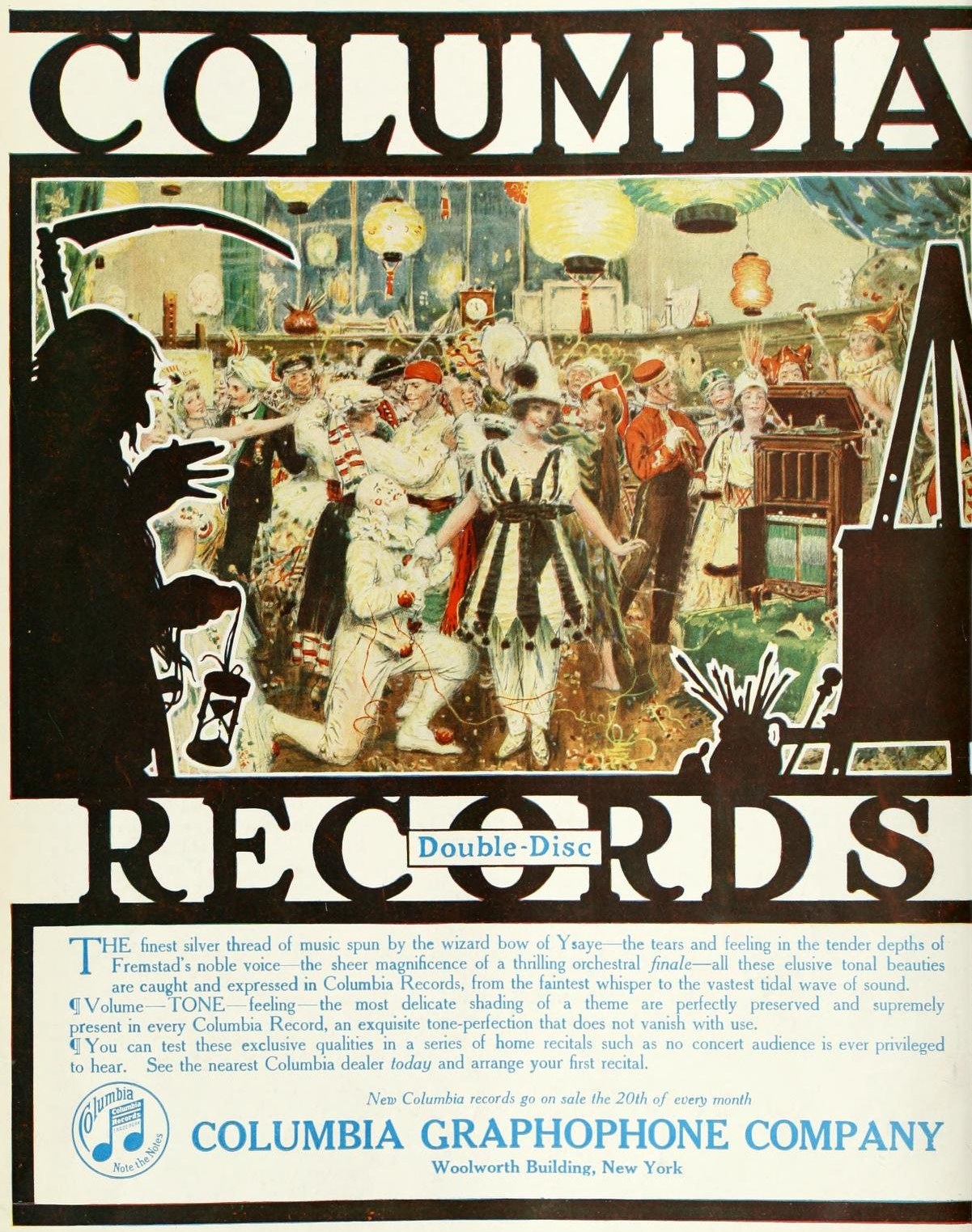
Columbia Records ad, January 1916
Columbia Records
- Medium:
- Oil Painting
- Era:
- 1900-1920 (Ragtime/Early Jazz)
- Source:
- Wikimedia Commons
- Rights:
- Public domain — free to use, share and adapt.
- Recorded as:
- Public Domain
This advertisement reveals how early 20th-century manufacturers positioned the phonograph as a gateway to ballroom culture and refined social dancing, and shows what the ideal ballroom dancer and dancing body were understood to be in 1916. It is also a rare example of dance imagery in commercial art from the period, offering evidence of how widespread and aspirational ballroom dancing had become among the American and European wealthy.
What you are looking at
This Columbia Records advertisement presents an exuberant ballroom or theatrical dance scene rendered in oil paint. A crowded interior space—suggested by tall windows with electric lights hanging overhead and architectural details visible in the background—is filled with dozens of figures in formal evening wear. The composition is dense and celebratory: men in tuxedos and women in white or cream gowns with colored accents (particularly red) occupy the space in various attitudes of motion. At the left, a silhouetted figure in black operates what appears to be a gramophone or recording equipment, their posture suggesting they are capturing this moment of music and movement. The lighting is warm and theatrical, with visible lamps and warm tones dominating the palette. The scene reads as a sophisticated social gathering or performance captured mid-celebration—bodies are animated, some mid-step, creating a sense of choreographed or spontaneous ballroom activity.
The dancing
The dancers display the upright, formal carriage characteristic of early 20th-century ballroom dancing. Several couples are visible in closed or semi-closed positions; arms are held at shoulder height or extended with the formality of social dance of the period. The figures are distributed across the canvas in groups and pairs rather than a unified formation, suggesting a social dance floor rather than a staged performance with synchronized movement. Weight appears to be centered and controlled—no extreme extensions or dramatic leans. The density of figures and their varied positions (some facing forward, others in profile or turned away) create a narrative of simultaneous, coordinated social movement rather than a single choreographed phrase.
The dance depicted
This image depicts an idealized social ballroom dance scene of the 1910s era, likely representing the kind of fashionable dances—Foxtrot, One Step, or Waltz—that were central to upper-class entertainment in that period. The advertisement conflates dance, live orchestral music (suggested by the visible orchestra and lamps), and the new technology of the gramophone, implying that Columbia Records could deliver this refined, coordinated social experience to the home. No specific dance style can be identified with certainty from body position alone, but the closed holds, formal dress, and architectural setting point toward historic-gilded-age social dances. The painting celebrates ballroom culture as aspirational modern entertainment.
How it was made
The work is executed in oil paint, a medium chosen to convey richness, detail, and visual persuasion appropriate to advertising a luxury product (phonographic records) to a wealthy audience. Oil allows the artist to render the shimmer of fabric, the play of electric light on faces and gowns, and the complexity of a crowded interior with atmospheric depth. The soft modeling and warm palette create an inviting, romantic tone that positions record-playing as a gateway to this sophisticated social world. As an advertisement, the work was likely reproduced in periodicals or as a poster, making it a commercial art form designed to circulate widely among middle and upper-class consumers.
About this work
This 1916 Columbia Records advertisement conflates three elements of modernity—electricity, recorded music, and fashionable social dance—into a single aspirational image. The composition presents a crowded, luminous ballroom where men in tuxedos and women in evening gowns participate in the formal social dances that defined upper-class leisure. By depicting this scene as the product of a Columbia gramophone, the advertisement sells not just a machine but access to the experience of refined ballroom culture.
The work matters as a historical document of how dance was understood and marketed in the early phonograph era. It reveals the intimacy between dance, music technology, and consumer desire in the 1910s, and demonstrates how the visual arts—here, oil painting—were deployed to make mechanical reproduction seem like a direct conduit to live social performance and human intimacy.
How to look at it
The viewer should attend to the silhouetted figure at left, which anchors the composition and makes explicit the advertisement's central claim: that the phonograph (operated by this figure) is the source of the music and movement visible in the ballroom. Notice how the artist has positioned this operator as both outside the dance and its cause—a visual metaphor for the gramophone's role in bringing ballroom culture to the home. Look also at the variety of positions and moments captured among the dancers: some are in clear closed holds, others are turning, others facing forward. This variety creates a sense of continuous, fluid social dancing rather than a single posed moment, suggesting that a Columbia record could sustain an evening of varied, lively ballroom activity.
The artist
The work is credited to Columbia Records (the company) rather than a named artist, which was standard practice for commercial advertising of the era. The painting demonstrates the investment major record companies made in fine art advertising to position their products as luxuries and gateways to refined culture. The execution is competent and detailed, suggesting a professional illustrator or painter hired for the campaign rather than a house staff member.
The period
In 1916, social ballroom dancing was at a cultural peak in the United States and Europe. The Foxtrot, One Step, and other "modern" dances (as opposed to the older Waltz) had recently swept into fashion, often causing moral panic among conservatives but enormous enthusiasm among the young and urban. The phonograph was still a relatively new and prestigious technology; Edison and Columbia were competing fiercely to position recorded music as essential to domestic entertainment. Dance and recorded music were natural partners: live orchestras played dance music in ballrooms, and home listeners wanted to recreate that experience. This advertisement capitalizes on that convergence, using dance as the visual hook for selling records.
In the visual arts, representational painting of social life remained the norm for advertising, though photography was beginning to emerge as an alternative. The warmth and detail of the oil painting here—the specific rendering of fabric, light, and facial expression—would have been persuasive to an audience still attuned to fine art as a marker of quality and legitimacy.
Where it lives
The work is a commercial advertisement published by Columbia Records in January 1916, likely distributed as a full-page advertisement in periodicals or as a promotional poster for display in music shops or department stores. The source for this cataloguing is Wikimedia Commons.
Dance in this work
Questions about this work
What dances are being shown here?
The painting does not depict a single specific dance style; instead, it presents an idealized ballroom scene of the 1910s social dancing era. The closed holds, upright carriage, and formal dress suggest the Foxtrot, One Step, or Waltz—the fashionable modern dances of the period. The variety of positions and the crowd suggest the continuous, social nature of ballroom dancing rather than a staged performance of a single choreography.
Why is there a figure operating a gramophone in this dance scene?
The silhouetted operator at left is central to the advertisement's message: Columbia Records wants the viewer to understand that the phonograph is the source of the music and the energy animating the dancers. It is a visual argument that buying a Columbia record brings the ballroom experience—the music, the refinement, the social status—into the home.
Who is this painting for?
This advertisement targeted wealthy and aspiring middle-class consumers, particularly those who valued social status, refinement, and access to entertainment. By depicting formal ballroom dress, electric lighting, and orchestral performance, the ad associates Columbia Records with luxury and sophistication. It suggests that owning a phonograph is the ticket to participating in (or at least enjoying the experience of) fashionable ballroom culture.
Is this a historical record of actual ballroom dancing in 1916?
It is idealized and aspirational rather than documentary. However, the painting does accurately reflect the clothing, ballroom architecture, and social conventions of fashionable dancing in 1916. It shows us what the era considered the ideal ballroom—crowded, elegant, well-lit, and refined—and what ballroom dancers were understood to look like: formally dressed, upright, and coordinated in their movement.
More dance artwork