34 works in this view — arrow keys or swipe to move between them.
Dance in Art · 1843
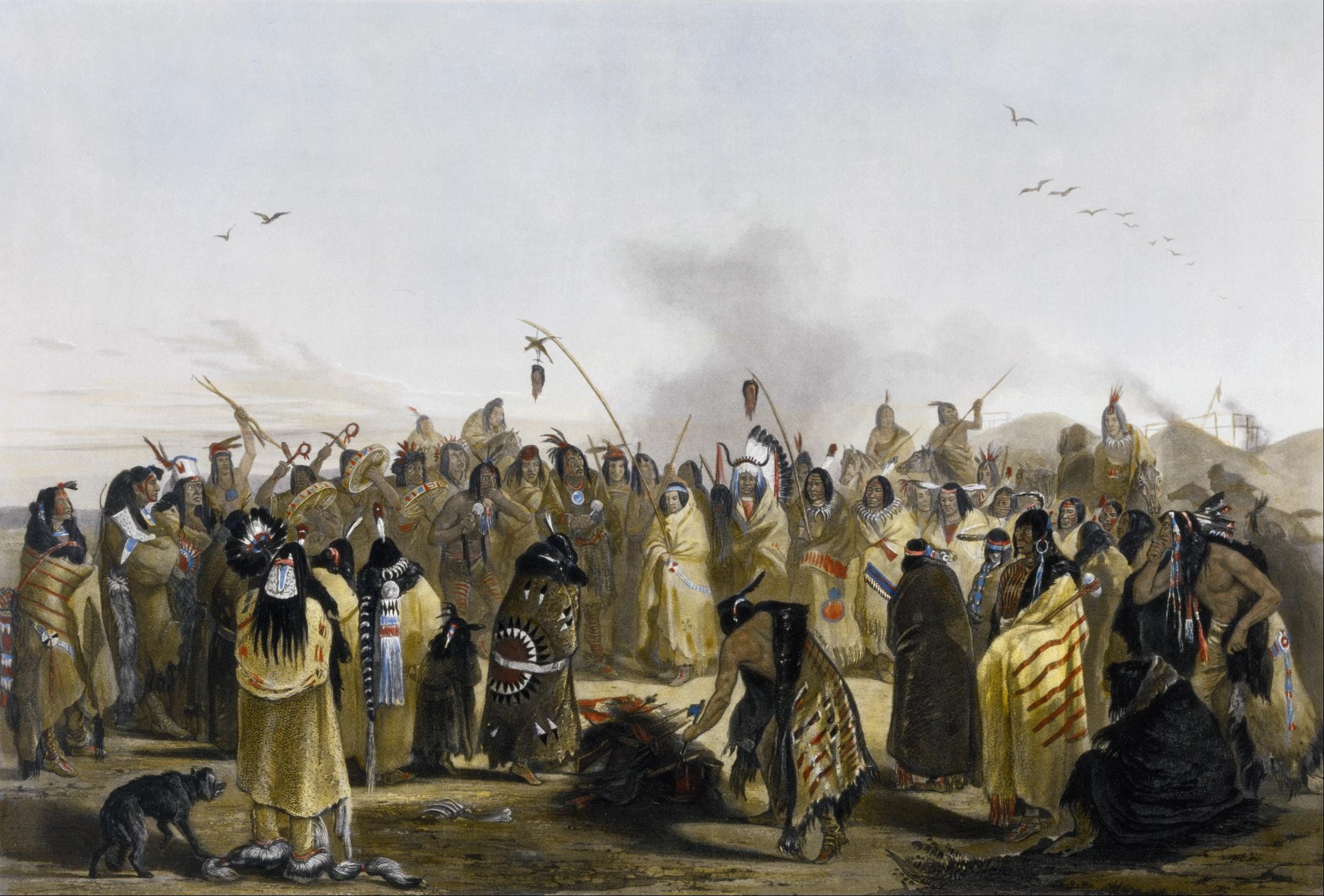
Karl Bodmer - Scalp Dance of the Minitarres
Karl Bodmer
- Medium:
- Oil Painting
- Era:
- Mid 1800s (Polka Era)
- Source:
- Wikimedia Commons
- Rights:
- Public domain — free to use, share and adapt.
- Recorded as:
- Public Domain
This is one of the most detailed visual records of a Plains Indian ceremonial gathering from the early 19th century, capturing costume, body comportment, and social organization in a moment before intensive Western colonization fundamentally altered these practices. For dance historians, it documents the movement vocabulary, spatial organization, and collective participation typical of victory and celebratory ceremonies among Missouri River tribes. The work also exemplifies how Indigenous dance was observed, interpreted, and represented through European Romantic painting traditions—a question central to understanding both the dances themselves and the history of their documentation.
What you are looking at
A large gathering of Indigenous peoples, primarily Mandan and Hidatsa (Minitarres), assembled in an open landscape with hills visible in the distance. The composition is crowded and densely populated, with figures wearing hide clothing and traditional dress decorated with geometric patterns, fringe, and ornamental details in earth tones and darker colors. The figures are arranged in a loose circle or gathering formation rather than in structured dance lines. Many hold weapons—spears, clubs, and what appear to be scalping implements—raised overhead. Smoke or dust rises from the center of the assembly, suggesting recent violence or ceremonial activity. The sky is overcast and pale. Several figures on the periphery, particularly at the right, wear darker clothing that may indicate non-Indigenous observers or mixed dress. Birds fly in formation in the upper portion of the canvas. The overall mood is one of ritual intensity and collective action, with the raised weapons and the density of bodies creating a sense of ceremonial or martial fervor.
The dancing
The figures are not engaged in the coordinated stepping or partnered movement characteristic of most European dance traditions. Instead, bodies are oriented toward the center in varied postures: many stand with arms raised overhead, weapons held aloft; others gesture with stabbing or thrusting motions. There is no discernible hold, frame, or synchronized footwork. The movement vocabulary appears to emphasize vertical gestures (raised arms and weapons), torso rotation, and forward-leaning weight rather than traveling steps. Individuals move independently within the collective group rather than in couples or lines. The bodies read as warriors or participants in a celebratory or retributive ritual rather than as dancers in the sense of partnered or synchronized ensemble technique.
The dance depicted
This depicts the Scalp Dance (also called the Scalp Dance or Victory Dance), a ceremony and social gathering practiced by multiple Plains and Missouri River tribes, including the Mandan and Hidatsa, following successful hunts or military encounters. Historical accounts describe the dance as a public celebration in which community members, particularly women and warriors, participated in rhythmic movement and gestures while displaying trophies and weapons. The dance served social, ceremonial, and commemorative functions. The image shows the collective, circular gathering typical of such ceremonies rather than a choreographed formation. The raised weapons, the central focus, and the density of participants all align with ethnographic descriptions of victory celebrations. However, the painting records a moment of complex cultural interaction: it represents the ceremony through a European Romantic painting tradition, and was created by a Swiss artist traveling with a colonial fur-trading expedition, filtered through artistic conventions of the period.
How it was made
Oil on canvas, a medium that allows for atmospheric effects and a large scale suitable to depicting a substantial crowd and landscape. Bodmer worked in the Romantic landscape tradition, which privileged dramatic light, distant vistas, and the picturesque arrangement of figures within natural settings. The technique permits fine detail in costume and decoration while maintaining the breadth needed to show the assembled group and the surrounding terrain. The painting is opaque and full-toned, with careful attention to the ochre, tan, and dark colorations of hide garments and the pale, overcast sky. This was a commissioned work produced during and after Bodmer's travels on the upper Missouri River (1832–1834) as part of a documented and illustrated expedition, intended for a European audience unfamiliar with Plains Indian life.
About this work
This oil painting by Karl Bodmer documents the Scalp Dance, a Plains Indian victory and celebratory ceremony, as practiced by the Mandan and Hidatsa peoples in the early 19th century. Rather than a waltz-era European social dance (the era label is misleading), the work depicts an Indigenous ceremonial gathering centered on collective gesture, raised weapons, and ritual participation. Bodmer, a trained landscape and ethnographic painter working in the Romantic tradition, recorded the ceremony during his travels on the upper Missouri River in the 1830s. The painting circulated in Europe as part of a larger visual and textual archive of Plains Indian life, produced through a colonial lens but preserving detailed observation of clothing, social organization, and ritual practice. For historians of Indigenous dance and ceremony, the work is a primary historical document of how the Scalp Dance was performed and witnessed in the early 19th century, even as it reflects European artistic conventions and the power dynamics of colonial documentation.
How to look at it
Observe the raised weapons and the orientation of bodies toward the center—this is not a waltz or partnered dance, but a collective ritual gesture. Note the variety of individual postures and the absence of synchronized footwork or holds; the dance operates through group participation and shared focus rather than coordinated technique. Look closely at the costume details—the hide garments with geometric decoration, the featherwork, the ornaments—to understand the care taken in presentation. The smoke or dust rising from the center suggests intense activity and heat. The presence of what appear to be non-Indigenous figures (on the right, in darker dress) is worth noting; it indicates that Bodmer himself or members of his party may have witnessed this ceremony, or that he worked from eyewitness accounts and sketches. The Romantic landscape tradition places the human figures in a vast, pale landscape, emphasizing both their collectivity and their distance from the European viewer.
The artist
Karl Bodmer (1809–1893) was a Swiss painter trained in the Romantic landscape and historical tradition. He traveled to North America in 1832 as the official artist for Prince Maximilian of Wied-Neuwied's expedition up the Missouri River, a naturalistic and ethnographic journey. Over two years, Bodmer produced hundreds of watercolor sketches and oil paintings documenting Indigenous peoples, landscapes, flora, and fauna of the Upper Missouri region, including the Mandan, Hidatsa, Blackfoot, and other nations. His works were engraved and published in Germany as part of Maximilian's two-volume account (Reise in das Innere Nord-America, 1839–1841) and reached a wide European audience. Bodmer's practice combined scientific observation (in the tradition of natural history illustration) with Romantic aesthetic principles—dramatic light, picturesque composition, and emotional intensity. His images are now recognized as both valuable ethnographic documents and products of the colonial gaze; they reveal careful attention to material culture and ceremony while reflecting European assumptions about Indigenous peoples as subjects of aesthetic interest and imperial knowledge-gathering.
The period
This painting was created in the 1830s–1840s, during a period when European Romanticism was at its height and when scientific expeditions to North America were producing lavish illustrated accounts for educated audiences. In Europe, the waltz and other ballroom dances were indeed dominant in elite social life, making the era label historically accurate for European dance history—but this work depicts a non-European ceremonial practice. In North America, the Indian Removal Act (1830) was forcing eastern tribes westward, and the Missouri River tribes depicted here would face devastating smallpox epidemics (1837–1838) and intense pressure on their lands and ways of life. Bodmer's expedition preceded these catastrophes and was itself part of the colonial infrastructure of observation and knowledge-making that enabled expansion. The Scalp Dance itself was a ceremony with deep indigenous roots, but it was increasingly documented (and, over time, restricted or suppressed) as part of white settlement and assimilation policies. The painting thus captures a moment of cultural practice on the eve of massive disruption.
Where it lives
The painting was produced during or shortly after Bodmer's expedition (1832–1834) and is part of the visual archive associated with Prince Maximilian of Wied-Neuwied's Missouri River expedition. It was engraved and published as part of the expedition's official illustrated account, ensuring wide circulation in Europe among the educated classes. The original holding collection is not recorded in the catalogue, but the work is known through Wikimedia Commons and appears in major museum collections.
Dance in this work
Questions about this work
Is this a waltz or European ballroom dance?
No. The era label (Waltz Revolution) applies to European dance history of the 1830s–1840s, but this painting depicts an Indigenous North American ceremony. The Scalp Dance was a collective ritual practice among Plains tribes, performed as a celebration following hunts or conflicts. It involved raised weapons, group participation, and ritual gestures, not the partnered holds and coordinated footwork of European ballroom dances.
What is a Scalp Dance?
The Scalp Dance was a ceremony and social gathering practiced by many Plains Indian nations, including the Mandan, Hidatsa, and others. Held to celebrate successful hunts or military actions, it involved community members—particularly women and warriors—participating in collective movement, gesture, and display of trophies. It functioned as both a ritual act and a social event, affirming group identity and commemoration.
Who painted this and when?
Karl Bodmer, a Swiss artist, painted this during or shortly after his travels on the Missouri River (1832–1834) with Prince Maximilian of Wied-Neuwied's expedition. The painting was created in the 1830s–1840s. Bodmer worked as the official expedition artist, recording Indigenous peoples, landscapes, and natural history. His images were later engraved and published in Germany and distributed widely in Europe.
How reliable is this image as a historical record?
Bodmer's works are valuable primary sources for understanding early 19th-century Plains Indian material culture, costume, and ceremony. However, they are also products of the colonial gaze—created by a European artist for a European audience, reflecting Romantic aesthetic principles and European assumptions about Indigenous peoples. The painting records detailed observation but also reflects the power dynamics of colonial documentation. Modern historians use such works in conjunction with Indigenous oral histories and other sources.
More dance artwork