27 works in this view — arrow keys or swipe to move between them.
Dance in Art · 1711
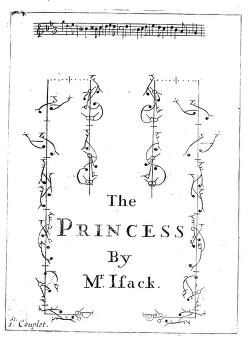
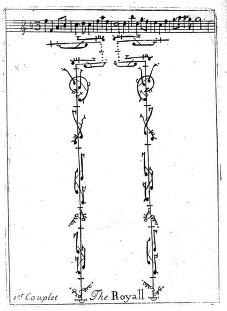
The royall : Mr. Isaac's new dance made for Her Majesty's birth day 1711
Unknown artist
- Era:
- 1700s (Enlightenment/Minuet Era)
- Source:
- Library of Congress
- Rights:
- Public domain — free to use, share and adapt.
- Recorded as:
- public_domain
This is one of the few surviving notated records of an actual court dance from the English Baroque period, and it bears the name of a specific dancing master and a specific occasion. For historians, it is invaluable evidence of what dances looked like, how they were structured, and how dancing masters documented their work before the invention of modern notation systems. For performers and choreographers, it is a rare window into the spatial and rhythmic logic of early 18th-century court dance.
What you are looking at
This is a notation diagram for a theatrical dance, rendered as a printed sheet with musical staff notation at the top and two parallel vertical columns of schematic figures below. Each column traces the path and positions of a single dancer through the steps of the choreography, with small linear figures marking stance and direction at regular intervals down the page. The figures are connected by flowing lines suggesting the dancer's trajectory across the floor, creating a bird's-eye-view map of spatial movement. At the bottom of each column are labels identifying the dancers: on the left "Mr. Coniglier" [or similar] and on the right "The Royall." The notation system is characteristic of early 18th-century Labanotation precursors, where choreographers documented court dances through a combination of staff notation (for the accompanying music) and floor-plan diagrams (for the dancers' spatial patterns and positions). The page itself shows the wear of age and handling, with faint ink and creasing typical of a historical document that served as a practical working score.
The dancing
The stick-figure notation is highly schematic, showing only essential information: the dancer's orientation (indicated by the direction the figure faces), approximate position on the stage floor, and the relative timing synchronized with the musical score above. There is no attempt at naturalistic representation of body shape or posture; instead, the system prioritizes reproducible information about where a dancer should be and when. The parallel columns allow the two dancers to be tracked simultaneously, making the spatial and temporal relationship between them clear—whether they are moving in parallel, toward each other, or in counterpoint. This is a system designed for memory and reconstruction rather than aesthetic appreciation.
The dance depicted
This is a choreographed court dance created by the dancing master Isaac (likely John Isaac, a prominent London dancing master of the early 18th century) for performance at a royal birthday celebration in 1711. The presence of named dancers ("Mr. Coniglier" and "The Royall") suggests these were skilled professionals or members of the court circle. The dance combines musical notation with geometric floor patterns typical of the minuet and other formal dances of the Baroque era. The notation system itself represents a sophisticated method of preserving choreography before modern dance notation: it treats the dance as a spatial and temporal problem to be solved and documented rather than as an expression of individual interpretation. The dual columns suggest a duet or a dance for two performers moving in structured relationship.
How it was made
This is a printed engraving or etching, likely hand-colored or left in black ink, produced from a copperplate or steel plate. The medium allowed for mechanical reproduction and distribution of choreographic scores, making it possible for dancing masters and their students to own copies and study them away from the master's studio. The fineness of the line work and the precision of the geometric figures suggest skilled engraving; the wear visible on this particular impression indicates it was a working document, perhaps consulted repeatedly during rehearsal or performance preparation. The combination of musical staff notation and geometric diagram was relatively innovative in the early 18th century and reflects the period's growing interest in documenting and codifying dance as a systematic practice.
About this work
This is a choreographic score for a court dance created for the British royal court in 1711, presented in the form of an engraved notation diagram combining music and floor-plan. It documents a dance for two named performers, likely a prominent dancing master (Isaac) and a member of court. The work represents an important moment in the history of dance notation—a period when dancing masters were developing systems to record and transmit choreography beyond the immediate context of the studio. The notation is not immediately legible to a modern reader unfamiliar with early 18th-century conventions, but its intention is clear: to serve as a complete performance script, allowing a trained dancer to reconstruct the work from the page. It belongs in a dance history collection as evidence of how dances were preserved, taught, and spread among the professional and amateur circles of the Georgian court.
How to look at it
Viewers should note that this is not a picture of a dance but a technical document—a kind of dance blueprint. The value lies not in the visual beauty of the page but in its historical significance as evidence of how dances were recorded and transmitted. Look at the relationship between the two columns: how they sometimes diverge and sometimes move in parallel, suggesting the spatial choreography of the dance. The notation at the top of each figure (small lines or marks indicating direction and position) represents the dancer's orientation and stance at that moment. The musical staff above provides the temporal framework—the score tells you how long each section lasts, and the floor diagrams tell you where the dancers should be.
The artist
The dancing master Isaac is not recorded in the catalogue, but the work itself identifies him as the choreographer. John Isaac (or similar spelling) was one of the leading London dancing masters of the early 18th century, known for teaching at court and among the aristocracy. Dancing masters of this period were skilled professionals who combined musical knowledge, geometric understanding, and physical virtuosity. They were responsible not only for teaching steps but for creating new choreographies to mark state occasions, celebrations, and the social calendar of the court. Isaac's decision to preserve this dance in notated form reflects the growing prestige of dance as a documented art form, not merely an improvised social skill.
The period
In the early 18th century, European court dance was undergoing rapid systematization and codification. The minuet was becoming the dominant form of courtly social dance, and dancing masters were developing increasingly sophisticated methods to notate and preserve choreography. This period saw the publication of several important treatises on dance notation, most famously Pierre Beauchamp's system (developed in France in the 1690s but not widely published until later). In England, dancing masters like Isaac were adapting and developing their own notation systems to record their choreographies and ensure their transmission to students and patrons. The occasion of a royal birthday in 1711 was a significant moment in court life, and a new dance composed for it by a leading master would have been an honor and a mark of artistic achievement. The survival of this score suggests it was valued enough to be printed and preserved.
Where it lives
The work is held in the Library of Congress and is catalogued as a 1711 print. It appears to be part of the LOC's collection of historical dance notation and court dance documents.
Dance in this work
Questions about this work
How would a dancer in 1711 have used this score?
A trained dancer would have studied it with a dancing master or while reviewing their lessons alone. The music at the top would be sung or played on a harpsichord, and the dancer would follow the notated floor patterns and positions, using the geometric diagrams as a guide to where they should move. The notation is a memory aid and a prescription, not a full description of every detail of movement.
What does the notation actually tell you about how the dance was performed?
It tells you the spatial path, the timing (via the musical score), the approximate facing direction, and the relative positions of the two dancers. It does not tell you the details of leg and arm positions, the quality of movement, or the style of execution—knowledge the dancer was expected to have from training or observation. You learn the what and where, but not the how of the performance.
Was this system of notation standard in 1711?
No—this appears to be the dancing master's own system, adapted from various conventions of the time. Different masters used different notational systems, and there was no universal standard until much later. The combination of staff notation with geometric floor diagrams was one approach; other masters used different methods. This is one reason why so few dances from this period can be reconstructed with confidence.
Why was this dance printed rather than kept as a manuscript?
Printing allowed multiple copies to be made and distributed, which was valuable for a prominent choreographer's reputation and for teaching. A published dance score was a form of professional advertisement and a way to ensure the dance's survival and spread. Manuscript copies were also made, but printing was a mark of status and ambition.
More dance artwork