35 works in this view — arrow keys or swipe to move between them.
Dance in Art · 1848
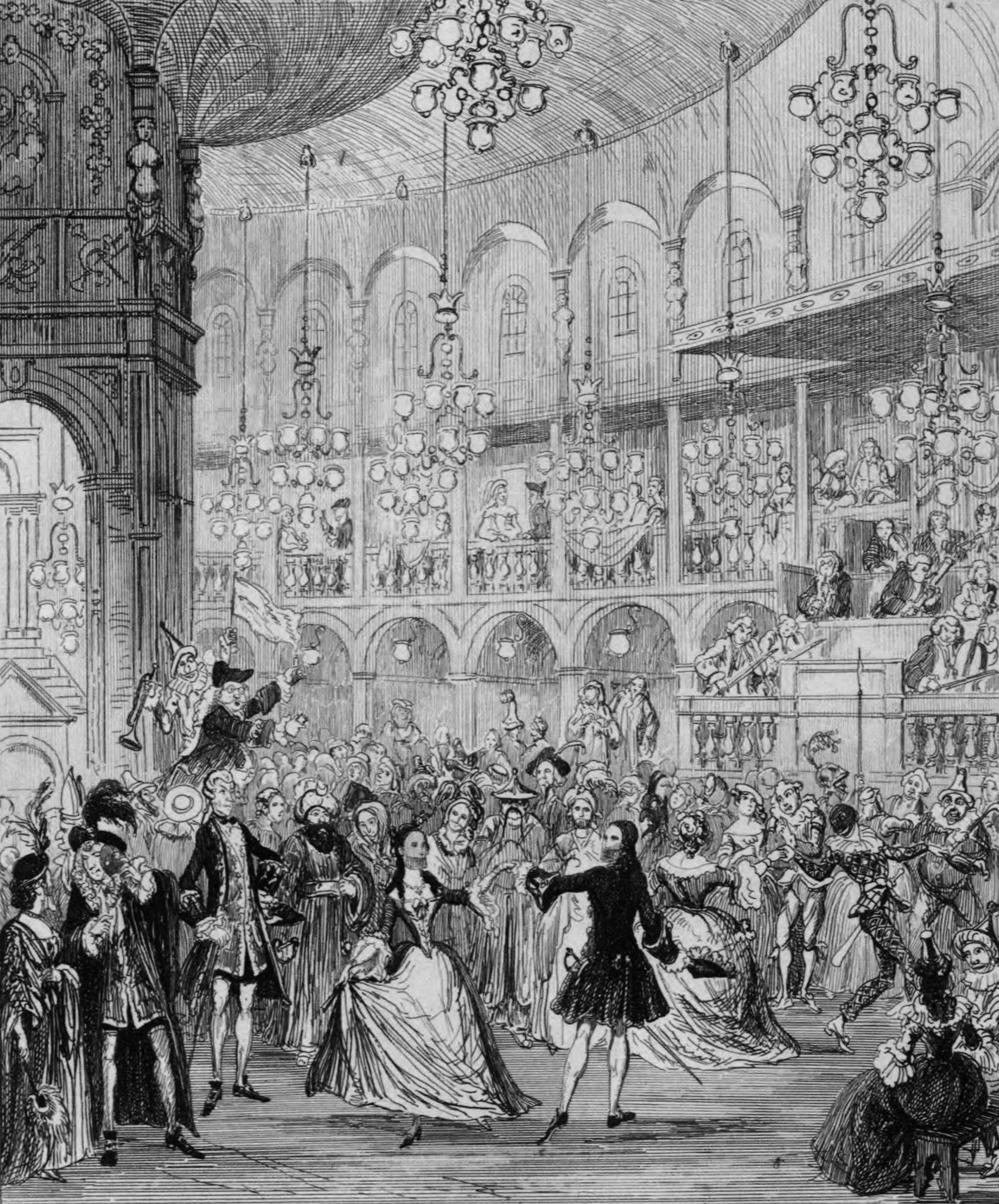
The Miser's Daughter Cruikshank
George Cruikshank
- Medium:
- Oil Painting
- Era:
- Mid 1800s (Polka Era)
- Source:
- Wikimedia Commons
- Rights:
- Public domain — free to use, share and adapt.
- Recorded as:
- Public Domain
This work is a rare large-scale representation of the lived practice of formal Regency ballroom dancing, showing not poses or principles but the actual crowded, public context in which these dances took place. For historians of dance and social life, it offers evidence of how couples positioned themselves, how spectators arranged themselves, and how these dances functioned as public, observable events rather than intimate performances. For art historians and illustrators, it demonstrates the engraver's capacity to organize complex narrative space and represent hundreds of figures with individual attention while maintaining compositional clarity.
What you are looking at
A grand ballroom scene rendered in fine engraving technique, packed with hundreds of fashionably dressed figures. The space is architectural and monumental: a vaulted ceiling with elaborate coffering, multiple tiers of arched openings holding spectators, hanging crystal chandeliers of impressive scale, and ornamental columns framing the composition. The floor is crowded with dancers and observers in mid-18th-century dress — the women in wide pannièred skirts, the men in coats and breeches. The primary action occupies the floor space in the foreground, where couples perform a formal dance in closed holds, their movements constrained and upright. The scene is organized with clear hierarchy: the dancers themselves at floor level, standing observers in the immediate surround, and ranks of watching figures in the galleries above, from which the artist has composed this view looking slightly downward across the assembled company. The lighting is uniform and bright, with no dramatic shadows — typical of engraving's capacity to fill every area with detail.
The dancing
The dancers visible in the foreground are arranged in couples holding each other in upright, formal posture — the characteristic closed position of 18th-century court dances. The women's arms are raised, and their heavy pannièred skirts dominate the silhouette; the men stand at a formal distance, bent slightly forward at the waist. The movement appears restrained and processional rather than vigorous. Hundreds of observers — both dancers waiting their turn and spectators — fill the remaining space, most standing upright and facing the central action, their bodies still and attentive. The density of figures suggests this is a public or semi-public entertainment rather than an intimate gathering.
The dance depicted
This is a ballroom or assembly scene of the Regency or early Georgian era, most likely depicting a quadrille, cotillion, or grand march — the formal social dances that dominated aristocratic gatherings in the 18th and early 19th centuries. The upright posture, closed couples, and processional arrangement are consistent with these highly structured dances, which were danced to specific figures and often involved multiple couples. The scale and formality suggest this may be depicting a famous public ball or state occasion rather than a private party. The work is titled as an illustration to *The Miser's Daughter*, a serialized novel by William Harrison Ainsworth published in the 1840s, which suggests the scene is either a literal depiction of a scene from the text or a contemporary visual interpretation of a ball described in the story.
How it was made
This is an engraving — a reproductive print created by incising lines into a metal plate (copper or steel), with ink held in the grooves and transferred to paper under pressure. The tonal range and fineness of line visible here — the delicate cross-hatching for shadow and volume, the precise rendering of architectural detail, and the capacity to depict hundreds of individual figures with clarity — are characteristic of mid-to-late 18th-century engraving technique at a high level of execution. Engraving allowed for mass production and wide circulation; such a work would have been issued either as a standalone print or, as here, as an illustration in a book or periodical. The technique's clarity and precision made it the standard method for reproductive prints in the era before lithography, and the finesse of line suggests this was an expensive, carefully executed plate.
About this work
This is a detailed engraved illustration of a grand Regency-era ballroom scene, depicting dozens of couples performing formal, structured dances (most likely quadrilles or cotillions) under the eyes of an assembled crowd in an architecturally imposing salon. The work captures not only the dance itself but the social context in which such dances occurred — the public or semi-public nature of the event, the separation of active dancers from spectators, and the rigid formality of movement and dress that governed upper-class social dancing in the 18th and early 19th centuries. As an illustration to a popular novel of the 1840s, it documents both the historical reality of these dances and how artists and authors of the mid-19th century imagined and represented the social world of a generation or two before their own. The engraving's compositional complexity — the framing from above, the multiplication of viewpoints, the careful organization of figure and architecture — makes it a significant document of how formal social dance was visualized and understood in the period.
How to look at it
Approach this as a work of social documentation as much as narrative illustration. Follow the eye downward and inward from the architectural frame to the dancers themselves in the foreground; notice how the composition uses the galleries above to create a sense of public scrutiny and social visibility — these dances were not private moments but carefully observed social transactions. Attend to the women's skirts and the formality of the couples' hold: the constraints of dress and posture tell you something about how movement itself was controlled and displayed in this era. The sheer density of figures — the sense of crowding, of many bodies occupying a formal space — is part of the content; these were social occasions where being seen and seeing were equally important to the dancing itself.
The artist
George Cruikshank (1792–1878) was one of the most prolific and celebrated illustrators and engravers of 19th-century England. Initially trained as an engraver by his father and working in the satirical tradition of political prints, he became the primary illustrator for major literary works, including novels by Charles Dickens and William Harrison Ainsworth. His style combined social realism with energetic observation of human character and behaviour; his compositions are characteristically crowded with detail and incident, and he had a gift for rendering complex social scenes — crowds, assemblies, street life — with both humor and sympathy. Cruikshank's work as an illustrator defined visual literacy for the novel throughout the 19th century; his prints were distributed widely and were often as celebrated as the texts they accompanied.
The period
This image was made in the 1840s, during the height of the illustrated novel in Britain, but it depicts a world — the formal ballroom of the Regency and Georgian aristocracy — that was already becoming historically distant. By the 1840s, ballroom culture was more accessible and informal than it had been fifty years earlier, and the highly structured courtly dances shown here were yielding to the waltz and other newer couple dances. Ainsworth's *The Miser's Daughter*, serialized in 1842–43, was a novel of historical fiction set in an earlier era, so Cruikshank's illustration is a period piece within a period piece — a mid-19th-century representation of 18th-century social life. The engraving's formal, architectural composition and its emphasis on hierarchy (dancers, observers, spectators in galleries) reflects older conventions of history painting and grand manner art, applied here to social documentation rather than heroic narrative.
Where it lives
This is an engraved illustration to William Harrison Ainsworth's novel *The Miser's Daughter*, published in serial form in 1842–43 and subsequently in collected form. Cruikshank's illustrations were integral to the publication and were distributed as part of the novel's reception; individual plates were also circulated as separate prints. The specific holding collection is not recorded in the available metadata.
Dance in this work
Questions about this work
What dance is being performed here?
The formal posture, closed couples, and processional arrangement are most consistent with quadrilles, cotillions, or grand marches — the highly structured, figure-based dances that dominated aristocratic ballrooms in the 18th and early 19th centuries. These dances required specific steps and patterns, performed in groups or longways sets, and were the primary social dances of the era. The formality and scale of this scene suggest a significant public or semi-public ball rather than a private assembly.
Why are there so many people not dancing?
In Regency-era ballroom culture, not everyone danced at once. Dances were performed in groups or sets, and there were lengthy intervals between dances. The spectators and waiting dancers you see here were a normal part of the social event — observing others dance, conversing, and waiting for the next dance were all central to the social function of the ball.
How does Cruikshank's style compare to other illustrators of the period?
Cruikshank was the dominant illustrator of his era and was celebrated for his ability to render complex, crowded scenes with both detail and clarity. His compositions characteristically organize many figures into a coherent narrative space while maintaining individual observation of human character and gesture. His style influenced how the novel itself was visualized for Victorian readers, and his prints were often as eagerly awaited as the text they accompanied.
Is this illustration historically accurate?
Cruikshank was conscientious about period detail, and the architectural setting, dress, and general arrangement of figures are consistent with descriptions and other visual records of grand ballrooms of the era. However, as an illustration to a novel, it is also a work of imagination and narrative interpretation, not a documentary record. It shows what someone in the 1840s believed an earlier ballroom looked like, which is itself historically valuable even if not photographically precise.
More dance artwork