29 works in this view — arrow keys or swipe to move between them.
Dance in Art · 1929
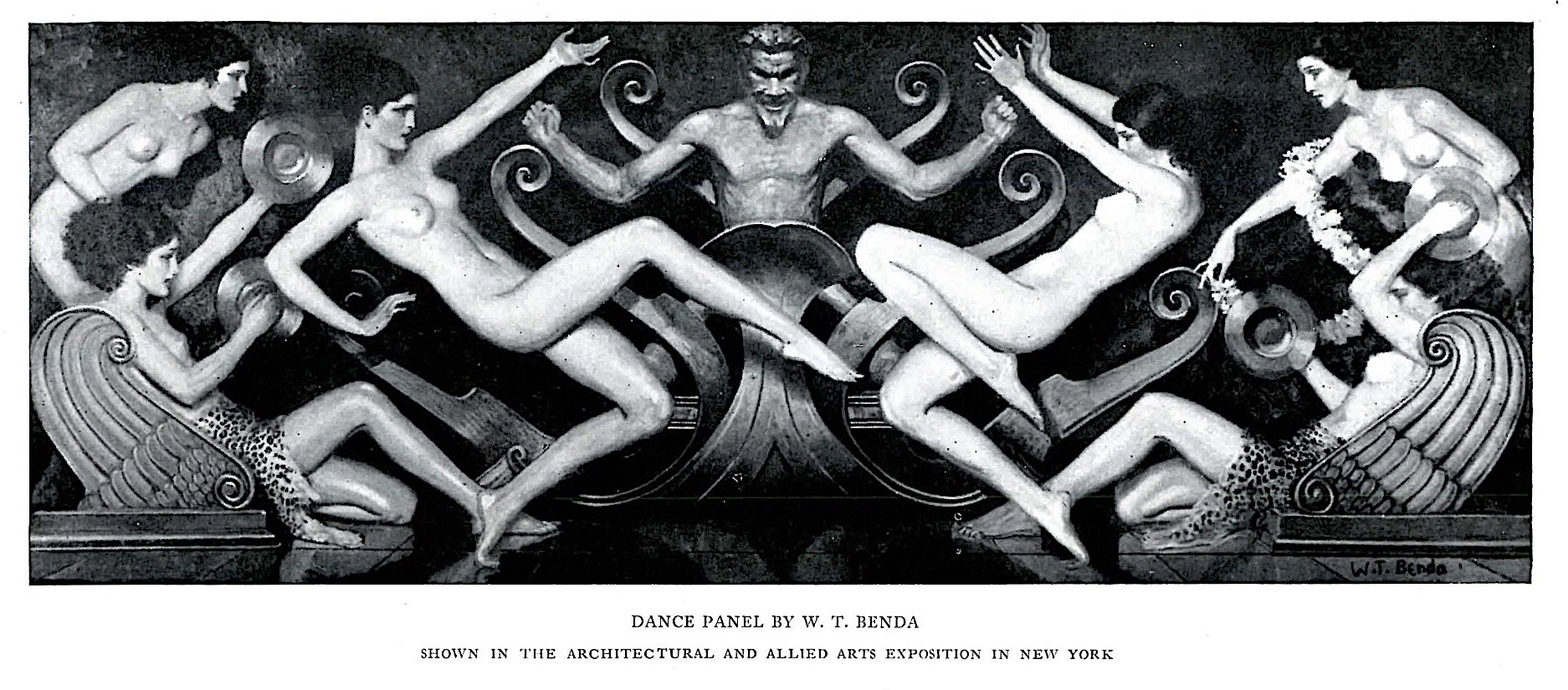
Dance Panel by W. T. Benda
Wladyslaw Teodor Benda
- Medium:
- Oil Painting
- Era:
- 1920-1950 (Swing Era)
- Source:
- Wikimedia Commons
- Rights:
- Public domain — free to use, share and adapt.
- Recorded as:
- Public Domain
This panel shows how deeply ballet aesthetics penetrated Art Deco design and how the dancing body—particularly the female body—became a primary symbol of modernity, grace, and desire in 1920s visual culture. It is a key artifact for understanding the relationship between theatre dance, fine art, and design during the period when Diaghilev's Ballets Russes were transforming European aesthetics.
What you are looking at
A frieze-like composition presenting an elaborate dance scene in black and white, arranged in a symmetrical, almost heraldic pattern. At the centre sits a satyr or faun-like male figure with pointed ears and a muscular torso, his arms raised in an expansive gesture that frames the composition. On either side of this central figure, reclining female nudes move in mirror-image poses, their bodies elongated and fluid, limbs extended in arabesque-like lines. Additional figures—some seated, some reclining—occupy the corners and edges of the panel, each rendered in classical contrapposto or relaxed poses. The entire scene is framed by ornamental scrollwork and spiral motifs in the corners, and what appears to be water or drapery at the base of each side. The style is decidedly Art Deco, with smooth surfaces, strong linear rhythm, and an emphasis on the female form in elegant, attenuated poses. The palette is entirely monochromatic, creating a sculptural quality despite the flatness of the medium.
The dancing
The central satyr holds both arms aloft in a triumphant or summoning gesture, his body upright and assertive. The female figures surrounding him are uniformly recumbent or reclining, their bodies arranged in extended lines—limbs stretched, backs arched, heads tilted. None of the female figures are weight-bearing or upright; all rest on the ground or float in space. The male figure at upper left appears more alert and observant, while those in corners assume passive, languorous positions. The overall effect is one of asymmetrical repose interrupted by the central male presence.
The dance depicted
This is not a representation of an identifiable social or theatrical dance form. Rather, it is a decorative or allegorical composition in which movement and the body are the subject matter, but in a mythological or fantasy context rather than a practised dance tradition. The poses suggest classical ballet vocabulary—notably the arabesque and the general elevation and extension of limbs—but they are deployed here for aesthetic and ornamental effect rather than to show an actual dance being performed. The satyr suggests Dionysian bacchanal or faun revels from classical art, a common theme in Art Deco design. The women are posed as if in a state of ecstatic abandon or passive languor in the satyr's presence, creating a narrative of desire and mythological entertainment rather than a dance lesson or performance.
How it was made
The work is rendered in oil on what appears to be a flat surface, using bold black outlines and high-contrast modeling to create distinct form and strong decorative effect. The monochromatic palette and the linear clarity suggest influence from both classical fresco and modern graphic design. Oil allows for the smooth, sculptural finish of the flesh tones and the crisp definition of ornamental borders. The technique favours flat, bold design over atmospheric perspective or chiaroscuro, making it suitable for architectural or decorative installation—consistent with the title 'panel' and the exhibition context (Architectural and Allied Arts).
About this work
This is a decorative dance panel by W. T. Benda, an artist known for design work in theatre and the decorative arts during the Art Deco period. The work presents a fantasy scene of mythological figures—a satyr surrounded by reclining nudes—arranged in a symmetrical frieze composition that emphasises the elegance and extension of the human body in classical ballet-inflected poses. Though not a representation of an actual dance, it uses the language and aesthetics of dance—extension, line, grace, and fluidity—as its primary expressive means. The work belongs in a gallery of dance in art because it demonstrates how dance vocabulary and the body in motion became a central motif of early 20th-century decorative design, and how the aesthetics of ballet (particularly Romantic and classical ballet) permeated visual culture even in non-theatrical contexts.
How to look at it
Attend first to the symmetry and the centrality of the satyr—this is a composition about power and display, with the male figure as the focal point and the female figures arrayed to frame and complement him. Notice the consistent use of the arabesque and the extended limb as the fundamental unit of design: almost every figure extends one or more limbs in a long line. The ornamental borders—the scrollwork and the wave motif—are as much part of the dance vocabulary as the figures themselves; they create a sense of flowing, rhythmic movement across the surface. The monochromatic rendering emphasises outline and silhouette, making the work read almost like a diagram of classical form rather than a naturalistic scene.
The artist
Wladyslaw Teodor Benda (1873–1948) was a Polish-born illustrator, painter, and designer who became prominent in American theatre and decorative arts. He was known for costume and set design, book illustration, and mural work. His style blended classical academic training with modernist simplification and decorative clarity. He exhibited widely in the early 20th century and was associated with the Architectural League and other avant-garde design circles in New York. His work consistently explored the human figure, theatrical themes, and the decorative potential of line and form.
The period
This panel was created in 1929, at the height of the Art Deco movement and just before the Wall Street Crash. The 1920s had seen an explosive growth in modern design, driven partly by the influence of the Ballets Russes (which premiered in Paris in 1909 and toured widely). The human figure—and especially the dancing figure—had become central to avant-garde aesthetics. At the same time, classical and mythological imagery remained fashionable in decorative arts, blended with modernist simplification. The exhibition in which this work was shown (the Architectural and Allied Arts Exposition in New York) reflects the period's fascination with integrating fine art, design, and architecture. The 1920s also saw intense interest in the female body as an aesthetic object, reflected in fashion, ballet, and the visual arts—often with problematic power dynamics present in this image.
Where it lives
The work was shown in the Architectural and Allied Arts Exposition in New York (date unspecified in the record but consistent with 1929, when Benda exhibited actively). The current holding collection is not recorded. The source is Wikimedia Commons. The work is titled a 'panel,' suggesting it was designed as a decorative or architectural element—possibly for wall installation or interior design.
Dance in this work
Questions about this work
Is this a real dance, or just a decorative arrangement of bodies?
It is a decorative composition that uses dance vocabulary—especially the extended lines and classical poses of ballet—to create its visual effect. The satyr and the mythological setting indicate this is a fantasy scene, not a record of an actual dance performance or style. However, the artist clearly understood ballet aesthetics and used them as the foundation for the design.
Why is the satyr in the centre and the women reclining around him?
This follows classical and Renaissance allegorical traditions in which a male figure (often divine or supernatural) is surrounded by female attendants or muses. In Art Deco design, this iconography was revived and often combined with modernist simplification and eroticism. The composition reflects period attitudes about gender, power, and display—attitudes that modern viewers may find problematic.
What does the artist's signature or monogram tell us?
The signature 'W.T. Benda' appears in the lower right, confirming the artist's attribution. Benda was a working commercial and fine artist, and his signature on exhibition works like this indicates his professional identity and stake in the piece's recognition and circulation.
Why was this shown in an Architectural and Allied Arts Exposition?
Because it was designed as a decorative panel—a work of applied art rather than fine art alone. In the 1920s, the boundaries between 'fine' and 'applied' art were breaking down, and modernist designers sought to integrate visual art into architectural and domestic spaces. This panel could have been intended for installation in a building, theatre lobby, or private collection.
More dance artwork