47 works in this view — arrow keys or swipe to move between them.
Dance in Art · 1912
Dance of Death cropped
Gordon Ross
- Medium:
- Oil Painting
- Era:
- 1900-1920 (Ragtime/Early Jazz)
- Source:
- Wikimedia Commons
- Rights:
- Public domain — free to use, share and adapt.
- Recorded as:
- Public Domain
This work is essential to understanding both the dance practices and the social anxieties surrounding modern social dancing in the early twentieth century. It provides visual evidence of how ballroom dancing was performed in commercial venues and simultaneously shows how dance itself—not just its setting or participants, but the act of dancing—was weaponized in moral discourse. For historians of dance, it reveals the gap between what people actually did (social, mixed, exuberant) and what moralists claimed it meant (moral collapse).
What you are looking at
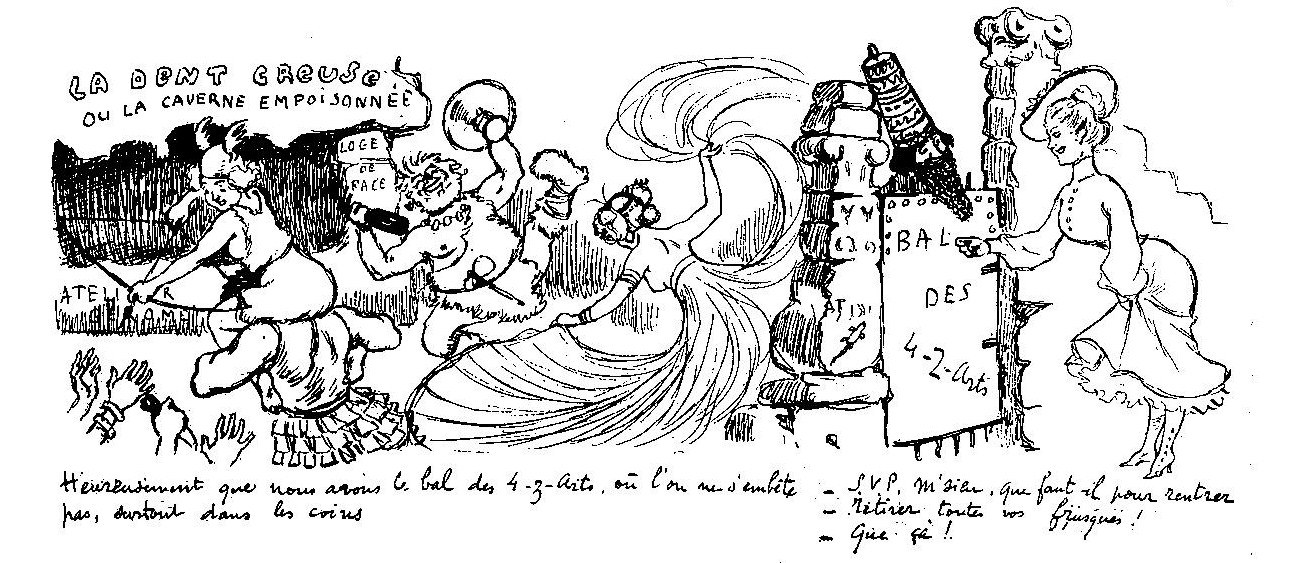
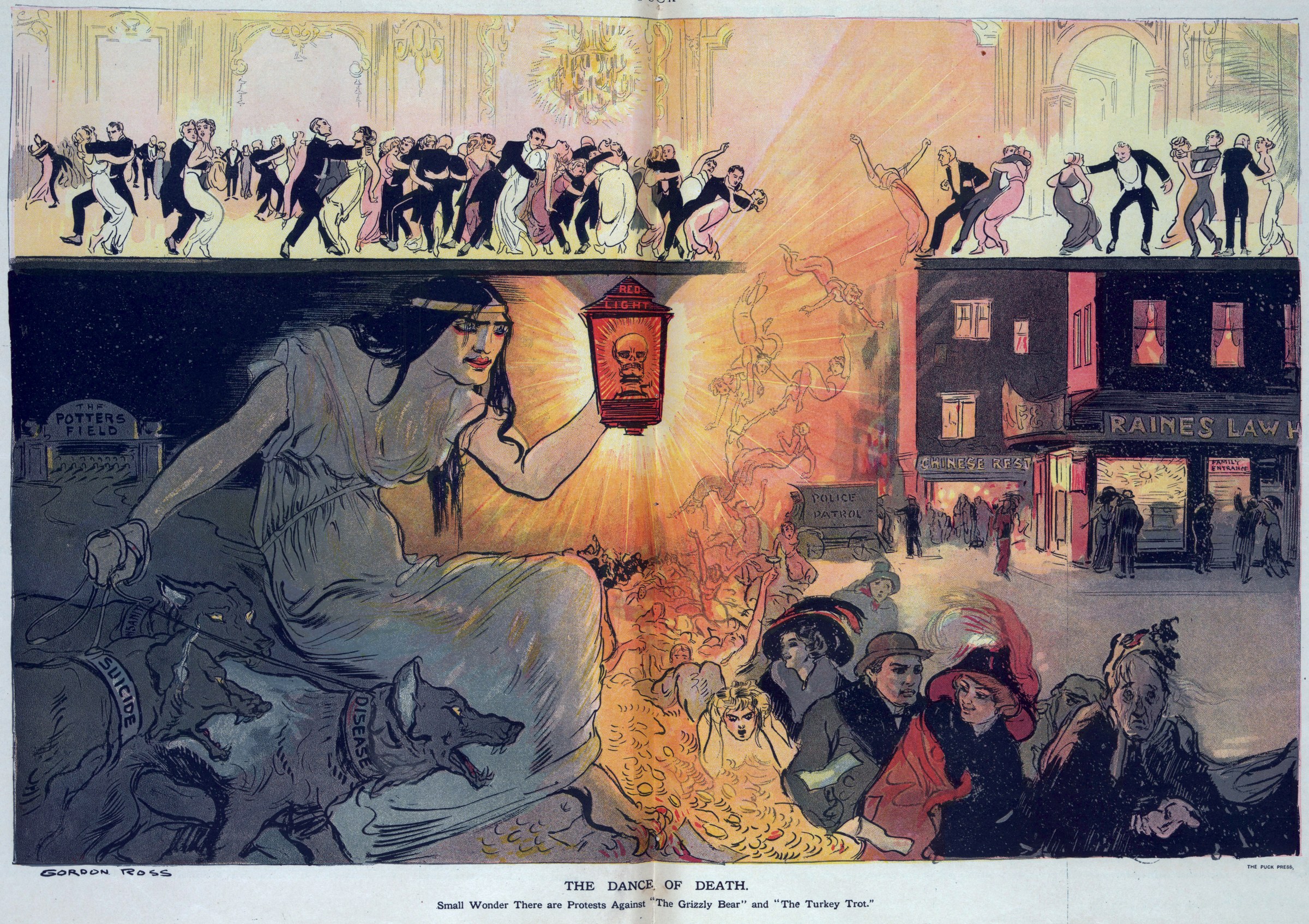
This is a complex allegorical cartoon divided into two registers. The upper portion shows a frieze of men and women dancing energetically in what appears to be a modern nightclub or dance hall—figures in formal dress (tuxedos, evening gowns) move in loose, exuberant poses across the architectural space. The composition fractures at the center, and the narrative darkens dramatically. The lower half presents a memento mori allegory: at left, a pale, gaunt female figure with clawed feet—personifying Death or moral ruin—holds aloft a red lantern marked with a skull. She restrains three snarling dogs labeled "Disease," "Insanity," and "Suicide." Behind her looms a cemetery gate inscribed "The Potters Field." At right, the scene shifts to an urban street at night: storefronts including "Raines Law" (a reference to prohibitive legislation) and a "Chinese Restaurant" are lit from within, with silhouetted figures passing. Police patrol. Street-level humanity—working-class men and women in coats and hats, some appearing to solicit or trade sex—populate the pavement. The entire composition uses color symbolically: warm yellows and oranges in the dance hall above give way to deep reds and blacks below, creating a visual descent from pleasure to perdition.
The dancing
Above, the dancers move in loose, rhythmic formations without obvious partnering—arms raised, bodies turned, weight shifting in what appears to be recreational, socially integrated dancing. The poses suggest vernacular ballroom or social dancing of the period (c. 1912), with both men and women dancing freely and informally. Below, the figures are much more still and anxious: they stand, huddle, observe rather than move. The allegorical Death figure dominates through stillness and restraint (holding back the dogs), creating a visual grammar in which unrestrained pleasure above and social paralysis below serve the moralist argument.
The dance depicted
The work depicts early twentieth-century social dancing in an urban nightclub setting, most likely the fox-trot, one-step, or other modern ballroom dances that had become fashionable and controversial by 1912. These dances were performed in commercial venues (dance halls, cabarets) and were associated in the minds of moral reformers with moral degeneracy, particularly when they mixed working-class dancers, new forms of gender mixing, and—in the context of the Raines Law reference—commercial sex work. The image is not a dance instruction or celebration, but a moral cautionary tale: the very act of dancing in modern commercial venues is presented as a gateway to ruination. This reflects genuine contemporary anxieties about dance halls and modern dancing among progressive reformers (who nonetheless often supported prohibition and regulation of such spaces).
How it was made
This is a color lithograph or chromolithograph, a technique that allowed for mass reproduction and color illustration in newspapers and magazines of the period. The signature "Gordon Ross" is visible in the lower left. The technique's capacity for bold symbolic color (the skull-lantern's red, the surrounding blacks and yellows) and its suitability for satirical and allegorical subject matter made lithography the natural medium for this kind of social commentary. The work would have circulated in print media—likely as a magazine or newspaper illustration—reaching a broad public audience.
About this work
This is a 1912 chromolithograph by Gordon Ross presenting a moral allegory of modern social dancing. The upper register shows energetic dancers in a nightclub in styles characteristic of early twentieth-century ballroom dancing; the lower shows the same scene transformed into an allegory of urban vice, disease, and death. The work embodies Progressive Era anxieties about commercialized leisure, dancing women, and the moral consequences of modern urban life. It is simultaneously a document of how 1912 audiences danced and a window into how that dancing was morally interpreted and feared.
How to look at it
Attend first to the compositional split: the artist has chosen to show the same activity (dancing) in two registers to argue for a causal connection. In the upper register, note the informality and exuberance of the poses—arms up, bodies turned, no obvious strict partnering rules—which contrasts sharply with the frozen, watchful quality of the lower figures. The symbolic objects (the skull-lantern, the cemetery gate, the police) are not incidental; they are the artist's explicit thesis. The work asks the viewer to read the scene as a sequence: pleasure leads to ruin. Finally, observe how the artist distinguishes the dancers themselves from the moral framework: the dancers look like real people doing real dances, suggesting that the artist understood the actual practice even as he condemned it.
The artist
Gordon Ross was a British cartoonist and illustrator active in the early twentieth century, known for satirical social commentary published in periodicals. His work frequently engaged with contemporary moral panics and social issues, using bold allegorical imagery and chromolithography to reach mass audiences. This piece is characteristic of his practice: combining observed social detail (the actual poses and dress of 1912 dancers) with explicit moral messaging.
The period
In 1912, social dancing was undergoing rapid transformation. New dances from the Americas—the turkey trot, the grizzly bear, the bunny hug—were spreading in Europe and North America, often danced in commercial establishments by people of mixed class and gender. These dances involved close partnering, hip movement, and syncopated music, which horrified moral conservatives. Simultaneously, the Raines Law (referenced in the image) and similar legislation attempted to restrict or regulate dance halls, saloons, and commercial leisure. Progressive reformers were split: some supported such regulation on moral grounds, while others argued that dance halls and modern dancing were symptoms of deeper urban and economic problems. Ross's cartoon reflects this moment of cultural anxiety and represents the reformist position that commercial dancing was a path to ruin.
Where it lives
This chromolithograph comes from Wikimedia Commons. The holding collection is not recorded in the catalogue metadata. The work likely circulated as a magazine or newspaper illustration in the British press around 1912.
Dance in this work
Questions about this work
What dances are shown in the upper register?
The poses and informality suggest early twentieth-century social ballroom dances such as the one-step, fox-trot, or other modern dances fashionable in 1912 dance halls. The artist does not label them specifically, but the loose arm positions, turned bodies, and mixed-gender, non-hierarchical positioning are consistent with vernacular social dancing of the period rather than formal ballroom technique.
Why is the Raines Law mentioned?
The Raines Law was New York State legislation (1896) that restricted the hours and licensing of saloons and hotels, ostensibly to reduce vice but in practice creating legal categories and enforcement mechanisms for commercial leisure spaces. Including it in the image anchors the moral allegory to specific legislation, suggesting that the artist (or the publication) saw modern dancing as inseparable from legal and regulatory debates about urban vice.
Is this work antisemitic, racist, or otherwise bigoted?
The image includes reference to a "Chinese Restaurant" and depictions of working-class and possibly immigrant street figures. The moral allegory itself—that commercial dancing and urban leisure lead to vice and ruin—was historically entangled with xenophobia and class anxiety in Progressive Era reform movements. A full historical assessment would require examining the original publication context and Gordon Ross's broader body of work.
What was the artist trying to argue?
The composition argues that modern commercial dancing (shown accurately in the upper register) leads inevitably to moral and physical ruin (shown allegorically below). This reflects a reform perspective common among moral conservatives and some Progressives in 1912: that dance halls, modern dances, and unregulated leisure were symptoms and causes of urban vice, disease, and social collapse.
More dance artwork