49 works in this view — arrow keys or swipe to move between them.
Dance in Art · 1759
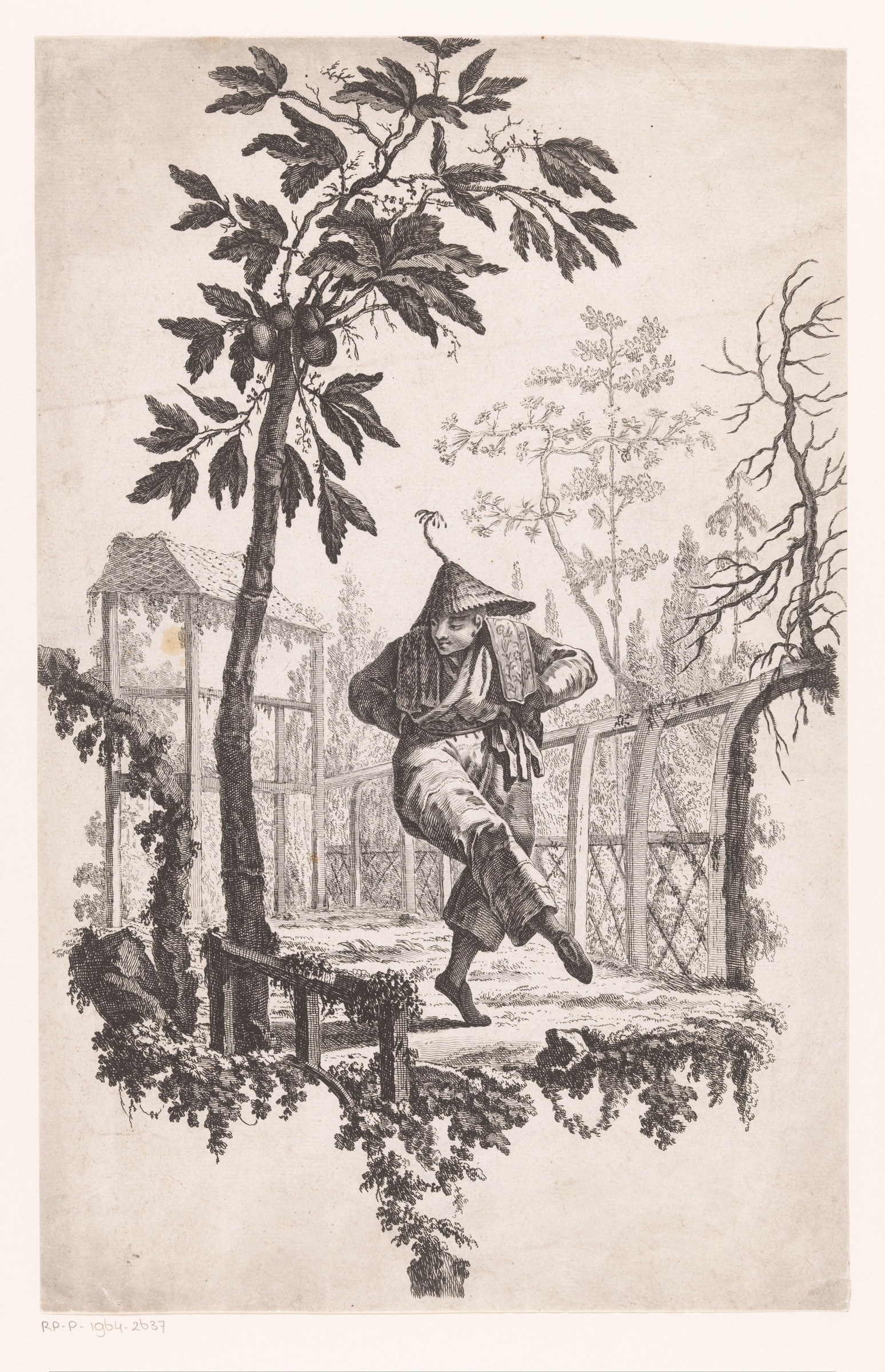
Dansende man Twaalf maanden (serietitel), RP-P-1964-2637
Unknown (Rijksmuseum collection)
- Medium:
- Oil Painting
- Era:
- 1700s (Enlightenment/Minuet Era)
- Source:
- Wikimedia Commons
- Rights:
- Public domain — free to use, share and adapt.
- Recorded as:
- CC0
This print captures the moment when European visual culture became fascinated by the idea of Asian dance as expressive, acrobatic, and unbounded—a fantasy that would shape European understanding of non-Western movement for centuries. For dance historians, it reveals how the rococo imagination translated movement across cultures, and how prints circulated ideas about the body, play, and otherness in the mid-18th-century salon.
What you are looking at
A figure in Chinese dress performs a dynamic movement in a formal garden setting, captured in this engraving from a series on the twelve months. The dancer wears a dark coat with white undergarments and a distinctive pointed hat, leaning dramatically backward with one leg extended in a lunging pose. He occupies a wooden pavilion or gallery with latticed railings, positioned beneath a fruit tree heavy with produce; the composition frames him with botanical detail—climbing vines, leafy branches, and delicate flowering plants rendered in fine lines around the margins. The garden recedes behind him into misty distance, with additional pavilion structures and vegetation suggesting a formal Chinese landscape garden. The entire scene is enclosed in a decorative border of trees and climbing plants, creating a frame-within-frame effect typical of ornamental prints.
The dancing
A single male figure dominates the composition, captured mid-movement in a deep backward lean with his torso nearly horizontal and one leg driving forward in a high, extended lunge. His arms are positioned for balance, one extended outward. The posture suggests explosive energy or a dramatic moment of play rather than a contained courtly gesture. His weight appears fully committed to the movement, with his body weight distributed through his extended supporting leg. The figure fills the vertical space assertively, and his isolation in the composition—no partners, no other dancers—emphasizes the individual virtuosity of the movement.
The dance depicted
This engraving depicts Chinese social or recreational dance of the mid-18th century, most likely a form of expressive movement or mime-dance popular in Qing-era entertainment. The exaggerated backward lean and lunging extension do not correspond to any codified European dance form of the period, but rather suggest the acrobatic or gestural vocabulary of Chinese theater and social dance. The title references one of a twelve-month series, implying these were decorative or instructional prints showing seasonal activities; this figure may represent a winter amusement or festive movement. The dynamic, asymmetrical pose suggests improvisation or display rather than the symmetrical, controlled geometry of minuet or other formal court dances.
How it was made
This is an engraving—a intaglio print technique where an image is incised into a metal plate and ink is forced into the grooves, then wiped clean and printed. The catalogue attributes the design to Jean-Baptiste Pillement (a rococo ornamental painter) with the engraving executed by Pierre Charles Canot, a skilled reproductive engraver active in London and Paris. The fine linear hatching and delicate cross-hatching visible throughout—particularly in the vegetation, fabric, and architectural detail—are characteristic of mid-18th-century European engraving technique. The print's format as an ornamental or decorative print (designated 'prent ornamentprent' in the record) suggests it was intended as a wall decoration or collected as part of a series, circulating among collectors of exotica and curiosities rather than as a serious ethnographic document.
About this work
This mid-18th-century engraving presents a Chinese dancer in expressive, acrobatic movement within a rococo-framed garden setting. Created as part of a twelve-month series by the ornamental designer Pillement and engraver Canot, it documents the European fascination with Chinoiserie—the imaginative interpretation of Asian aesthetics that captivated rococo taste. The work belongs in a dance history collection not as a record of authentic Chinese practice, but as evidence of how European artists visualized Asian movement, and what that visualization tells us about the period's dance vocabulary, gender, play, and intercultural fantasy. The dramatic backward lunge and extended gesture represent neither European courtly restraint nor documented Chinese classical forms, but rather a European invention of exoticism—a figure designed to appear foreign, uninhibited, and physically daring in contrast to the formality of contemporary European social dance.
How to look at it
Notice the exaggeration of the backward lean—no minuet-era dancer would arch the spine so extremely or extend a leg so high without support. The pose is theatrical and displays balance as a feat of strength, not as invisible control. The artist has frozen a moment of dynamic imbalance, suggesting movement as spectacle and risk rather than as courtly geometry. Attend also to the framing: the elaborate botanical border and pavilion setting are as much the subject as the figure, indicating that the 'exotic' garden and the exotic dancer belong together in European fantasy. The precision of the engraving technique—the fine hatching and delicate detail—contrasts with the violence of the figure's gesture, creating tension between ornamental refinement and raw physicality.
The artist
Jean-Baptiste Pillement (1728–1808) was a French rococo painter and ornamental designer celebrated for fantastical, decorative scenes incorporating exotic animals, plants, and figures. He worked across Europe—France, England, Austria, Spain—and was prolific in creating designs for porcelain, textiles, and prints that capitalized on the rococo appetite for chinoiserie. Pierre Charles Canot (1710–1777) was a French-born engraver who specialized in reproductive printmaking and ornamental designs, working in London from the 1740s onward. Together they created a series of prints capitalizing on English and European curiosity about Asian life and aesthetics.
The period
The mid-18th century was the height of rococo taste in Europe, characterized by asymmetry, theatrical exoticism, and playful abandon. Chinoiserie—the European fantasy of China—dominated decorative arts, porcelain, garden design, and prints. Dance during this period was strictly codified in Europe: the minuet governed polite society, and formal rules of posture, arm position, and closure defined respectability. Asian movement, by contrast, was imagined (not documented) as free, acrobatic, and expressive—a projection of what European dance was not. This print reflects that binary imagination rather than any authentic record of Chinese dance practice.
Where it lives
The work is housed in the Rijksmuseum, Amsterdam (accession RP-P-1964-2637), as part of their print collection. It bears the collector's marks of at least two historical collections (Lugt 2228 and 2760, noted verso), indicating it circulated among European print collectors and was valued as an ornamental work. The Berlin Ornament Catalogue (Berlijn Orn Cat 449-Band 1) references it, confirming its status as a canonical example of rococo ornamental printmaking.
Dance in this work
Questions about this work
Is this depicting real Chinese dance?
No. This is a European fantasy of Chinese movement, created by rococo designers who had not studied Chinese dance. The exaggerated backward lean and acrobatic pose reflect what Europeans wanted to imagine about 'Asian' physicality—uninhibited, extreme, and opposed to European courtly restraint. It tells us about rococo taste, not about 18th-century Chinese practice.
Why is it part of a twelve-month series?
The series likely represented seasonal or monthly activities and amusements. This particular figure may represent a winter pastime, festive moment, or general recreational movement. Pillement and Canot created these as decorative prints for collectors, not as systematic documentation.
What is the significance of the garden framing?
The rococo garden—with its pavilion, fruit trees, climbing vines, and ornamental plants—was a crucial part of the 'Chinoiserie' fantasy. European rococo aesthetics imagined both the garden and the dancer as aspects of an idealized, exotic world. The framing elevates the garden to equal importance with the figure.
Who would have owned or displayed this print?
Wealthy European collectors and patrons of rococo taste—aristocrats, merchants, and connoisseurs of ornamental design. These prints were often bound into albums, framed as wall decoration in salons, or collected as examples of fine engraving technique. They circulated among the cultured elite.
More dance artwork