35 works in this view — arrow keys or swipe to move between them.
Dance in Art
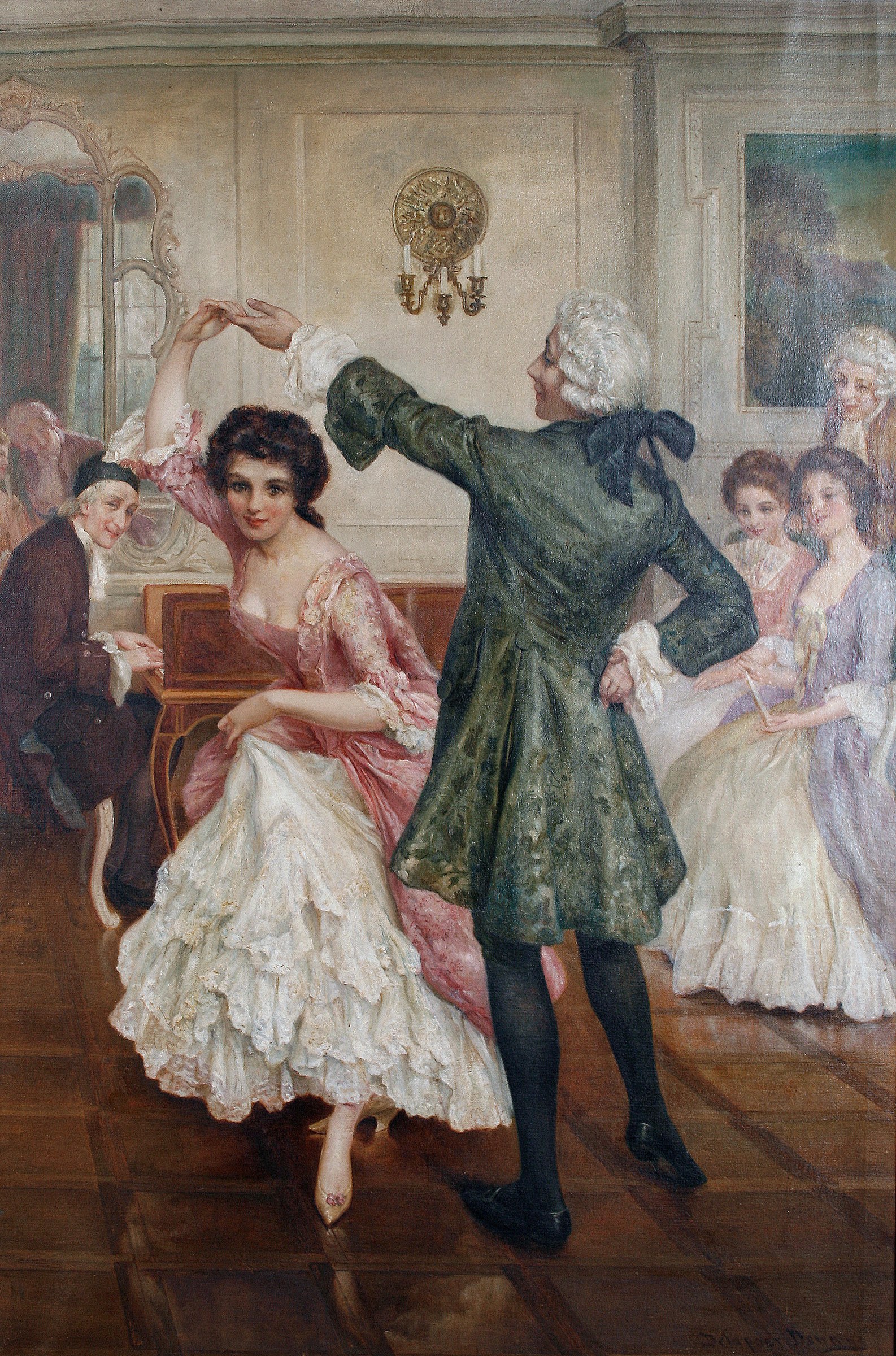
Delapoer Downing Ballroom
Delapoer Downing ( fl.1885-1902)
- Medium:
- Oil On Canvas
- Dance:
- Ballroom
- Source:
- Wikimedia Commons
- Rights:
- Public domain — free to use, share and adapt.
- Recorded as:
- Public Domain
The painting documents how ballroom dance was seen and valued in late 19th-century British society: as an art of bodily grace, formal propriety, and heterosexual courtship conducted in candlelit drawing rooms. For historians of dance and social practice, it is evidence of the persistence and prestige of partnered ballroom dancing in elite culture, and of how dance was understood as simultaneously intimate and public, private and performative.
What you are looking at
A formal ballroom scene depicts an elegant social dance in progress, set in a neoclassical interior with pale walls, a decorative mirror, wall sconces, and a gilt sunburst ornament. A gentleman in a dark green coat and white breeches leads a woman in a pink silk gown with white lace underskirt; she wears her dark hair up and gazes toward her partner. Around them, spectators in formal dress—elderly gentlemen in dark coats, young women in white and pale silk gowns—watch from the margins. The lighting is warm and diffused, suggesting gaslight or candlelight, and falls evenly across the polished floor. The composition centers the dancing couple but frames them as part of a larger social gathering, with attentive observers creating depth and spatial recession into the background. The moment captured is mid-turn or mid-glide, the woman's skirt caught in graceful movement, the gentleman's extended arm leading her through the figure.
The dancing
The lead dancer's posture is upright and confident, his left arm raised and extended to guide his partner; his frame is open and his weight appears forward on the ball of the foot. The woman in pink holds his hand at shoulder height and turns toward him, her body aligned with his direction, her skirt spiraling outward from the momentum of the turn. Both dancers maintain the formal closed or semi-closed frame typical of 19th-century ballroom dance, with a clear sense of partnership and shared line. The watching couples and onlookers in the background are still and attentive, allowing the primary pair to hold the visual focus.
The dance depicted
This is ballroom dance of the mid-to-late 19th century, most likely a waltz, quadrille, or polka given the formal setting, mixed-gender pairing, and the turn captured mid-movement. The waltz is the strongest candidate: the woman's spiral skirt and the man's leading arm position are consistent with a waltz turn, and the waltz dominated fashionable ballroom dancing from the 1850s onward. The setting and dress suggest this is social ballroom dancing among the upper or upper-middle classes—not performance, but the ritual of courtship and social display that occupied ballrooms in elite households and assembly rooms of the period.
How it was made
Oil on canvas, a medium that allowed the artist to build form through glazing and to capture the soft luminosity of interior candlelight and the varied textures of silk, lace, and cloth. The painting's scale (approximately 95 × 64.5 cm) and exhibition quality suggest it was a work of professional ambition, likely made for display in a gallery or private collection rather than circulation as a print. The oil medium permitted the artist to render the social psychology of the scene—the subtle exchanges of glance and attention, the formal postures that mask intimacy—with a nuance that lithography or engraving could not achieve.
About this work
A mid-to-late 19th-century oil painting by British artist Delapoer Downing depicting a ballroom waltz or quadrille in a formal neoclassical interior. The work captures a moment of social dance among the upper classes: a gentleman in green leading a woman in pink through a turn, observed by attentive spectators in formal dress. The composition balances the grace of the dancing pair against the stillness of the watching crowd, using light, interior architecture, and the spiral of the woman's skirt to convey movement and elegance. This is a genre scene of social dance—dance as courtship, display, and social ritual rather than theatrical spectacle—and exemplifies the Gilded Age fascination with ballroom culture as a subject for fine art.
How to look at it
Attend first to the couple at the center: the woman's spiral skirt and the man's extended arm capture the precise moment of a turn—dynamic but frozen in paint. Notice how the artist has positioned the spectators: their stillness and attention define the dancing pair as special, set apart by grace and movement. The neoclassical interior—the pale walls, the mirror, the gilt ornament—frames the dance as refined and civilized. Look at the woman's face: she gazes not outward but toward her partner, her expression serene and focused, exemplifying the social ideal of the ballroom partner who is attentive without being aggressive or self-directed.
The artist
Delapoer Downing (fl. 1885–1902) was a British painter active in the late Victorian era. Little is currently documented about his training or exhibition history, but the quality and ambition of this work suggest he was a professional artist working in the salon tradition, likely exhibiting at the Royal Academy or similar institutions. His choice of subject—the social dance scene—places him within a broader tradition of Gilded Age genre painting that found aesthetic and social interest in the rituals of fashionable life.
The period
The late 19th century saw the waltz, quadrille, and other ballroom dances at the height of their cultural prestige. The Gilded Age brought wealth and leisure to an expanding upper-middle class, and ballroom dancing became a central fixture of social life and display. Simultaneously, academic and salon painting took increasing interest in scenes of modern social life—the drawing room, the ballroom, the promenade—as worthy subjects for fine art. Downing's painting sits within this broader current of interest in capturing the aesthetics and psychology of social dancing as a distinctly modern, urban, and class-marked practice.
Where it lives
The work is recorded as oil on canvas, approximately 95 × 64.5 cm. The current holding collection and acquisition history are not documented in the available record. The painting is known from Wikimedia Commons, suggesting it may be held in a publicly accessible collection, though the specific institution has not been verified.
Dance in this work
Questions about this work
What dance are they doing?
Most likely a waltz. The woman's spiral skirt, the man's extended arm position, and the turning motion all match the waltz, which dominated fashionable ballroom dancing in the 1880s–1890s. A quadrille or polka is also possible given the formal setting, but the grace of the captured turn points most strongly to waltz.
Why are all those people standing around watching?
This reflects the actual social practice of ballroom dancing in the period. Not everyone danced at every moment; spectating was a valued activity. Older guests, unmarried men, and others would watch from the sides, observing the dancers, evaluating partners, and discussing the events. The painting captures this mixed social dynamic authentically.
What does her dress tell us about the period?
The woman's pink silk gown with an elaborate white lace underskirt, small waist, and full skirt are consistent with fashions of the 1870s–1890s. The lace and silk were expensive materials, signaling her family's wealth. Her hair is up and adorned, again indicating status. Ballroom dress was a primary arena for displaying class and taste.
Is this a famous painting?
Not widely known today. Delapoer Downing is a minor figure in British Victorian painting, and this work has not achieved canonical status in art history. However, it is a competent and historically valuable document of Gilded Age ballroom culture and may have been well-regarded when exhibited in the 1880s–1890s.
More Ballroom artwork