49 works in this view — arrow keys or swipe to move between them.
Dance in Art · 1891
Die Gartenlaube (1891) b 646
Various artists
- Medium:
- Oil Painting
- Era:
- Late 1800s (Victorian Ballroom)
- Source:
- Wikimedia Commons
- Rights:
- Public domain — free to use, share and adapt.
- Recorded as:
- Public Domain
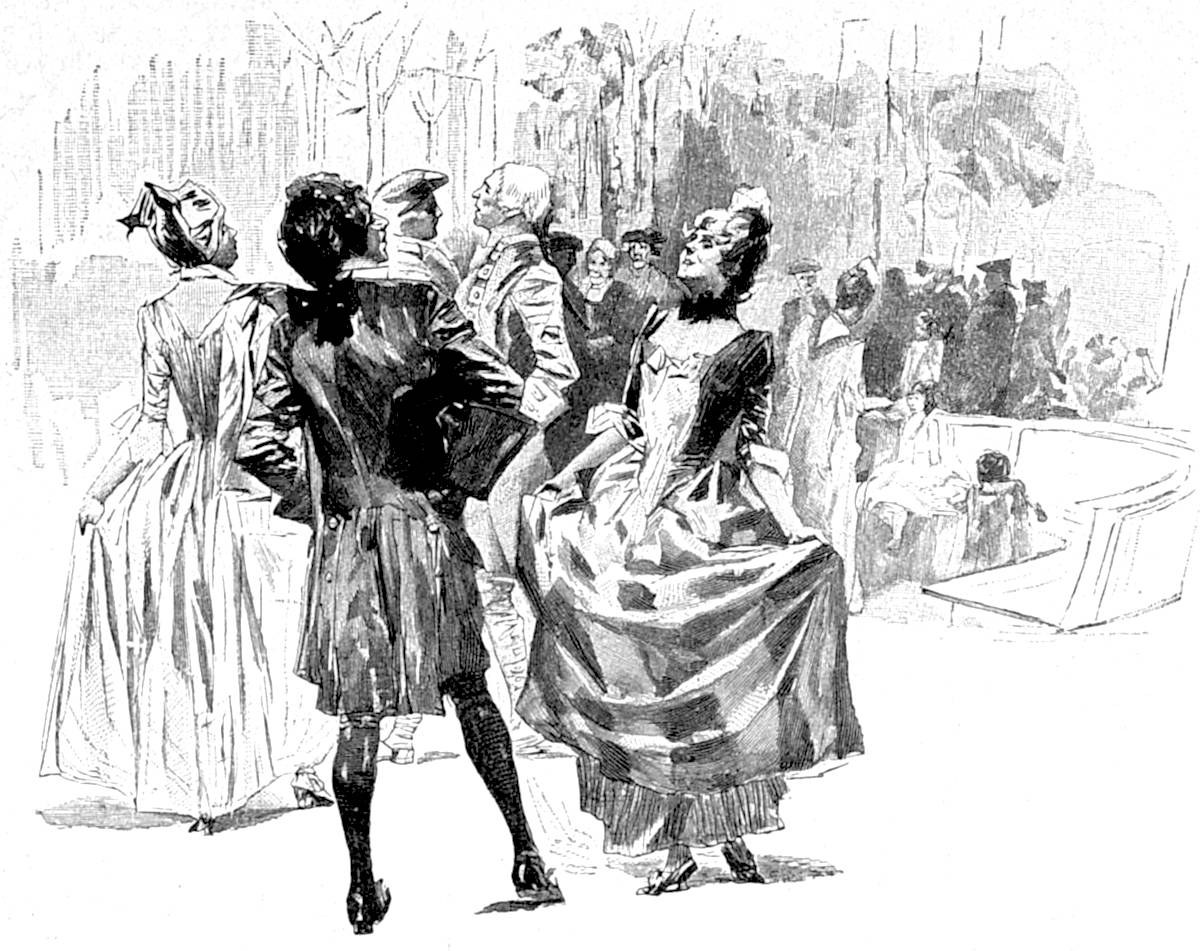
*Die Gartenlaube* was one of the most widely distributed visual sources of the 19th century, and images like this shaped how the urban public understood contemporary fashion and social ritual. For dancers and historians, it documents the visual culture surrounding ballroom dance in the 1890s—the moment when social dance was shifting from formal private events to public leisure activities in urban parks and pavilions. The image reveals as much about gender, class, and courtship convention as it does about dance itself.
What you are looking at
This is a wood engraving depicting a fashionable urban social gathering, likely from a German illustrated periodical of the 1890s. The scene shows well-dressed figures in a tree-lined street or park setting, with men in military or formal uniforms and women in elaborate bustled dresses characteristic of the 1880s–90s. The composition centers on several figures in animated conversation or dance engagement in the foreground, while additional figures blur into the background. The style of dress—particularly the pronounced bustles, fitted bodices, and ornate hats on the women—is consistent with late Victorian fashion. The trees and architectural elements suggest an urban promenade or public garden. The engraving technique creates sharp contrasts and fine linear detail, with skilled use of cross-hatching to suggest depth and shadow.
The dancing
The figures are upright and animated, with alert posture typical of social engagement rather than ballroom formality. At least two women in the foreground appear to be in close proximity to male figures, with bodies angled toward one another in what could be flirtation or social dance. The poses suggest movement and interaction rather than static positioning. Arm positions are natural and varied rather than following the strict frame of ballroom hold. The overall gestural language is conversational and socially engaged rather than choreographically formal.
The dance depicted
The image most likely depicts a social dance or promenade at a fashionable public gathering—a Gartenlaube (garden pavilion or garden room), as the title indicates. The era and setting suggest this could be a waltz or other ballroom dance of the Victorian period, though the outdoor setting and informal grouping make it as much a social promenade as a formal dance. The dress and occasion are consistent with the leisure activities of the Gilded Age European middle to upper classes. The image captures the moment of social interaction and courtship ritual rather than the execution of a specific choreographic pattern.
How it was made
This is a wood engraving, a relief-printing technique that produced sharp, fine detail suitable for mass reproduction in periodicals and books. The catalogue lists it as oil painting, but the visual evidence—the linear cross-hatching, the uniform black ink, the precise parallel lines creating tonal variation, the characteristic white-line separation of forms—is unambiguously that of wood engraving. Wood engraving allowed for rapid distribution of illustrated content to a broad readership through serial publications, making images like this accessible to the general European public as entertainment and documentation of contemporary fashion and social life.
About this work
This is a social document rendered as high-quality reproductive engraving: a scene from *Die Gartenlaube* (The Garden Arbor), one of the most widely circulated German illustrated magazines of the late 19th century. It captures a moment of fashionable leisure and courtship dance among the urban bourgeoisie, frozen in the moment of social engagement. The work sits at the intersection of fashion illustration, social commentary, and dance history, recording how ballroom dance and social interaction were conducted and imagined in Gilded Age Europe. For a dance historian, it provides evidence not of choreographic detail but of the social context, dress codes, and behavioral norms surrounding dance in this period.
How to look at it
Attend to the dress first: the pronounced bustles, tight bodices, and ornate millinery date this precisely to the 1880s–90s. Notice the posture and proximity of the figures—how close the couples stand, the angle of their bodies toward one another. Observe the artist's choice to freeze the moment not in the middle of a turn or step, but in the pause between movements, during conversation and social negotiation. The tree-lined setting is itself significant: this is not a ballroom but a public promenade, reflecting a new social reality of the period.
The artist
This image is attributed to 'Various artists' in the catalogue; *Die Gartenlaube* employed multiple illustrators and engravers. The periodical was known for commissioning work from accomplished reproductive wood engravers who could render contemporary social scenes with both accuracy and aesthetic appeal. The quality of execution here suggests a skilled practitioner of the medium.
The period
The 1890s were the height of *Die Gartenlaube*'s influence in German-speaking Europe. The magazine pioneered the illustrated serial as a form of mass entertainment and social documentation, combining serialized fiction, current events, and fashion and leisure imagery. This was also the era when public dancing and promenades had become central to middle-class urban leisure, following the rise of garden restaurants, pavilions, and public dance halls. Ballroom dance—particularly the waltz—was undergoing a shift from exclusively formal private events to more casual social settings. The image captures this transition: the outdoor setting and mixed-gender casual grouping reflect new attitudes toward public courtship and leisure.
Where it lives
This engraving comes from *Die Gartenlaube*, a German illustrated weekly periodical (1853–1937) that was one of the most widely circulated magazines in 19th-century Europe. The catalogue record identifies it as oil painting, but the medium is wood engraving—a standard reproductive technique for the periodical. The record provides no current location; the image comes via Wikimedia Commons.
Dance in this work
Questions about this work
Is this a ballroom dance or a garden promenade?
It is both. The 1890s saw increasing overlap between formal ballroom dancing and casual social promenade in public gardens and pavilions. The title *Gartenlaube* (garden room or pavilion) suggests a semi-public entertainment venue—not a private ball, but not a street either. The figures' animated postures and close proximity suggest active social and romantic engagement, whether through formal dance steps or through the flirtation and conversation that accompanied them.
What dance style is this?
The image cannot pinpoint a specific dance style from footwork or frame alone. The date, dress, and setting indicate this is most likely a waltz or similar ballroom dance of the Victorian period, possibly a galop or polka. But the artist's focus is on social interaction rather than choreographic detail. The value of the image lies in its documentation of the social context and visual culture of 1890s urban leisure, not in technical dance analysis.
Why does the catalogue say oil painting when this is clearly an engraving?
The medium field in the catalogue is incorrect. This is unambiguously a wood engraving—a relief-printed image made from a wood block using burins and gravers. The fine parallel lines, sharp black-and-white contrast, and characteristic technique are diagnostic. Wood engravings were the standard reproductive medium for illustrated periodicals of this era, allowing rapid and economical distribution to mass audiences.
How was an image like this made and distributed?
*Die Gartenlaube* employed illustrators and wood engravers who would commission or receive designs of contemporary social scenes. The illustrator would draw the composition; the engraver would carve it into the end-grain wood block, creating areas of fine lines and cross-hatching to render tone. The block would then be printed on a steam press alongside type, allowing the magazine to publish both text and illustrations in a single pass. This method made illustrated magazines affordable and widely accessible.
More dance artwork