49 works in this view — arrow keys or swipe to move between them.
Dance in Art · 1716
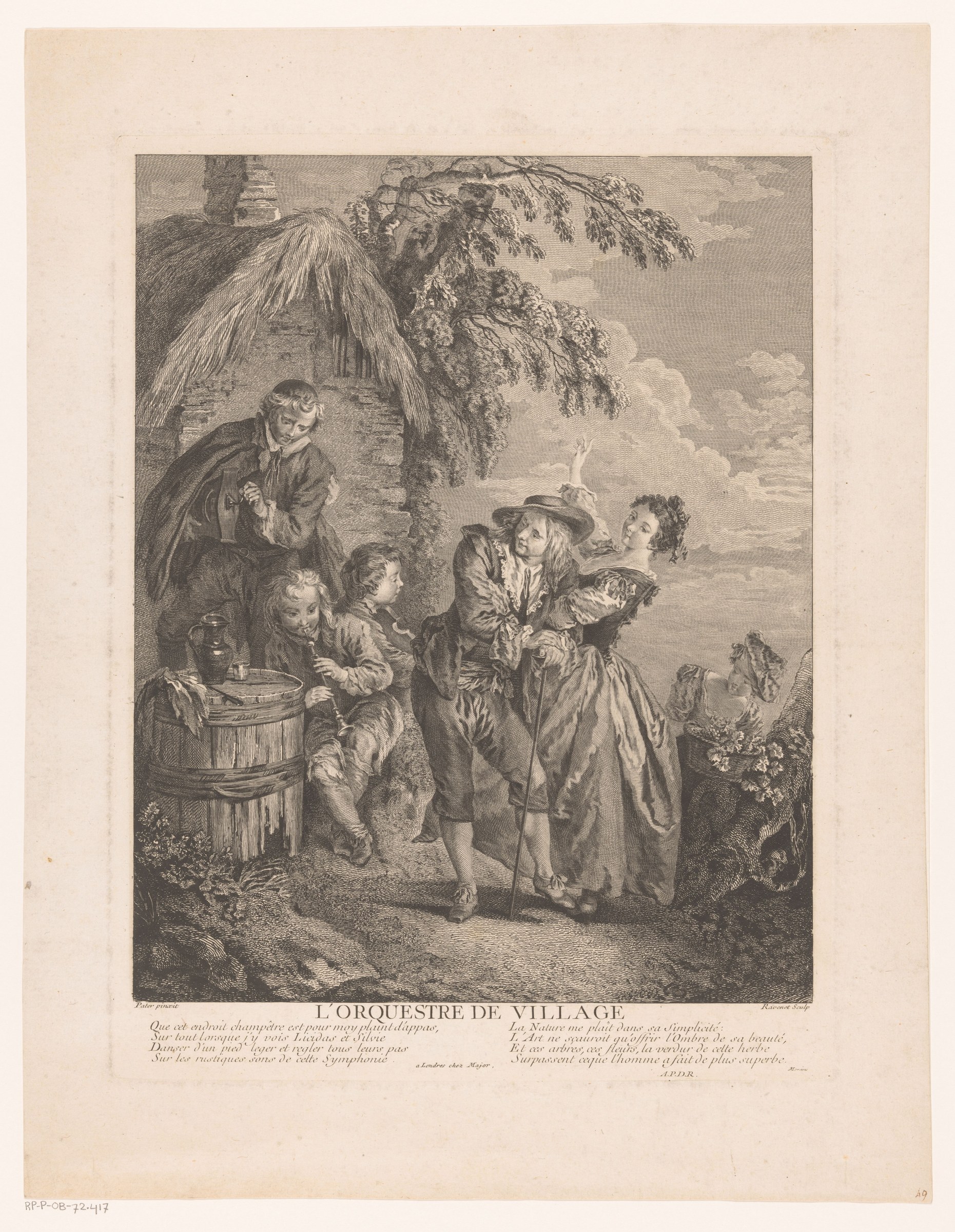
Drie muzikanten bij een huis, ervoor een dansende man en vrouw, RP-P-OB-72.417
Unknown (Rijksmuseum collection)
- Medium:
- Oil Painting
- Era:
- 1700s (Enlightenment/Minuet Era)
- Source:
- Wikimedia Commons
- Rights:
- Public domain — free to use, share and adapt.
- Recorded as:
- CC0
This print documents the social context of early eighteenth-century dance—where it happened, who played for it, how men and women positioned themselves together—in a way that no text can. It shows dance not as technique to be taught but as leisure to be enjoyed, revealing the aesthetic values of the rococo period and how the educated classes imagined the lives of rural people.
What you are looking at
A village entertainment unfolds beneath a willow tree beside a modest dwelling. Two couples dance in the foreground while three musicians play to their left—one seated with a stringed instrument, two standing with wind instruments. The dancers are dressed in rustic clothes of the early eighteenth century: the man wears a brown coat and hat, the woman a full skirt and bonnet. Their postures suggest active movement, with the woman's body angled and the man leaning toward her. The setting is rural and intimate: buildings cluster in the background, clouds drift across the sky, and flowering plants frame the scene at right. Light falls evenly across the figures, characteristic of the rococo prints that sought to capture a world of refined, pleasurable leisure even in peasant settings.
The dancing
The male dancer inclines his body toward his partner with a gesture suggesting courtship or invitation. The female dancer's weight appears shifted, her skirts displaced by motion. Both figures maintain upright spines and seem to be in a social dance position rather than holding hands in a closed frame—their bodies angled to face each other across a small distance. The seated and standing musicians frame the pair, establishing the dance as a social event accompanied by live music rather than a solo or formal performance.
The dance depicted
This is a village dance, most likely a minuet or contredanse of the type that dominated social dancing in early eighteenth-century Europe. The title *L'Orchestre de Village* (The Village Orchestra) and the inscription in French indicate this is a rococo genre scene celebrating rural entertainment as leisure. The dress, the musicians, and the outdoor setting all point to a social dance occasion rather than theatrical performance. The specific dance cannot be determined from posture alone—the engraving captures a moment of interaction rather than a recognizable step sequence—but the formal dress and courtship dynamic suggest a minuet or similar courtly form adapted for village celebration.
How it was made
This is an engraving by Simon François Ravenet after a painting by Jean Baptiste François Pater, published by Major. The technique of engraving allowed fine detail and wide reproduction, making this a work of commercial circulation aimed at collectors and prints dealers rather than a unique object. The print preserves a rococo painting in black ink on paper, translating Pater's composition into a durable, portable form that could be distributed across Europe. The tonal range, achieved through hatching and cross-hatching, mimics the painterly effects of light and shadow.
About this work
This is a rococo genre print celebrating village dance and music-making as refined entertainment. It records not a specific historical dance but rather the contemporary fantasy of rural leisure—how the educated urban viewer of the 1710s imagined peasant celebration. The work sits at the intersection of two traditions: the documentary impulse to show how different social classes entertained themselves, and the rococo aestheticizing of rustic life as innocent and charming. For dance history, it is valuable precisely because it captures the social and musical context of eighteenth-century dance rather than isolated steps or costumes. The engraving after Pater made this image widely available and influential in establishing the visual vocabulary of the village dance as a subject for European art.
How to look at it
The engraver chose the moment of encounter rather than a recognizable step, capturing the social and courtship dimension of dance rather than its technical content. Notice the postures and glances of the dancers—how they orient toward each other—and how the musicians are positioned as essential to the scene rather than incidental. The title in French, the inscription with poetic text, and the attention to landscape and light all signal this as a refined entertainment meant for educated eyes, not a documentary record of step technique. The print asks the viewer to imagine themselves in this scene of rural leisure, to enjoy it as a fantasy rather than an ethnographic record.
The artist
Jean Baptiste François Pater (1696–1736) was a leading rococo painter known for fêtes galantes and scenes of contemporary entertainment. Simon François Ravenet (1706–1774) was a prolific French engraver who translated paintings into prints for wider circulation. This collaboration between painter and engraver was standard practice in the eighteenth-century print market, with engravers creating multiple versions of popular compositions to sell to collectors and institutions.
The period
The early eighteenth century saw dance established as a central subject of polite entertainment across European society. Minuets, contredanses, and other social dances were taught by dancing masters, performed at court, and celebrated in art and literature as markers of refinement and social status. Rococo art embraced scenes of leisure, pleasure, and courtship—including dance—as appropriate subjects for painting and print. Village scenes became fashionable as educated viewers enjoyed the fantasy of innocent rural entertainment, even as actual rural dance traditions continued alongside these refined versions. The print market in Paris and other capitals made such images accessible beyond the nobility to merchants, professionals, and collectors.
Where it lives
This is an engraving in the Rijksmuseum collection, Amsterdam (accession RP-P-OB-72.417). It is catalogued as a print after a painting by Pater, with text by Moraine and publication details (Major as publisher). The work is part of the Rijksmuseum's extensive holdings of eighteenth-century prints, which include similar rococo genre scenes.
Dance in this work
Questions about this work
What dance are these people doing?
The specific dance cannot be identified from the postures shown. The formal dress, courtship dynamic, and musical accompaniment suggest a minuet or contredanse—social dances of the early eighteenth-century European elite. The engraver chose to capture a moment of social interaction rather than a recognizable step pattern. The title and inscription frame this as a village entertainment, so it may represent how courtly dances were adapted for rural celebration.
Is this a documentary image or an invented fantasy?
It is both. The image records real elements of eighteenth-century dance—the musicians, the outdoor setting, the dress appropriate to the period—but combines them in an idealized rococo fantasy. Educated viewers of the 1710s enjoyed scenes of 'village entertainment' as charming and innocent, even while actual rural dance traditions were quite different. The print should be read as a statement about how the urban elite imagined rural leisure, not as ethnographic evidence of how village people actually danced.
Why is this a print and not a painting?
This is an engraving made after a painting by Pater. Engravings were the primary means of circulating images in the eighteenth-century art market. By translating Pater's composition into black ink and paper, the engraver Ravenet made it reproducible, portable, and affordable to a much wider audience than could own the original painting. Multiple impressions could be printed from the same plate, making this type of work a commercial product rather than a unique object.
More dance artwork