49 works in this view — arrow keys or swipe to move between them.
Dance in Art · 1868
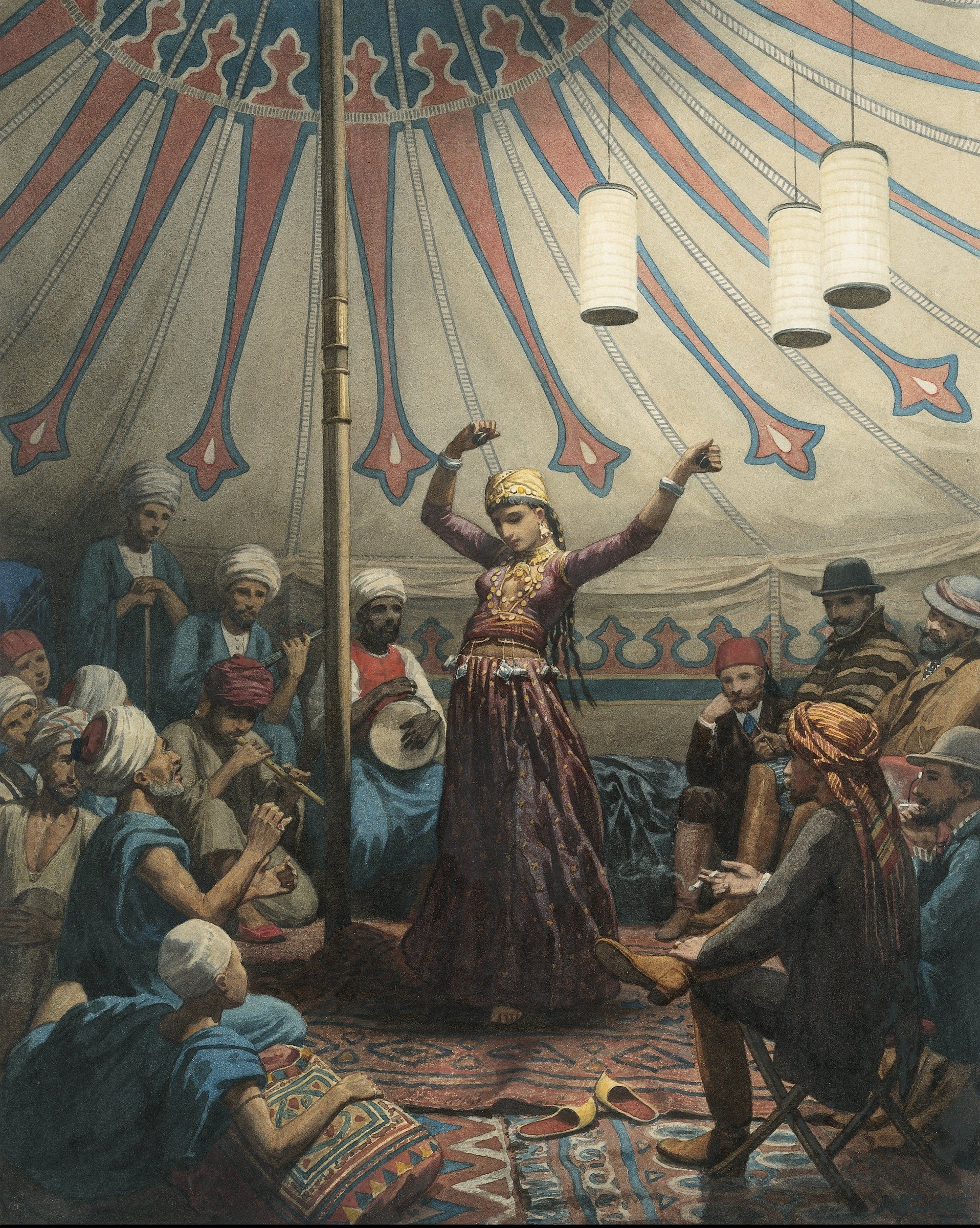
Egyptische danseres in een tent, met muzikanten en toeschouwers, RP-T-1892-A-2698
Unknown (Rijksmuseum collection)
- Medium:
- Oil Painting
- Era:
- Late 1800s (Victorian Ballroom)
- Source:
- Wikimedia Commons
- Rights:
- Public domain — free to use, share and adapt.
- Recorded as:
- CC0
The work is a rare documentary record of Egyptian dance performance in the 19th century, showing the costume, setting, and social context of a professional or semi-professional dancer at a time when such performances were largely accessible to European travelers and collectors through private performances in tents and domestic settings. It captures a moment in which Raqs Sharqi and related traditions were being perceived, filtered, and represented through a European artistic lens, making it valuable for understanding both the actual practice and the stereotypes that surrounded it.
What you are looking at
A woman in ornate dress performs a solo dance within an elaborate tent, her body vertical and arms raised in a celebratory pose. She wears a richly decorated burgundy costume with gold embroidery, a jeweled headdress, and bracelets; her posture is upright and commanding, weight centered, with both arms lifted to shoulder height or higher. The tent's interior is rendered in meticulous detail: a radial canopy of striped fabric in reds, blues, and creams, punctuated by hanging cylindrical lanterns and ornamental finials. The floor is covered with a patterned carpet. Around her sit and stand roughly a dozen spectators of mixed gender and dress, some in European clothing (bowler hats, suits), others in Ottoman or North African garments (turbans, robes, wide brimmed hats). The observers hold musical instruments — drums, what appear to be tambourines or frame drums — and their attention is fixed on the dancer. The composition uses deep perspective to suggest the tent's depth and creates an intimate theatrical tableau.
The dancing
The dancer's body is vertical and centered, with both arms raised in a lifted, expansive frame—a position of dominance and display rather than balance or forward momentum. The arms are not in a balletic port de bras but held higher and more openly, palms facing outward or upward in a gesture of presentation. Her weight appears grounded through the center, with the body held in a proud, erect carriage. There is no evidence of turn-out, relevé, or the technical apparatus of ballet. The spectators are seated or standing at various depths within the tent, creating a semicircular audience arrangement typical of performance in an enclosed social space rather than a stage.
The dance depicted
This is a representation of Raqs Sharqi (belly dance) or a closely related Middle Eastern or North African solo dance tradition, performed in a semi-private setting. The title given in the catalogue record confirms this as 'Danseuse Égyptienne (Raziëh)' — an Egyptian dancer. The raised-arm pose, the ornate hip-focused costume, the presence of percussive musicians, and the intimate tent setting are all consistent with 19th-century documentation of performance in Ottoman and Egyptian contexts. The dance is a solo, female-centered event performed for an assembled company that includes both men and women, some European observers among them. The artist has chosen to capture a moment of stillness or pause rather than dynamic movement, emphasizing the dancer's visual presentation and ornamentation.
How it was made
The catalogue record lists this as a watercolor and brush drawing on paper, dated in or after 1868. The delicate coloring, the fine linear detail in the tent's stripes and ornamental patterns, and the careful attention to fabric texture and ornament are consistent with 19th-century European watercolor practice. The technique allowed the artist to capture both fine detail and the jewel-like quality of the costume and setting. Watercolor on paper was a portable, relatively economical medium suited to travel documentation, and the work's scale and finish suggest it was made as a finished artwork rather than a sketch, indicating it was meant for a European collector or salon audience familiar with Orientalist subjects.
About this work
This is a watercolor depicting an Egyptian dancer performing in an ornate tent, surrounded by musicians and a mixed audience of European and Ottoman/North African spectators. The work belongs to the 19th-century Orientalist tradition of European art depicting performances and social scenes from the Ottoman and North African worlds. It documents both the visual spectacle of the performance—the costume, the tent, the instruments—and the social occasion itself, capturing a moment of pause or stillness that emphasizes the dancer's ornamentation and commanding presence. The inclusion of European observers marks this as a piece addressing a European artistic and collecting audience's fascination with Middle Eastern and North African performance culture.
How to look at it
Attend first to the moment of stillness the artist has chosen: the dancer is not mid-movement but posed, arms aloft, allowing the viewer to absorb her costume, jewelry, and bearing without the visual disruption of rapid motion. This was likely the artist's intent—to present the dancer as an ornamental spectacle as much as a performer of movement. Notice the careful rendering of the tent's interior as a complete, almost architectural space; the dancer is framed and contained by this elaborate structure, suggesting that the performance is inseparable from its setting. Finally, observe the spectators' positioning and dress: the mix of European and local observers, and the presence of instruments, remind us that this is not a theater performance but a social occasion, one that attracted both local participants and European witnesses.
The artist
The catalogue record attributes the drawing to 'Willem de Famars Testас' (also known as Willem de Famars Testás), a 19th-century Dutch artist known for travel scenes and Orientalist subjects. He traveled in the Ottoman territories and North Africa, producing a body of watercolors documenting local life, dress, architecture, and performance. Artists of this type were part of a wider European fascination with the Middle East and North Africa in the 19th century, combining the roles of documentarian, ethnographer, and commercial illustrator.
The period
This watercolor was created in the mid-to-late 19th century, a period of intense European fascination with and commercial engagement in the Ottoman and North African regions. The decade of the 1860s was marked by increased European travel to Egypt following the opening of the Suez Canal in 1869, which made the region more accessible. Simultaneously, Orientalist painting and watercolor were at the height of their popularity in European salons and among wealthy collectors. In the realm of dance, this was the period when belly dance and related Middle Eastern performance styles were being introduced to European audiences through world's fairs, traveling shows, and the travel narratives of European visitors. Professional female dancers, including those who performed in private settings for wealthy patrons and travelers, occupied a complex social position in Ottoman and Egyptian society.
Where it lives
The work is held in the Rijksmuseum in Amsterdam (accession number RP-T-1892-A-2698), where it is catalogued as a watercolor and drawing on paper. It is part of a larger collection of 19th-century travel drawings and watercolors documenting European encounters with the Mediterranean and Middle Eastern regions.
Dance in this work
Questions about this work
Is this a ballet or a belly dance?
It is a representation of Raqs Sharqi (belly dance) or a closely related Middle Eastern/North African solo dance tradition, not ballet. The posture, costume, setting, and the raised-arm gesture are characteristic of 19th-century Middle Eastern performance rather than European classical dance. Ballet would have shown turned-out positions, different arm positions, and typically a European setting and costume.
Who was the dancer, Raziëh?
The catalogue record identifies her as 'Raziëh,' an Egyptian dancer, but no further biographical information is provided. She is known to us only through this image and the artist's documentary watercolor.
Why are there European observers in the tent?
By the mid-19th century, European travelers, diplomats, and collectors regularly attended performances by Egyptian and Ottoman dancers in semi-private settings. Such performances were often arranged for wealthy foreign visitors. The presence of men in European dress suggests this was either a special showing for travelers or that the artist witnessed such a mixed gathering.
What do the instruments tell us?
The presence of drums and frame drums (likely bendir or tar) confirms that the performance was accompanied by live percussion music, typical of Raqs Sharqi and related traditions. The musicians are arranged around the dancer, creating an intimate musical and social ensemble rather than a separated orchestra.
More dance artwork