40 works in this view — arrow keys or swipe to move between them.
Dance in Art · 1865
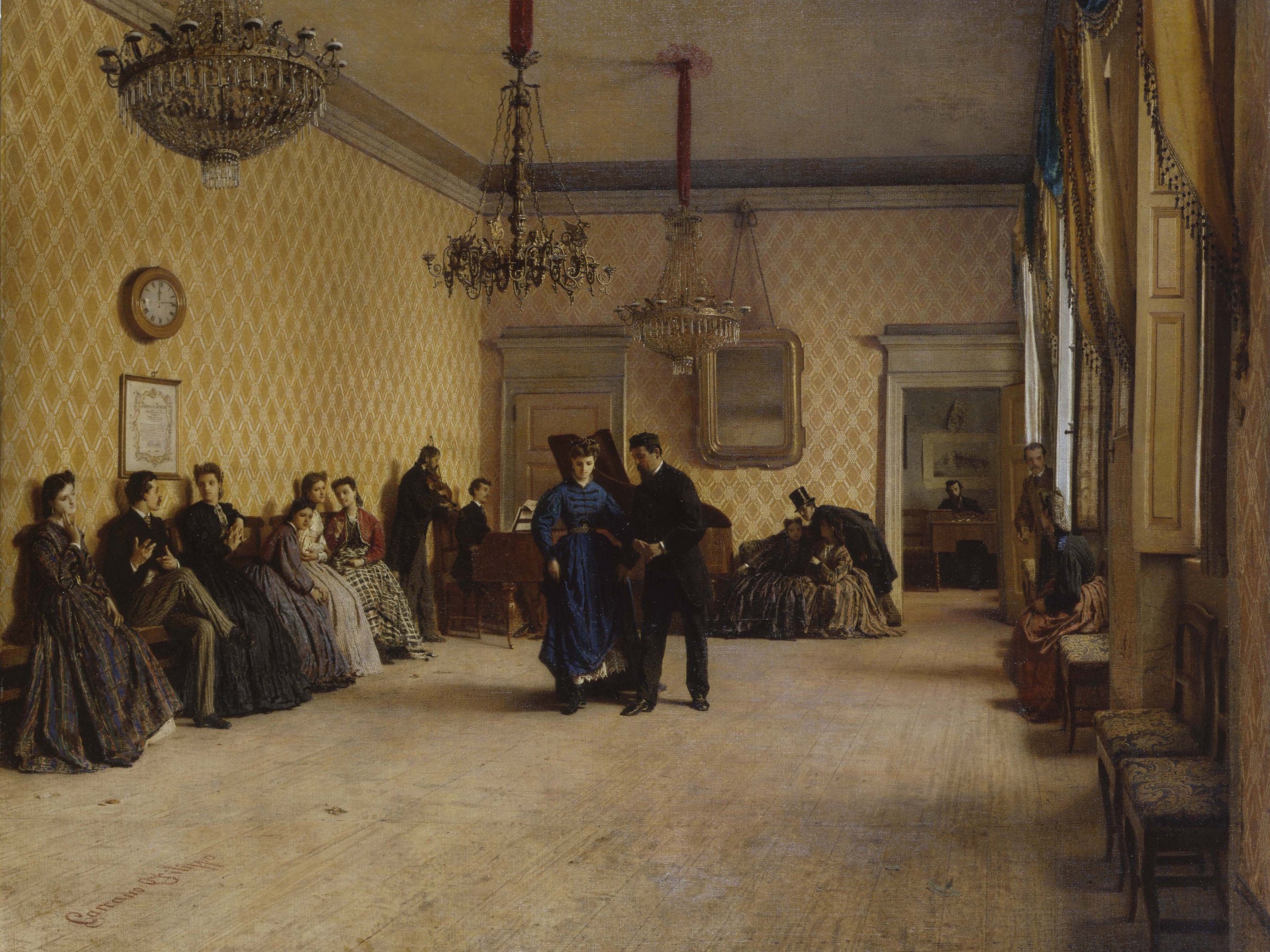
Filippo Carcano - Lezione di ballo
Filippo Carcano
- Medium:
- Oil Painting
- Era:
- Mid 1800s (Polka Era)
- Source:
- Wikimedia Commons
- Rights:
- Public domain — free to use, share and adapt.
- Recorded as:
- Public Domain
This painting is rare documentary evidence of how ballroom dance was actually staged and socialized in the 1860s: as a form of instruction, courtship negotiation, and female spectatorship. It demonstrates that mid-19th-century artists understood ballroom dancing as a subject worthy of serious academic treatment, elevating a social practice to the status of genre painting. For dancers and historians, it confirms that the architecture of the Victorian ballroom—the audience, the formality, the lighting, the separation of participants—was as much a part of dance as the steps themselves.
What you are looking at
A formal ballroom scene painted in warm, muted tones of ochre and gray. The room is expansive and high-ceilinged, lit by two ornate chandeliers and a wall-mounted mirror that reflects the gathering. Around the perimeter, perhaps a dozen women in dark Victorian dress sit in small clusters on chairs, most engaged in conversation. In the center of the floor, a man in black tailcoat escorts a woman in a striking blue silk gown; they stand close, her arm linked through his, positioned as though mid-conversation or about to dance. To the right, another couple stands similarly positioned. The floor is bare wood. The wallpaper is a pale diamond-patterned damask, and a clock hangs on the left wall. The scene captures a moment of social pause—neither a dance in full motion nor a static gathering, but the threshold moment between them.
The dancing
The central couple are close but not in a closed dance hold; their posture is upright and formal, the woman leaning slightly toward the man. Her blue gown, with its fitted bodice and full skirt, dominates the composition. The seated women sit with characteristic Victorian posture—upright, knees together, hands folded or gesturing. No one's feet are visible enough to read footwork. The arrangement is hierarchical: the standing figures in the center command attention, while the seated women form an attentive audience. The overall frame suggests social courtship and the formal protocols of ballroom ritual rather than active choreography.
The dance depicted
This is most likely a ballroom dancing lesson or the preliminary moments of a waltz or quadrille, given the formal dress, the seated audience, the central positioning of the instructing couple, and the date. The 1865 setting and the title *Lezione di ballo* (a lesson in dance) suggest this depicts instruction in European court dance—probably the waltz or a quadrille variant. The woman's blue silk dress is formal enough for a ball, not a rehearsal costume. The pairing of a presumably instructing man with a single woman, surrounded by an audience of other women, is consistent with the social dance culture of Victorian ballrooms where a dancing master might demonstrate proper form. However, no visible choreography—no leg extension, no turn in progress—can be identified from the postures alone.
How it was made
This is an oil painting on canvas, as stated in the record. The technique is academic realism: careful perspective, atmospheric rendering of the room's depth through the receding ceiling and the mirror, subdued color harmony dominated by earth tones punctuated by the woman's dress, and meticulous attention to costume and interior detail. The lighting is soft and even, characteristic of interior academic painting of the mid-19th century. This technique and scale suggest a work created for exhibition or a patron's collection, not a sketch or study—it is a finished statement about Victorian social life.
About this work
Filippo Carcano's *Lezione di ballo* is an academic realist painting that documents the material culture and social choreography of Victorian ballroom dancing around 1865. The work is not primarily about the kinetic excitement of dance but about its social scaffold: the formality of dress, the geometry of the room, the spectatorship of other women, and the careful staging of instruction or courtship. The painting records a moment of profound social significance—a woman standing with a male partner in a public indoor space, watched by her peers—and makes that moment the entire subject. In this, the work exemplifies how 19th-century salon painting understood dance not as movement but as ritual, display, and social possibility.
How to look at it
Look first at the composition: the woman in blue is not shown in mid-motion but in a moment of pause or presentation. Her body is frontal, her dress fully visible, her face turned toward her partner but her posture not yet engaged in a step. This is the language of formal portrait pose applied to a social scene. The surrounding women, seated and attentive, frame her as an object of observation. The room itself—with its symmetrical chandeliers and calm color—acts as a stage set. Carcano has chosen not to show the actual movement of dance but the stillness before or between dances, the moment of social negotiation and aesthetic display. This choice tells us that for academic painters of this period, the interest in ballroom dancing lay in its role as social spectacle, not as kinetic art.
The artist
Filippo Carcano (1840–1914) was an Italian academic painter known for genre scenes and historical subjects. He trained in Milan and became associated with the Scapigliatura (a literary and artistic movement emphasizing realism and social themes). His work often depicted contemporary bourgeois life with careful attention to costume, interior spaces, and social interaction. Carcano was exhibited widely in European salons and his work is held in Italian public collections. *Lezione di ballo* fits his broader practice of documenting 19th-century social customs through painting.
The period
By 1865, the waltz and quadrille had been the dominant ballroom dances across Europe for several decades, though regional variants and newer dances were emerging. The Victorian ballroom was highly codified: dancing was a regulated social activity, often supervised by dancing masters, and segregated by gender in terms of spectatorship and instruction. The 1860s were the height of the Victorian era in Britain and a period of similar bourgeois cultural formation across continental Europe. The formality of dress and the strict spatial divisions in Carcano's painting reflect real social conventions. In art, the representation of contemporary domestic and social life had become a major academic genre, particularly in Italian and French painting. Dance scenes in particular allowed artists to explore themes of femininity, social ritual, courtship, and the display of wealth through costume and interior decoration.
Where it lives
The work is catalogued through Wikimedia Commons, which suggests it is in a public collection, though the specific holding institution is not recorded in the available metadata. The image quality and metadata suggest a digital surrogate of good resolution.
Dance in this work
Questions about this work
Is the woman being taught to dance, or is she dancing with a partner?
The title *Lezione di ballo* (lesson in dance) and the formal, static posture of both figures suggest this is a demonstration or instruction moment rather than active dance. The man's formal dress and central position suggest he may be a dancing master. The surrounding women, seated and observing, reinforce the idea of a lesson or formal demonstration.
What dance is being shown?
The dress, date, and setting all point to either a waltz or quadrille, the two dominant ballroom dances of the 1860s. No footwork or turn is visible, so the specific dance cannot be certain. The formal arrangement and the presence of what appears to be an instructor suggest a quadrille or a waltz lesson rather than a casual social dance.
Why are all the other women seated?
This reflects authentic Victorian ballroom practice. Women did not dance continuously; they sat along the walls between dances or while waiting for partners. Carcano has captured this social reality: the activity of dancing is shown as something performed by a select pair while others watch, wait, and converse. The painting records the spectatorship and social structure of the ballroom, not just the dance itself.
How does this painting compare to other images of Victorian ballrooms?
Carcano's approach is unusually calm and interior-focused. Rather than showing the excitement or motion of dance, he emphasizes the formality, the costume, and the social ritual. The painting is as much about interior design and fashion as it is about dance, which reflects how 19th-century salon painters understood ballroom culture as a whole way of life, not just a form of movement.
More dance artwork