37 works in this view — arrow keys or swipe to move between them.
Dance in Art · 1829
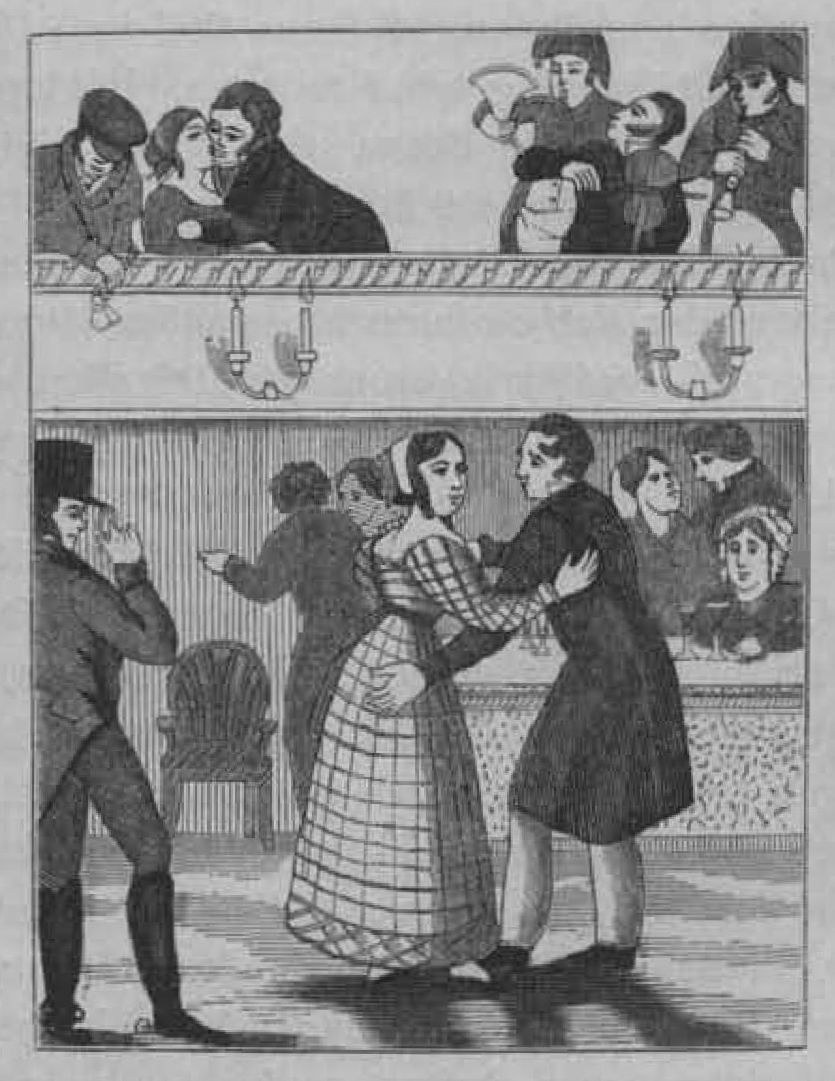
Gamla Stockholm 1882 s75 Fig35
Unknown
- Medium:
- Oil Painting
- Era:
- Early 1800s (Waltz Revolution)
- Source:
- Wikimedia Commons
- Rights:
- Public domain — free to use, share and adapt.
- Recorded as:
- Public Domain
This is primary evidence of how the waltz and popular couple dances were actually performed and experienced in early 19th-century Northern European social life. The image captures the informality, the spectacle, and the participatory joy of dance outside the ballroom or concert hall—documentation that survives for many regions and periods only in literary form or formal manuals. For historians of dance practice, social history, and visual culture, it is an invaluable record of the Waltz Revolution's reach into everyday Swedish life.
What you are looking at
This is a two-register illustration showing a social dance scene in what appears to be an 19th-century Swedish inn or public hall. The upper register depicts five figures crowded at a railing or balcony, observing the scene below; several wear hats and heavy winter coats, and their expressions register engagement or amusement at what unfolds beneath them. The lower register shows a lively floor scene with roughly a dozen figures in varied dress. At center is a woman in a checked or plaid dress with a distinctive white collar or kerchief, her body angled in mid-movement as she dances; she is supported or guided by male figures on either side. To the left stands a man in formal dress—top hat, dark coat, watch chain visible—watching or directing the proceedings. To the right, several other figures in dark coats cluster and observe. The floor is indicated by horizontal hatching; the walls show vertical line work suggesting institutional or public interior space. The engraving technique creates sharp contrasts between figure and ground, with careful attention to the texture of fabric and the individual postures of each onlooker.
The dancing
The central female dancer is the focal point: her body is turned and her weight appears shifted, with one arm extended or held by her partner. The men flanking her maintain contact but their frames are loose and informal, not the closed holds of ballroom partnership. Her movement suggests a turning or pivoting action rather than traveling steps. The observers above and around the dance floor lean and gesture with evident interest, their body language informal and relaxed. No one adopts the rigid posture or turned-out stance of theatrical training; all movement reads as social and improvisational.
The dance depicted
This appears to document a Swedish folk or popular social dance of the early-to-mid 19th century, most likely a variant of the waltz, polka, or local couple dance popular in Stockholm taverns and inns. The Waltz Revolution label on the record is plausible; the couple-dance format, the male-female pairing, the informal partnering, and the public-house setting all align with early waltz culture in Northern Europe. The woman's checked dress and the men's formal day wear suggest working or middle-class participants rather than aristocratic dancers. The image records how such dances were actually performed in social space—with spectators, with loose partnering, and with an evident joy in public movement—rather than how they appear in ballroom manuals.
How it was made
This is a wood engraving or steel engraving, characterized by fine parallel hatching, precise line work, and the tonal range created by varying line density. The technique allowed for mass reproduction and circulation in printed books and periodicals, making it the standard medium for documentary illustration in 19th-century Sweden and Europe. The engraving's sharpness and detail suggest it was created from a drawing or sketch, possibly rendered after observation or from written description, rather than from life. The two-register composition and the clarity of individual figures indicate an artist with skill in narrative engraving who understood how to organize complex social scenes.
About this work
This is a Swedish engraved illustration from the 1882 book *Gamla Stockholm* (Old Stockholm), documenting a moment of social dance in a Stockholm inn near Uggleviken in the early 19th century. It is a snapshot of working- or middle-class leisure culture during the era when the waltz was spreading through European society, captured with the documentary precision of wood or steel engraving. The image is notable not for depicting trained or theatrical dance, but for recording how actual people—spectators and participants alike—experienced dance in public social space: with informality, pleasure, and community.
The work belongs in a dance history collection precisely because it treats dance as a social practice rather than an art form. It shows the waltz not as it appears in ballroom competition or in the stylized poses of romantic ballet, but as it was actually danced and watched in Northern European taverns. The engraving's attention to dress, posture, and social hierarchy among the onlookers also provides evidence about who danced, who watched, and what dance meant in early 19th-century urban Swedish society.
How to look at it
Attend first to the woman's body: the turn of her torso, the position of her arms, the angle of her weight suggest a turning or pivoting step rather than the traveling movement of later ballroom waltz. Notice the informality of the male partners' hold—neither the closed frame of competitive ballroom nor the rigid arm extension of some folk traditions. The composition deliberately includes as many onlookers as dancers, emphasizing that this is a social and communal event, not a performance for distant spectators. The engraver's choice to show both the floor and the observing crowd suggests that the pleasure of the dance involved both participation and spectatorship simultaneously.
The period
The Waltz Revolution of the early 19th century saw the waltz spread from aristocratic and ballroom contexts into popular, public, and working-class dance cultures across Europe. In Sweden, as elsewhere, the waltz appeared in taverns, inns, and public assemblies well before it was codified into the standardized ballroom hold and frame of later dance pedagogy. This engraving dates to the 1882 publication of *Gamla Stockholm*, a retrospective historical account of the city's past, but it illustrates scenes and practices from several decades earlier—a common practice in 19th-century historical illustration. The image thus participates in a broader mid-to-late 19th-century interest in documenting and preserving images of earlier social customs, particularly working-class leisure, before industrialization and modernization altered such practices entirely.
Where it lives
This illustration appears as Figure 35 on page 75 of the 1882 Swedish-language publication *Gamla Stockholm* (Old Stockholm), a historical account of the city's past. It is a wood or steel engraving, intended for mass circulation in a printed book aimed at a Swedish historical or educated audience.
Dance in this work
Questions about this work
Is this a waltz? How can you tell?
The couple-dance format, the male-female pairing, the turning movement of the central woman, and the era label on the record all suggest a waltz or waltz variant. The woman's pivoting action and the informal partnering style are consistent with early waltz practice before the closed Viennese frame became standardized. However, without notation or a written description, we cannot rule out a related couple dance popular in Stockholm at the time.
When was this dance actually happening?
The illustration was published in 1882, but it depicts scenes from earlier in the 19th century—likely the 1820s–1850s, based on the dress and hairstyles shown. The publication is a retrospective historical account, so the artist was illustrating the past, not documenting contemporary dance.
Who danced like this?
The dress, setting, and informal style suggest working- or middle-class Stockholmers—not aristocratic ballroom dancers or trained performers. The checked dress of the central woman and the day wear of the men indicate urban, non-elite dancers. The tavern or inn setting confirms this was popular, public social dance rather than private or elite entertainment.
What is the building?
The record identifies it as an inn near Uggleviken in Stockholm. The interior detailing—the railing, the wall treatment, the lighting fixtures—all suggest a public establishment rather than a private home.
More dance artwork