40 works in this view — arrow keys or swipe to move between them.
Dance in Art · 1552
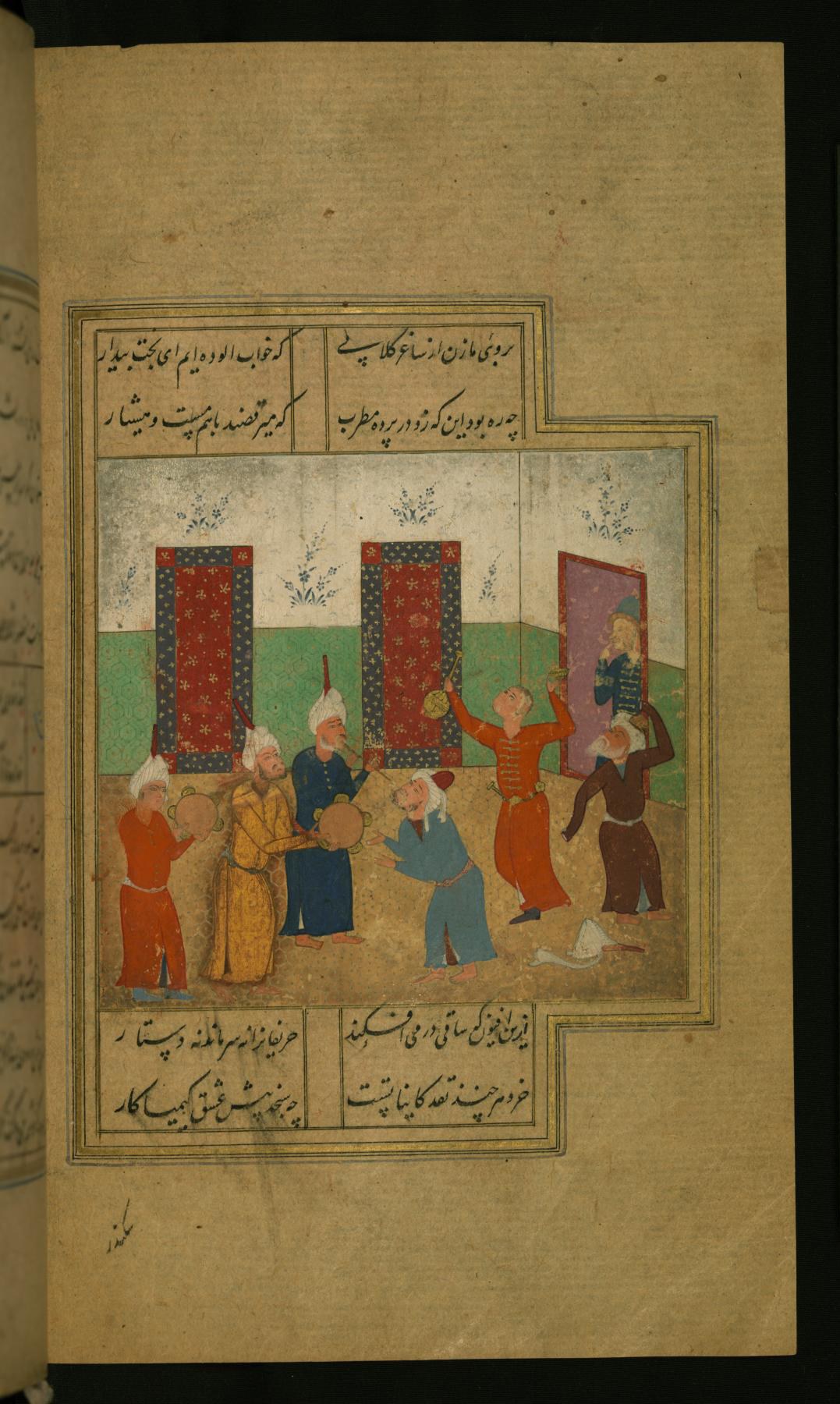
Hafiz - Sufis Dancing - Walters W62995B - Full Page
Hafez
- Medium:
- Oil Painting
- Era:
- Pre-1700 (Renaissance/Baroque)
- Source:
- Wikimedia Commons
- Rights:
- Public domain — free to use, share and adapt.
- Recorded as:
- Public Domain
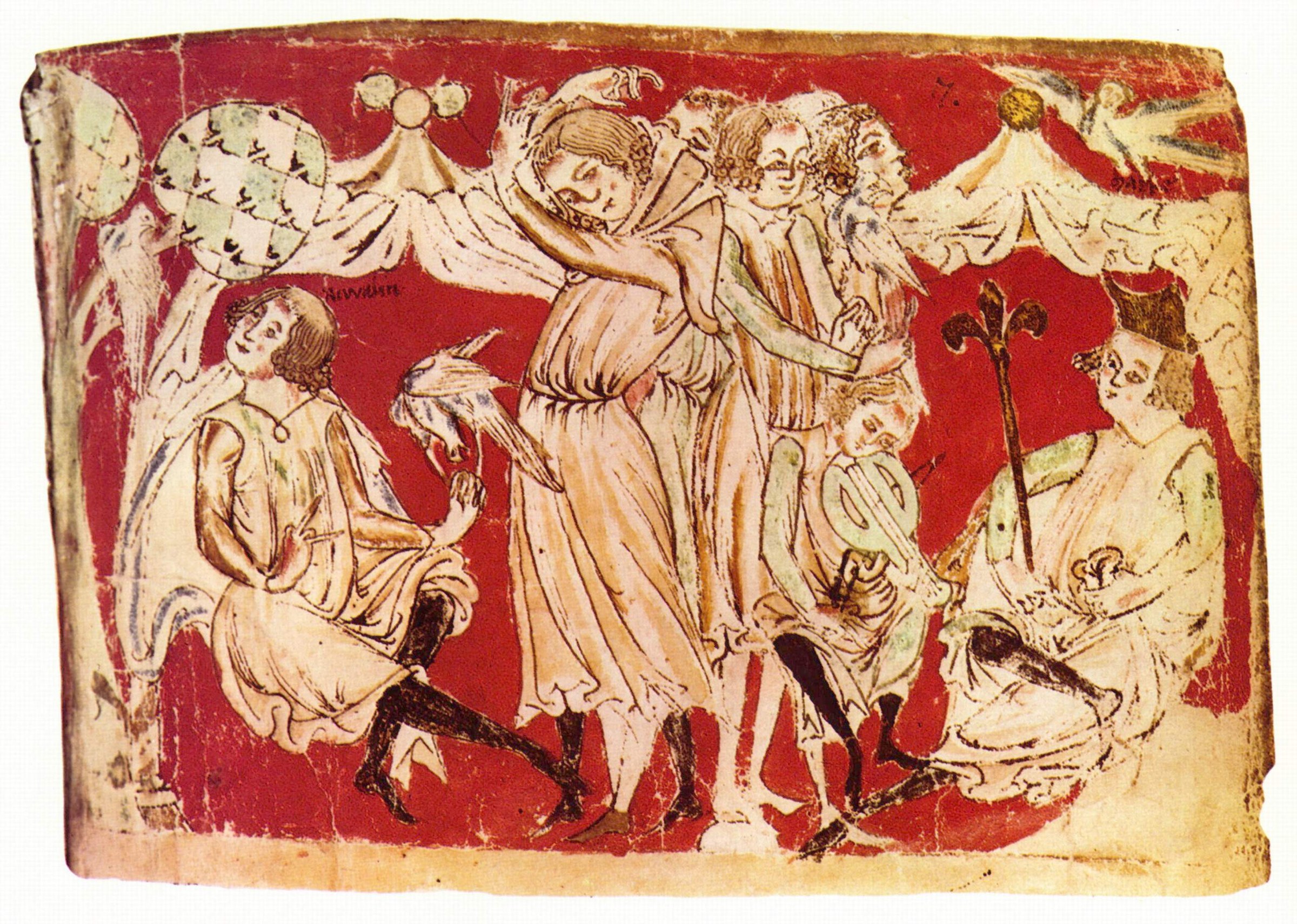
Sufi sama is one of the world's major sacred dance traditions, yet visual documentation of its actual practice from the period is rare. This manuscript folio records the bodily reality of sama—the arm positions, the inclination, the collective gathering—as understood by a 16th-century artist with access to living tradition. For historians of dance and religion, it is primary evidence of how mystical movement was performed and perceived in its own time.
What you are looking at
A manuscript folio illustrates a group of figures in animated movement within an architectural setting. Seven figures occupy the interior space, their bodies arranged in a loose circle or gathering. The setting comprises a pavilion or chamber with deep red and patterned blue columns supporting the structure, set against a pale ground with delicate scattered floral motifs suggesting a garden or courtyard. The figures wear robes and turbans in jewel tones—deep reds, blues, golds, and earth browns—rendered in the characteristic palette of 16th-century Persian manuscript painting. The composition captures a moment of ecstatic movement: several figures have their arms raised or extended, their bodies tilted and twisted, suggesting spinning or swaying motion. The artist has conveyed kinetic energy through the angles of the torsos and the gestures of the hands, some reaching skyward. This is not a formal, ordered gathering but an intimate record of spiritual movement in progress.
The dancing
The dancers display the characteristic posture of Sufi dhikr or sama: bodies inclined at angles away from the vertical, arms lifted or extended in gestures of invocation, heads tilted back or turned. No two figures repeat the same pose. The closest figures to the viewer show open arm positions with palms and hands active in the upper body register; those in the middle distance sway and lean. The distribution is loose and asymmetrical—this is communal movement rather than coordinated line work. The turbans and long robes would restrict certain movements, and the artist has captured the way the heavy fabric moves with the body, not against the gesture.
The dance depicted
This is Sufi sacred dance, most likely the whirling or swaying practice known as sama (literally 'listening'), which is central to Mevlevi and other mystical orders. The image documents a moment of collective ecstatic devotion—the raising of the hands, the inclination of the bodies, the inward focus. Sama is not choreographed in the Western sense; it emerges from devotional states and the instrumental music (not visible here) that accompanies it. The grouping and body language confirm this is sama or a closely related Sufi dhikr practice. The intimacy of the setting suggests a khanqah (dervish lodge) gathering rather than a public performance.
How it was made
This is a painted manuscript folio from the 16th century, executed in opaque watercolor and gold leaf on paper—the standard medium for Persian and Ottoman manuscripts of the period. The artist has worked with flat color fields, minimal modeling, and a high viewpoint that flattens the space while allowing all figures to be read simultaneously. The precision of the framing lines and the careful composition within a bounded rectangle indicate this was a formal commission. The technique allowed for intimate illustration of textual narratives and enabled circulation among educated courtly and scholarly audiences rather than a mass public.
About this work
This folio from a manuscript of Hafez's poetry depicts Sufi dancers engaged in sama, the devotional whirling or swaying practice that represents an encounter with the divine through movement and music. The work is from a 16th-century Persian or Ottoman manuscript tradition in which mystical poetry was illustrated with scenes of spiritual practice. It sits at the intersection of Islamic religious life, courtly manuscript culture, and the embodied knowledge systems of Sufi orders—recording not merely a story about dance but an image of the dance itself as a path to transcendence. The painting preserves evidence of how sacred movement was understood and valued in the early modern Islamic world, at a moment when written and visual culture were intertwined.
How to look at it
Attend to the variety of arm and body positions: no two dancers mirror each other, yet all are engaged in the same spiritual practice. Notice how the artist has rendered the moment not as stillness but as captured movement—the lean of the torsos, the lift of the hands, the sense of bodies in transition. The setting—the geometric columns, the measured space—provides a container for movement that might otherwise seem boundless. The work records not a frozen pose but a living, flowing state of ecstatic prayer.
The artist
The work is attributed to the tradition of Persian manuscript illumination associated with Hafez and the illustrated literary and mystical texts of the 16th century. While the specific artist is unknown, the work reflects the sophisticated conventions of Safavid or Ottoman court workshops, where poetry, painting, and calligraphy were integrated into objects of high refinement. Artists working in this tradition would have been familiar with courtly life and possibly with Sufi communities; the precision and sympathy of the rendering suggests direct knowledge of the subject.
The period
The 16th century saw a flourishing of Persian and Ottoman manuscript culture, particularly in the illustration of poetry and mystical texts. Sufi orders were central to religious and intellectual life across the Islamic world; the Mevlevi order, founded in the 13th century but fully elaborated by this period, made sama a cornerstone of practice. Sacred movement and music were not marginal to Islam but woven into devotional life, and the decision to illustrate sama within a manuscript of Hafez—one of the greatest mystical poets—reflects the integration of poetry, dance, and spirituality in this culture. Visual representation of sacred practice in manuscripts was an accepted and valued form of documentation.
Where it lives
This folio belongs to Walters manuscript W.629, held in the Walters Art Museum. The manuscript is a dated copy of the works of Hafez, the 14th-century Persian poet whose verses were especially prized in the mystical traditions. Folios from such manuscripts typically circulated among educated elites and in libraries of courts and religious institutions.
Dance in this work
Questions about this work
What is sama, and how is it different from other forms of dance?
Sama is the devotional practice of Sufi orders, particularly the Mevlevi, in which movement, music, and poetry converge as a path to spiritual experience. Unlike theatrical or social dance, sama emerges from an interior state and is understood as prayer in motion. The whirling (or in other orders, swaying) is not choreographed step-by-step but flows from the individual's attunement to the music and the divine presence. This folio captures the communal dimension of sama—the gathering of seekers in a shared spiritual practice.
How do we know this is Sufi dance and not another kind of gathering?
Several elements in the image converge to identify this as Sufi sama: the raised arms and hands in postures of invocation, the inclination of the bodies (characteristic of the meditative lean in dhikr), the interior architectural setting (suggesting a khanqah or lodge), the turbans and robes of the figures, and the fact that the work illustrates Hafez, whose poetry is deeply mystical. The artist has rendered not a moment of social greeting but of spiritual transport.
Who would have seen and read this manuscript?
Manuscripts like this were owned and viewed by courtly elites, educated scholars, administrators, and wealthy patrons. They would have been kept in palace libraries, endowed collections, and the libraries of learned men. The manuscript was not a mass-produced text but a luxury object, suggesting that the depiction of Sufi practice had prestige and was valued by the Ottoman or Safavid court that commissioned it.
More dance artwork