26 works in this view — arrow keys or swipe to move between them.
Dance in Art
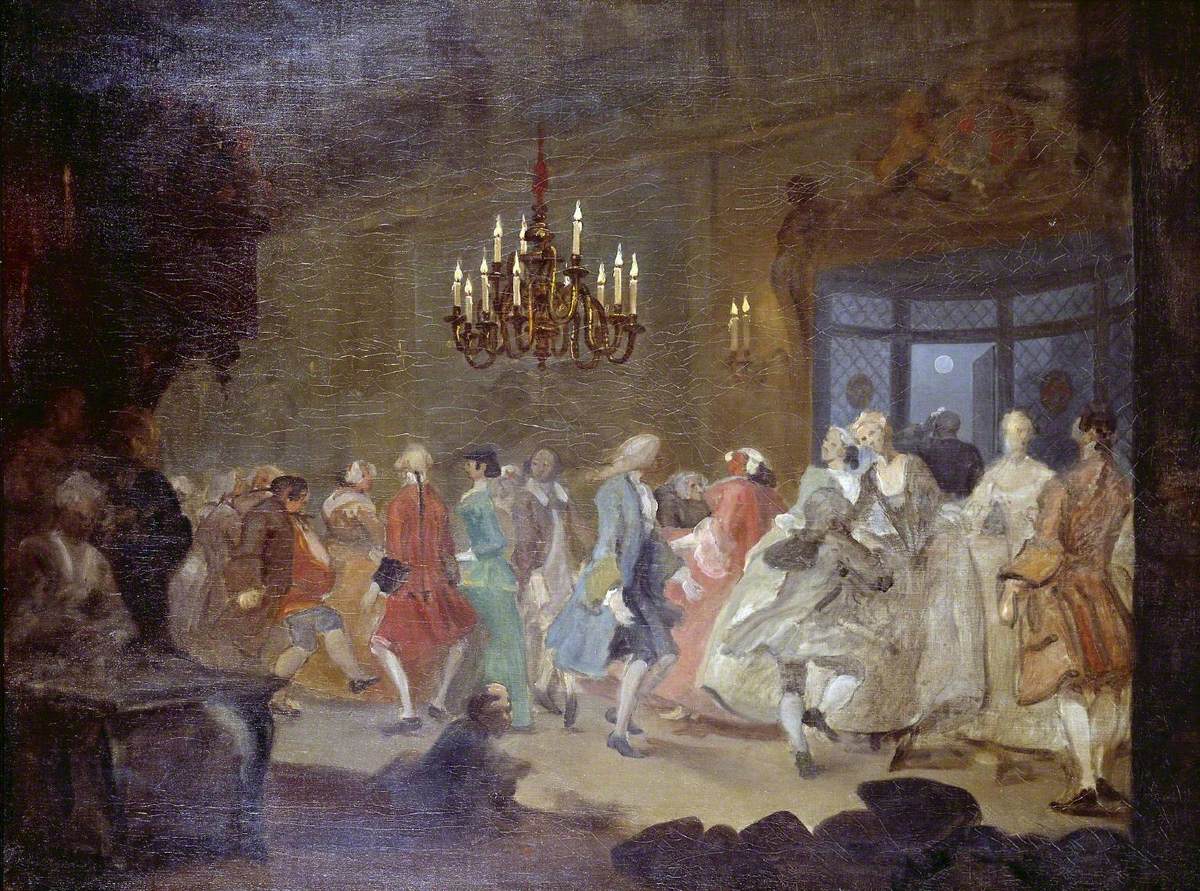
The Country Dance
William Hogarth
- Medium:
- oil on canvas
- Era:
- 1700s (Enlightenment/Minuet Era)
- Source:
- Wikimedia Commons
- Rights:
- Public domain — free to use, share and adapt.
- Recorded as:
- public_domain
This work is a primary historical document of how country dances were actually performed in their social context, rather than as idealized steps in a dance manual. It reveals the artist's acute observation of bodily movement under real constraints—costume, crowding, varying skill, and the performative pressure of a social occasion. For anyone studying the history of social dance, courtship rituals, or 18th-century gender relations, the specific details of posture, proximity, and chaos here offer more honest evidence than formal dance notation or idealized prints.
What you are looking at
A crowded interior ballroom or assembly room lit by a grand chandelier with multiple candles, the light pooling on the floor below and casting the surrounding walls into shadow. The room is packed with figures in 18th-century dress—men in coats and breeches, women in full skirts and low-cut bodices—gathered around a central dance floor where several couples are actively dancing. The composition creates a sense of theatrical spectacle: some dancers move with apparent grace while others are caught in awkward, exaggerated postures. A large window on the right shows moonlight and spectators watching from outside, framing the ball as a public occasion of social importance. The painting's warm, muted palette of ochres, greys, and flesh tones, combined with the shadowy background, suggests both the intimacy of candlelit assembly and the artificiality of the occasion—a moment of social performance where elegance and grotesqueness coexist.
The dancing
The dancers exhibit wildly varied positions and apparent skill levels. Several couples are in closed embraces typical of the period, but their postures range from composed and upright to bent-kneed and flailing. One woman in the foreground right appears mid-stride in a full skirt caught in motion. A man in red coat leans backward dramatically. The crowded arrangement—bodies overlapping, some seated, some standing, some active in the dance—creates visual chaos. No unified line or synchronized movement is visible; instead, individual bodies pursue their own trajectories in the confined space, suggesting either the actual difficulty of dancing in a crowded room or satirical commentary on the dancers' varying competence.
The dance depicted
This is a country dance, a genre of social dancing popular in 18th-century Britain and Continental Europe, where couples or small groups moved through set figures, often in longways or round formations. The painting depicts the kind of ball or assembly that would have been held in country houses or public assembly rooms—the title and setting make this clear. The satire likely turns on the gap between the formalized technique these dances required and the chaotic reality of execution: bodies cramped by the room, by fashion, and by varying levels of training. The dancers' varied positions suggest individuals attempting remembered steps or improvising within the constraints of the occasion, rather than executing the precise geometric patterns these dances were supposed to achieve.
How it was made
The painting is executed in oil on canvas, a medium that allows for the precise rendering of texture, light, and the subtle gradations of flesh and fabric visible here. The artist has used the warm glow of the chandelier as the dominant light source, a compositional choice that both unifies the crowded scene and creates pockets of shadow where detail dissolves. This technique of selective focus and atmospheric light was characteristic of 18th-century conversation pieces and theatrical painting, suggesting the work was created for a viewer at close range—a patron or collector who could appreciate both the narrative satire and the technical accomplishment of rendering so many bodies in varied states of motion.
About this work
This is a satirical representation of an 18th-century country ball, painted in oil on canvas in 1745. The work captures a moment of social dancing that is simultaneously graceful and absurd: fashionable figures attempting the measured steps of country dances in a crowded, candlelit room. The artist has chosen to emphasize the gap between the idealized formality of such occasions and their chaotic reality, filling the canvas with bodies in conflicting states of elegance and awkwardness. The painting belongs in a gallery of dance imagery precisely because it documents not how the dance was supposed to look in theory, but how it actually looked in practice—a record of the social and physical realities of 18th-century ballroom dancing.
How to look at it
Attend first to the chandelier and its light: the painter has used it to create a focal point and to suggest the spectacle of the ball. Then trace the individual dancers and their postures—notice how none of them occupy the same plane of motion or composure. Look at the woman on the right in the pale skirt: her position mid-stride captures the specific awkwardness of dancing in a full skirt. Observe the man in red leaning backward: is he falling, dancing, or flirting? The ambiguity is intentional. Finally, note the window on the right and the faces peering in: the painting frames the ball as a performance for external observers, not just a private moment. This double audience—the dancers for each other, and the scene for the viewer—was typical of 18th-century satirical painting.
The artist
William Hogarth (1697–1764) was an English painter, printmaker, and social satirist renowned for his narrative scenes of contemporary life rendered with moral commentary and sharp observation of human behaviour. His approach combined fine technical skill with a deliberate choice to depict middle and lower-middle-class life, street scenes, and social follies rather than history painting or aristocratic portraiture alone. Hogarth was deeply interested in movement, gesture, and the comedy of bodily behaviour; his sequential narrative paintings and engravings often froze moments of chaos or moral disorder to comic or cautionary effect. His practice was influential in establishing a new category of subject matter—modern social life as worthy of serious artistic attention.
The period
In the 1740s, when this painting was made, the country dance was at its height of popularity across Europe. Dancing was a central form of social bonding and courtship, particularly in the assembly rooms and country houses of Britain. At the same time, there was a growing gap between the idealized presentation of these dances in instruction manuals and prints, and the lived experience of performers constrained by fashion, space, and variable skill. Hogarth's painting belongs to the era of rococo lightness and social comedy, but it also reflects the emerging 18th-century interest in capturing modern life with satirical realism—a movement that would culminate in the novel and in social commentary more broadly.
Where it lives
The work is recorded as oil on canvas, dated 1745, by William Hogarth. No current holding institution is recorded in the available catalogue information; the image comes from Wikimedia Commons.
Dance in this work
Questions about this work
Is this a real ball or an imaginary scene?
It is almost certainly based on the reality of 18th-century assemblies and country-house balls, which Hogarth would have observed firsthand. However, the artist has composed and exaggerated the scene for satirical effect: the chaos and the varied skill levels are emphasized to make a point about the gap between social aspiration and actual competence. It is a representation of a type of event, not a record of a specific occasion.
What dance is being performed?
A country dance, a general category of social dancing popular in 18th-century Britain and Europe. Country dances typically involved couples or groups moving through set figures, often in longways (two facing lines) or round formations. The specific figure cannot be determined from the painting—the crowding and varied postures obscure the geometry that would identify the particular dance.
Why does the painting look so crowded and chaotic?
This is the artist's deliberate choice: Hogarth is satirizing the contrast between the formal elegance that dancing was supposed to represent and the messy reality of bodies, fashion, and space. The crowding emphasizes that real people in real rooms could not always execute the ideal patterns shown in dance manuals. It is also a comment on social ambition and pretence.
What is the historical importance of this image?
It provides rare visual evidence of how 18th-century social dancing actually looked in practice, rather than in idealized form. The specific postures, the constraint of costume, the mix of skill levels, and the architecture of the ballroom all document the real conditions of performance. For historians of dance, fashion, and social life, the painting is a primary source.
More dance artwork