42 works in this view — arrow keys or swipe to move between them.
Dance in Art · 1859
Hans-makart-salzburg-1840-1884-wien-9544313
Hans Makart
- Medium:
- Oil Painting
- Era:
- Mid 1800s (Polka Era)
- Source:
- Wikimedia Commons
- Rights:
- Public domain — free to use, share and adapt.
- Recorded as:
- Public Domain
This work demonstrates how mid-nineteenth-century fine artists used dance as a vehicle for aesthetic and allegorical expression rather than as documentary of social practice. It shows the persistent influence of Renaissance and Baroque precedent on Victorian artistic culture, and reveals how the concept of 'dance' could be elevated from the ballroom or theatre into the realm of mythological and decorative art. For historians of Victorian aestheticism and the ornamental tradition, it illustrates the period's fascination with historical revival and its use of female bodies and flowing drapery as markers of artistic refinement.
What you are looking at
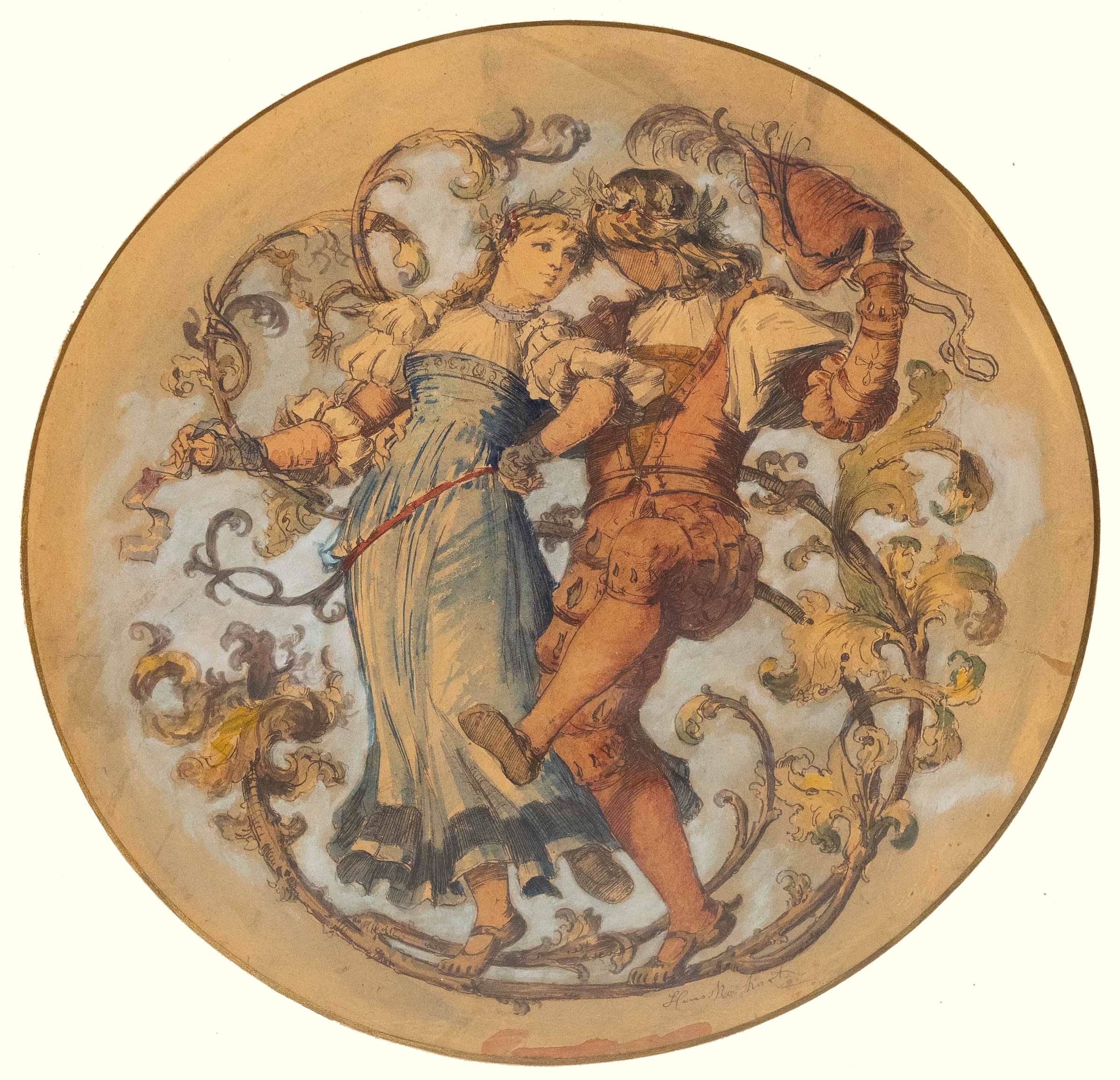
A circular composition (tondo) presents an allegorical pair dancing among elaborate acanthus scrollwork. The female figure, rendered in pale tones with blonde hair, wears flowing drapery in white and blue—a classical gown with transparent folds that billow around her body. Her male partner, painted in warmer ochre and rust tones, appears as a winged putto or genius figure with ruddy complexion and darker curled hair. The two figures occupy the center of the design, their bodies in dynamic relation. The background is filled entirely with ornamental foliate scrollwork in muted browns and golds, creating a dense, almost jeweled surface. The entire scene is contained within a circular border, emphasizing the classical medallion format. The palette is limited and warm—pale yellows, whites, soft blues, browns, and reddish earth tones—giving the work an antiquarian character despite its mid-nineteenth-century date.
The dancing
The pair are arranged in an intimate but asymmetrical embrace. The woman's torso leans slightly away, her arms extended in a gesture that suggests both grace and movement; the putto figure appears to support or guide her, his body turning toward hers in complementary action. Neither figure is rigidly posed—both show weight shift and directional impulse. The woman's drapery catches light and falls in sweeping curves that suggest rapid rotation or forward momentum. The putto's smaller stature and winged form establish him as a supernatural or allegorical partner rather than a human male dancer, which places this outside the ballroom tradition despite its ballroom-era label.
The dance depicted
This appears to be an allegorical representation of dance as a romantic or aesthetic ideal rather than a depiction of a specific social or theatrical dance. The pairing of a classical nymph or muse figure with a winged attendant suggests a Renaissance or Baroque allegorical tradition rather than contemporary ballroom practice. The composition and subject matter are consistent with mid-nineteenth-century Romantic aesthetics, in which historical and mythological subjects were used to elevate contemporary artistic practice. The woman's classical dress and the work's ornamental, medallion-like format suggest the artist drew on old master sources—particularly sixteenth-century decorative panels and Renaissance tondo compositions—rather than observing live dancers. No identifiable ballroom technique is evident.
How it was made
The catalogue record identifies this as watercolor on tinted paper in a passepartout mount, approximately 41 cm diameter. The limited palette and soft tonal transitions are consistent with watercolor practice of the period. The technique allowed Makart to work with transparency and layered washes while maintaining the linear precision required for ornamental detail—the scrollwork demonstrates fine penwork in brown or sepia ink beneath the watercolor. The circular format and oval mount suggest this was made as a finished work for display rather than as a sketch, and the level of finish indicates it was intended for an educated art collector rather than as a stage design or illustration.
About this work
This is a watercolor tondo by Hans Makart depicting an allegorical dance between a classical female figure and a winged putto amid elaborate ornamental scrollwork. The work combines Makart's characteristic ornamentalism with a Romantic taste for historical subject matter and elevated allegorical content. Rather than depicting contemporary ballroom practice, it represents a mid-nineteenth-century artist's imaginative reconstruction of Renaissance decorative tradition—both in its formal language (the tondo, the scrollwork borders) and in its subject (the pairing of a nymph with a supernatural attendant). The work sits at the intersection of fine art and decorative arts, treating dance as an allegorical theme suitable for high aesthetic treatment.
How to look at it
The viewer should trace the movement through the pair's bodies first: notice how the woman's torso and flowing drapery suggest rotation or forward momentum, and how the putto's wings and posture suggest he is both supporting and attending her. Then attend to the ornamental frame—the scrollwork is not merely decorative but creates a rhythmic, almost dizzying visual field that echoes the swirling movement of the figures. The work rewards close looking at the transparency and delicacy of the watercolor technique, particularly in the rendering of drapery folds. Finally, observe how the classical references (the nymph, the winged attendant, the medallion format) work together to frame dance as an ideal aesthetic and moral concept rather than as a social practice.
The artist
Hans Makart (1840–1884) was an Austrian academic painter and decorative artist celebrated for his large-scale historical and allegorical compositions. Based in Vienna, he was one of the most fashionable painters of his era, known for his rich color, dramatic poses, and ornamental sensibility. His work bridged fine art and decorative design; he created monumental historical canvases as well as designs for applied arts. Makart's aesthetic—emphasizing color, movement, and ornamental abundance—was influential in the Austro-Hungarian artistic community and beyond. This smaller watercolor on paper suggests the kind of finished study or independent work that established his reputation, even though his largest and most famous works were executed in oil on canvas.
The period
In the 1850s–1870s, European academic painting was dominated by historical, allegorical, and literary subjects. The ballroom waltz and polka were at their height as popular social dances, yet fine artists rarely depicted them directly; instead, dance appeared most often in allegorical, mythological, or Romantic contexts. Makart's early work coincided with the height of Victorian medievalism and Renaissance revivalism in the visual arts. The ornamental aesthetics visible here—the acanthus scrollwork, the classical drapery, the tondo format—were part of a broader mid-century taste for historical decoration that would eventually contribute to the Aesthetic Movement and Art Nouveau. The separation between ballroom practice and high allegorical art was marked: one was social and contemporary, the other was timeless and elevated.
Where it lives
The work is recorded in Wikimedia Commons. The catalogue record provides minimal information on current holding or provenance. The passepartout mount and finished watercolor support suggest this was a collectors' item rather than a preparatory work, but the location of the original is not recorded.
Dance in this work
Questions about this work
Is this depicting a real ballroom dance?
No. While the catalogue record labels it 'Victorian Ballroom,' the image shows an allegorical scene with a mythological putto rather than two human dancers in contemporary dress. The classical gown and ornamental setting place it in the Romantic allegorical tradition rather than in ballroom documentation. The artist drew on historical precedent—Renaissance tondi and ornamental decoration—rather than observing social dancers.
Why did nineteenth-century artists paint dance this way?
Dance offered allegory—a way to represent grace, movement, freedom, and the beauty of the female form without depicting explicit narrative or contemporary social life. By clothing it in classical or mythological dress and setting, artists could elevate it to the status of fine art. The ornamental context here signals that this is about aesthetic beauty and historical cultivation rather than social entertainment.
What is the winged figure?
Most likely a putto or genius—a cupid or attendant spirit derived from Renaissance and Baroque art. The wings mark him as supernatural or allegorical. His small stature and association with the female figure suggest he represents love, desire, or the spirit of the dance itself rather than a human partner.
Why is the work circular?
The tondo (circular format) was a favored shape in Renaissance and Baroque art, particularly for allegorical and decorative subjects. Makart's use of it here signals his engagement with historical precedent and his positioning of this work within a tradition of fine art decoration. The circle also creates an enclosed, almost jeweled world separate from everyday experience.
More dance artwork