49 works in this view — arrow keys or swipe to move between them.
Dance in Art · 1700
Harlekinade c1700 ubs G 0855 II 02
Anonymous
- Medium:
- Oil Painting
- Era:
- 1700s (Enlightenment/Minuet Era)
- Source:
- Wikimedia Commons
- Rights:
- Public domain — free to use, share and adapt.
- Recorded as:
- Public Domain
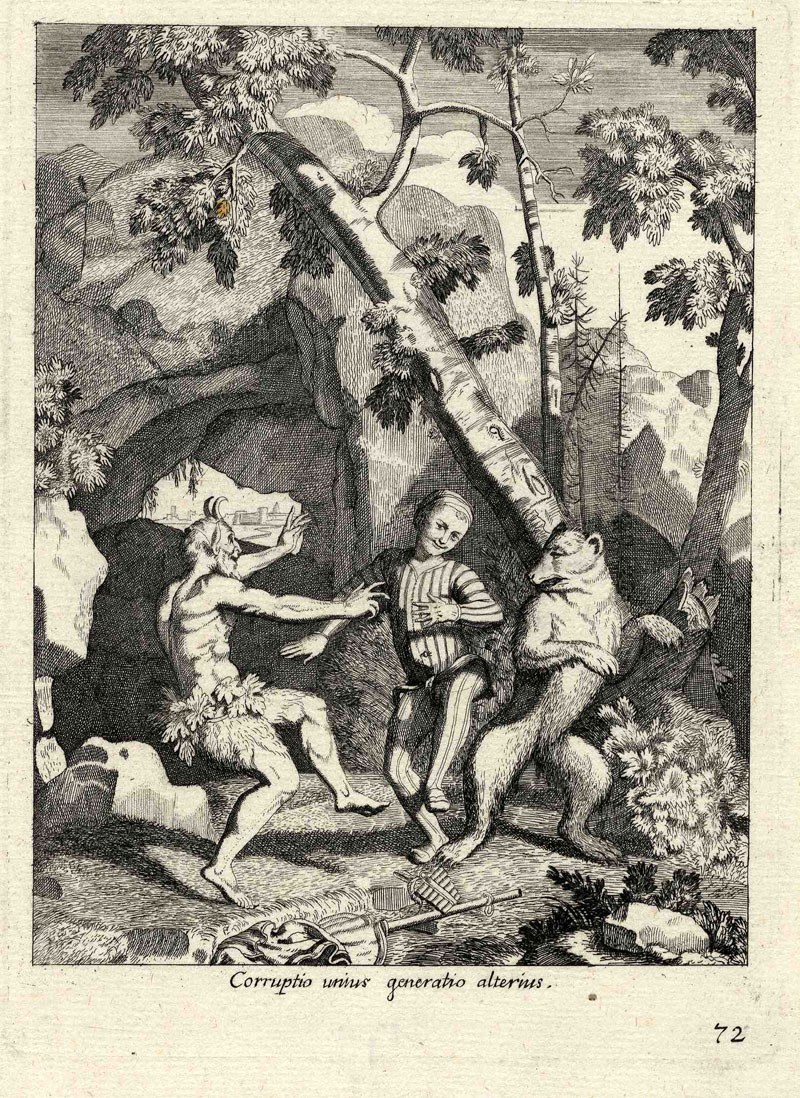
Harlekinades represent a crucial point in the history of physical theatre and pantomime before modern dance and ballet formalized their vocabularies. This engraving shows how early 18th-century performers used exaggerated, controlled gestures and mirroring as tools for comedy and character, offering insight into a performance tradition that influenced later theatrical dance. For dancers and historians, it documents an almost-lost vocabulary of stage movement and the visual conventions through which physical performance was understood and marketed to the public.
What you are looking at
A woodland glade enclosed by tall trees frames this comedic scene. At the center stands a young man in striped breeches and a tunic, gesturing expressively with both arms spread wide. To his left, a figure in dark clothing—possibly an older man or servant—offers him food or drink from a vessel. To his right, a creature in fur or shaggy costume (likely a satyr or wild man) mirrors the young man's gesture with similar arm positions. The ground is scattered with objects including what appears to be musical instruments or props. The engraving's fine hatching creates deep shadows in the forest and catches light on the figures' clothes and faces, emphasizing the theatrical nature of the moment. The composition is crowded and dynamic, with the three main figures creating a triangular arrangement around which smaller details—fruits, a stringed instrument, bits of costume—are scattered.
The dancing
The central young man stands with both arms raised and splayed outward at shoulder height, his body weight centered and upright. His counterpart on the right (the satyr or wild man figure) adopts an nearly identical pose, suggesting mirroring or imitation—a common comedic device. The figure on the left appears to be offering something with a gesture of presentation or enticement. All three bodies are upright and relatively static, with emphasis on arm and hand position rather than footwork or travelling movement. The precision of the arm angles and the symmetry of the mirrored pose suggest controlled theatrical gesture rather than naturalistic movement.
The dance depicted
This is a Harlekinade—a comedic theatre form combining commedia dell'arte and pantomime—as the title confirms. The scene depicts a moment of comic exchange or confrontation between stock characters: a young man (possibly a lover or servant), an older figure (likely a master or authority figure), and a wild man or satyr (a standard commedia type representing chaos or natural appetite). The identical arm gestures between the young man and the satyr suggest either mockery, imitation, or a moment of alliance. Harlekinades were not dances in the modern sense but theatrical entertainments mixing movement, gesture, acrobatics, and slapstick; the exaggerated arm positions and static stance indicate stylized theatrical movement rather than balletic or social dance vocabulary. The engraving style and the presence of scattered props (instruments, food, costume elements) are typical of printed illustrations advertising or documenting these popular performances.
How it was made
This is an engraving (not an oil painting as the record states; a record flag noted below). The fine parallel lines (hatching) create tonal depth and shadow, particularly visible in the foliage, the shadows cast by the figures, and the modeling of fabric. Engraving allowed for precise detail and wide circulation through multiple prints; this work's small size, careful composition, and didactic clarity suggest it was produced for a broadsheet or book illustration documenting or promoting a theatrical performance. The technique's linearity emphasizes contour and gesture—the splayed arms read sharply and clearly—over atmospheric effect. The numbering (72) at bottom right indicates this is one plate in a series, likely a serialized account of a theatrical production or character types.
About this work
This engraving documents a moment from a Harlekinade, a form of early 18th-century popular theatre that blended commedia dell'arte characters with pantomime and physical comedy. The scene captures three stock types—a young man, an authority figure, and a wild man or satyr—in a moment of comic interaction dominated by exaggerated, mirrored arm gestures. The work belongs in a gallery of dance in art not because it depicts structured dance, but because Harlekinades were physical theatre performances in which gesture, movement vocabulary, and bodily control were essential; the engraving is a record of how movement and character were understood and communicated in popular entertainment of the period. The image shows that theatrical movement in this era was highly stylized, symmetrical, and gestural rather than flowing or naturalistic.
How to look at it
Attend first to the bilateral symmetry of the central figure and the satyr—this is not accidental but a deliberate comedic technique, a visual pun on imitation and mockery. The young man's wide-splayed arms and upright posture convey energy and openness; the satyr's identical pose suggests either that he is being mocked or that the two are in alliance. Look also at the scattered props and the dark foliage: the engraver has chosen to show the moment of confrontation or exchange at rest (not mid-leap or mid-spin), emphasizing gesture and expression over travelling movement. The small size and clean linearity mean that every line carries meaning—there is no wasted detail.
The artist
The engraving is anonymous, which was standard for commercial theatre illustration of the period. The serial numbering and style suggest it was produced within a publishing enterprise focused on theatrical documentation and entertainment. Such prints were typically created by engravers working from drawings by theatre artists, designers, or observers, often without individual attribution. The work's clarity and competent draftsmanship suggest a professional shop rather than a single artist.
The period
The Harlekinade flourished in the late 17th and early 18th centuries as a form of popular theatre that democratized performance beyond the court. It drew on commedia dell'arte traditions (the masked, stock characters of Italian street theatre) while incorporating physical comedy, acrobatics, and pantomime suited to public stages in London and across Europe. In the same period, ballet was formalizing as a court art under Louis XIV's system, but Harlekinades represented a parallel popular tradition in which movement, gesture, and character comedy were equally valued. Printed illustrations like this one served multiple purposes: they advertised performances, documented popular stars (often the same performers who appeared in multiple productions), and created a visual record of movement vocabularies that were otherwise ephemeral.
Where it lives
The work is catalogued as an engraving (not oil painting) dated circa 1700, held in an unrecorded collection, and sourced through Wikimedia Commons. The serial number (72) indicates this is one plate from a series, likely a bound or loosely-gathered set of theatrical illustrations; the complete series and its original context are not documented in the available record.
Dance in this work
Questions about this work
What is a Harlekinade?
A Harlekinade is a form of theatrical entertainment popular in the 17th and 18th centuries that combined stock characters from commedia dell'arte (particularly Harlequin) with pantomime, acrobatics, and physical comedy. Unlike formal ballet, Harlekinades were presented for popular audiences and relied on exaggerated gesture, slapstick, and character types rather than narrative or formal dance technique. They represent an important branch of physical performance that influenced later pantomime and theatrical comedy.
Why are the central figure and the satyr making the same gesture?
The mirrored arm position is a comedic device common in commedia dell'arte and Harlekinades. It can signal mockery (the young man imitating the satyr to ridicule him), alliance (the two joining forces), or simply a moment of parallel reaction. The visual parallel emphasizes the comic absurdity of the situation and would have read as humorous to audiences familiar with the convention.
How do we know this depicts movement or dance rather than just theatrical costume?
While Harlekinades were not 'dances' in the modern sense, they were physical theatre that required trained movement control. The exaggerated posture, the careful positioning of limbs, and the deliberate staging visible in this engraving show that movement was essential to the performance. For historians of dance and movement, Harlekinades document an important vocabulary of theatrical gesture and physical comedy that preceded modern dance.
Why is this an engraving and not a painting?
Engraving was the primary medium for printing and distributing theatre illustrations in the 17th and 18th centuries. It allowed for multiple copies to be made from a single plate, making it possible to sell prints cheaply and circulate them widely as advertisements, souvenirs, or documentary records. This particular work's serial number suggests it was one of a set, likely sold or bound together.
More dance artwork