33 works in this view — arrow keys or swipe to move between them.
Dance in Art · 1929
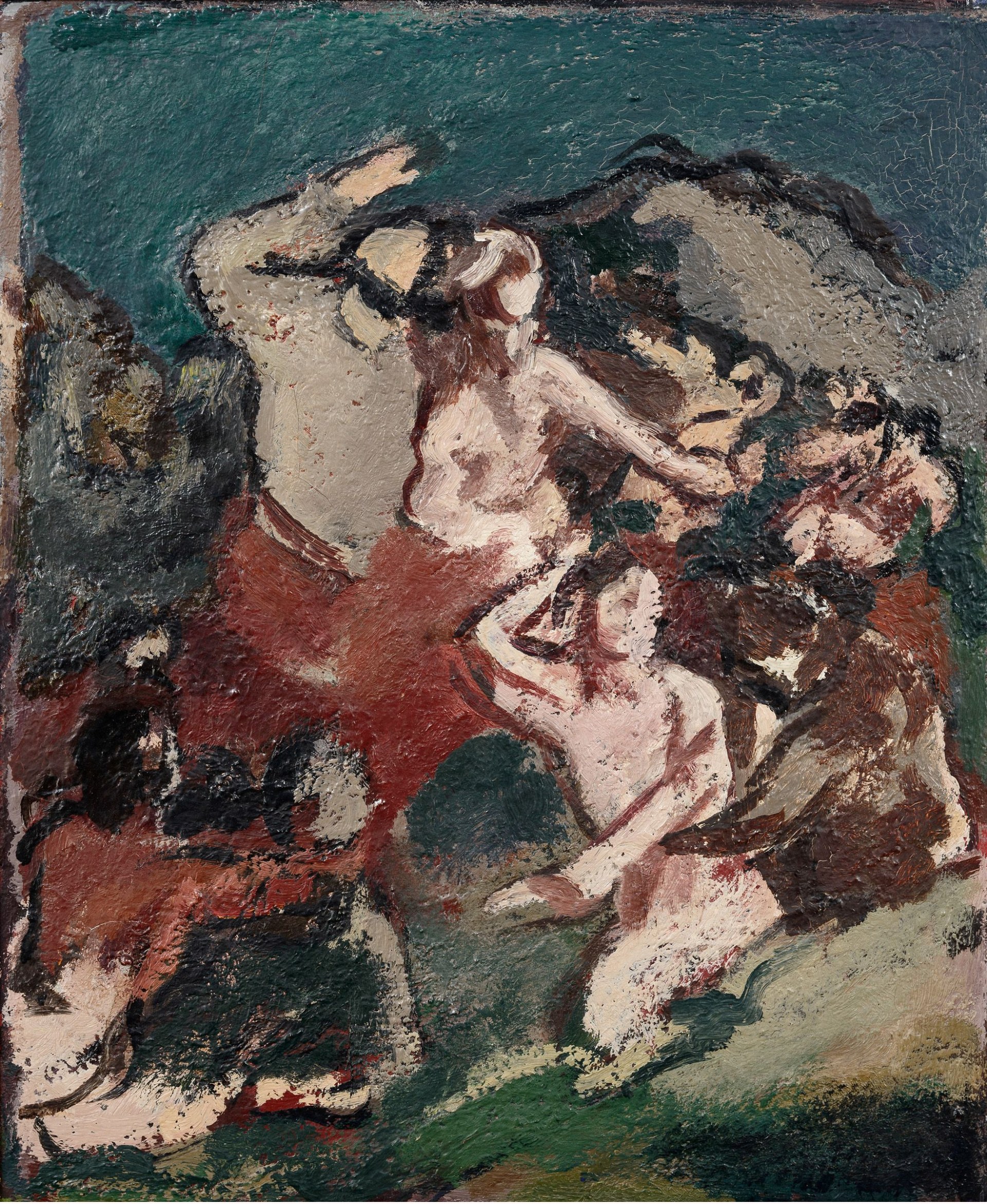
Heinrich Altherr Ekstatischer Tanz 1929
Heinrich Altherr
- Medium:
- Oil Painting
- Era:
- 1920-1950 (Swing Era)
- Source:
- Wikimedia Commons
- Rights:
- Public domain — free to use, share and adapt.
- Recorded as:
- Public Domain
This work captures the philosophy of German Expressionist dance at the moment of its greatest cultural influence. Ausdruckstanz rejected narrative and technique in favour of authentic emotional expression, and Altherr's painting visualises that ideology through formal means. For historians of modernist dance and visual culture, the work documents the interdependence of dance and visual art in 1920s Germany.
What you are looking at
A densely composed oil painting depicting a group of figures in ecstatic, swirling motion. The composition is tightly framed and energetic, with overlapping bodies rendered in pale flesh tones and warm browns set against a dark teal-green background that dominates the upper half of the canvas. At least three or four figures are visible, their forms interpenetrating and their limbs raised in expressive gestures. The nearest figure, seen from behind, has reddish-brown hair and extends arms upward and outward in an attitude of abandon. To the right, another figure in profile appears to pitch forward or backward, mouth open. A third figure lower in the composition leans or writhes, the musculature and movement suggested through vigorous brushwork. The lower portion of the canvas shifts to muted greens and ochres, suggesting ground or drapery. The paint handling is loose and gestural, with heavy impasto in the flesh areas and broad strokes defining the background. There is no defined setting—the focus is entirely on the bodies in motion.
The dancing
The bodies are arranged in a near-tangle of intertwined limbs, with no formal hold or partnering structure. Heads are thrown back or turned in profile, mouths open as if singing or crying out. Arms are flung upward, outward, and across the body in attitudes of release rather than control. The weight appears unstable—bodies lean, twist, and curve as though caught in a moment of intense physical and emotional expression. There is no evidence of footwork or grounding; the focus is on the torso, head, and upper body gesture. The painting suggests multiple bodies (at least three or four) moving together but not in unison or any recognisable partner configuration.
The dance depicted
This work depicts ecstatic or expressionist dance—likely of the modernist choreographic tradition emerging in the 1920s. The title *Ekstatischer Tanz* (Ecstatic Dance) and the date of 1929 align with the Ausdruckstanz (German Expressionist Dance) movement, which rejected the rigid formalism of classical ballet in favour of uninhibited bodily expression rooted in emotion and spiritual release. The painting does not depict any specific historical dance style—ballroom, folk, or classical—but rather captures the aesthetic and philosophy of modernist dance-making. The bodies move from inner compulsion rather than external form, a hallmark of the expressionist approach. This is closer to the work of dancers like Mary Wigman than to any codified technique.
How it was made
The work is oil on canvas, mounted on hardboard (Hartfaserplatte), a support common in German art of the interwar period. The painting employs vigorous, expressive brushwork typical of German Expressionism, with thick impasto in the flesh tones and looser, broader strokes in the background. The technique emphasises emotional intensity over descriptive detail; form is suggested through colour, light, and gestural mark-making rather than precise anatomical rendering. This approach was suited to the avant-garde galleries and exhibitions of Weimar Germany and the early Nazi era, where such work would have circulated among modernist audiences.
About this work
This is a German Expressionist painting from 1929 that captures a moment of ecstatic group dance through the vocabulary of modernist abstraction. Rather than depicting a recognisable dance form, Altherr freezes the aesthetic and emotional register of Ausdruckstanz—the expressionist dance movement that rejected classical ballet in favour of raw, uninhibited physical expression. The work belongs in a dance gallery because it documents not the steps or positions of a dance but the philosophy and bodily experience of modernist choreography at a pivotal moment in its history. The painting is a record of how the avant-garde understood the body in motion during the late Weimar period.
How to look at it
Observe the moment of bodily intensity the artist has chosen: not a step or sequence, but a peak moment of emotional and physical release. The composition is deliberately chaotic and crowded, with bodies overlapping and interpenetrating rather than arranged in a clear spatial or temporal sequence. This reflects the expressionist aesthetic of *Gefühl* (feeling) over *Form* (form). Notice how the artist uses colour—the pale, almost ghostly flesh against the dark teal background—to emphasise the luminous, almost spiritual quality of the body in movement. The loose brushwork conveys spontaneity and emotional urgency, key values of the expressionist dance philosophy.
The artist
Heinrich Altherr (1878–1952) was a German painter active in expressionist circles during the Weimar period. He worked primarily in oil and was engaged with the avant-garde movements of his time, including expressionism and abstraction. His practice emphasised emotional and psychological content over representational fidelity. Altherr's interest in dance as a subject reflects the broader expressionist fascination with the body as a vehicle for authentic feeling and spiritual truth. The signature and date on the verso indicate a methodical studio practice.
The period
By 1929, German Expressionist Dance (Ausdruckstanz) was at the height of its influence. Pioneers like Mary Wigman and Harald Kreutzberg had established a new paradigm of modern dance rooted in emotional authenticity and rejection of classical technique. In visual art, German Expressionism—with its emphasis on distortion, emotional intensity, and subjective truth—had found a natural alliance with these dancers and choreographers. The painting dates to the final years of the Weimar Republic, a period of extraordinary cultural ferment but also rising political instability. The interwar modernist investment in the expressive body would soon be corrupted by Nazi ideology, which appropriated dance and visual art for propaganda purposes.
Where it lives
The work is recorded in the Sammlung Manfred Erb (Manfred Erb Collection), a private collection in Germany. It is dated and signed on the verso in pencil. The work is sourced here from Wikimedia Commons.
Dance in this work
Questions about this work
Is this a real dance, or is the artist making it up?
The painting depicts ecstatic or expressionist dance (*Ausdruckstanz*), a real modernist movement pioneered in Germany in the 1910s–1920s. However, Altherr is not documenting a specific choreography or step vocabulary. Instead, he is capturing the *philosophy* of expressionist dance—the rejection of classical form in favour of authentic emotional expression through the body. The dance is real; the specific movements are imaginative.
Why does the painting look so messy and distorted?
This is German Expressionism, an avant-garde style that prioritised emotional truth over visual clarity. Distortion, rough brushwork, and chaotic composition were deliberate choices meant to convey inner feeling. In the context of dance, this visual language aligned perfectly with expressionist choreography, which also rejected the neat lines and geometries of classical ballet in favour of raw, uninhibited gesture.
Who was dancing expressionist dance in 1929?
Pioneers like Mary Wigman (Germany) and Harald Kreutzberg were the most famous. Both rejected classical ballet training and developed movement vocabularies based on emotional and spiritual authenticity. Wigman's school in Dresden was internationally influential. By 1929, expressionist dance had become a major avant-garde movement, especially in Germany, though the Nazi regime would eventually suppress it as 'degenerate.'
More dance artwork