41 works in this view — arrow keys or swipe to move between them.
Dance in Art · 1693
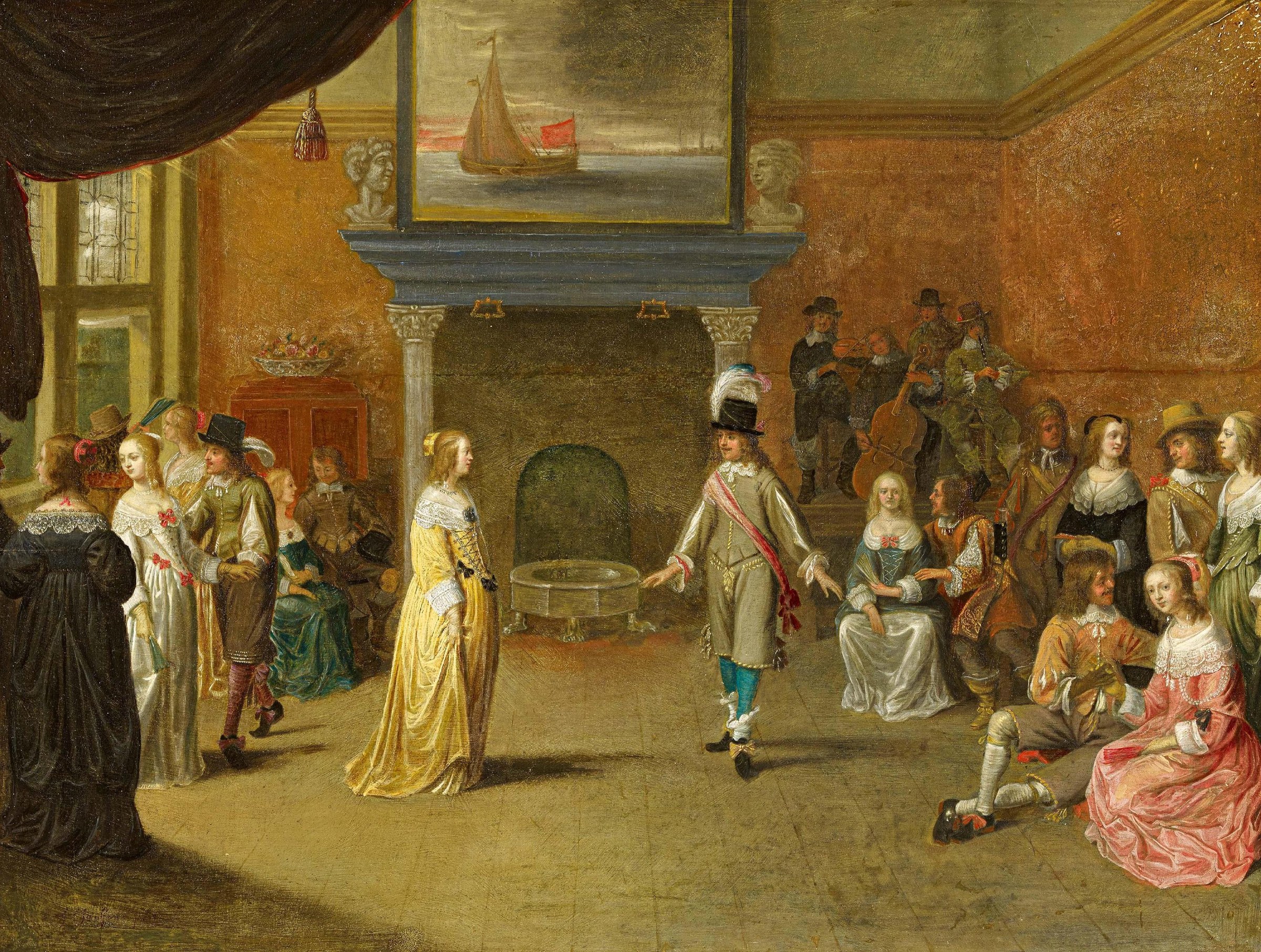
Hieronymus Janssens Festliche Tanzgesellschaft
Hieronymus Janssens
- Medium:
- Ink
- Era:
- Pre-1700 (Renaissance/Baroque)
- Source:
- Wikimedia Commons
- Rights:
- Public domain — free to use, share and adapt.
- Recorded as:
- Public Domain
For historians of dance, this painting is invaluable evidence of how courtly dances were actually performed—the frame, the spacing, the relationship between dancers and observers, the integration of dance into social ritual. It shows that Baroque court dancing was not the stiff formality later movements made it seem, but a fluid, conversational art embedded in courtship and social bonding. Janssens's work is one of the few visual records we have of the context in which minuets and bourées were danced.
What you are looking at
A formal court assembly fills an ochre-walled palace interior, its architectural grandeur emphasized by Corinthian columns flanking a dark fireplace and a seascape painting hung above. Roughly thirty figures in rich silk costumes—yellows, crimsons, blues, greens—are arranged across the space in no rigid formation. At center, a couple dominates the floor: a man in pale green coat with blue stockings and a feathered hat stands opposite a woman in golden silk, their bodies angled toward each other. Around them, other elegantly dressed figures stand in small clusters, some watching intently, others in conversation. The lighting is warm and diffuse, suggesting candlelit evening. A heavy draped curtain hangs at the left margin. Children sit on the floor in the lower right, observing. The overall mood is of an aristocratic gathering at leisure, the dance neither frantic nor formal, but intimate within its ceremonial setting.
The dancing
The central couple show no closed ballroom hold; instead they face each other at conversational distance, their postures upright and elongated in the manner of court deportment. The man's arm extends toward the woman in a gesture of address or invitation; her body is poised but not yet committed to motion. Around them, other figures maintain the erect frame and small, controlled steps typical of early 18th-century court dancing—no large traveling steps, no passionate lean. The assembly forms an audience as much as a company of dancers, with the floor acting as a stage visible to all.
The dance depicted
This depicts a social dance of the Baroque or early Rococo court, most likely a minuet or related courtly dance form such as a bourrée or courante. The setting, dress, and decorum point to the aristocratic salons of the Spanish or Flemish court in the late 17th or early 18th century. The dance is shown not as virtuosic spectacle but as an everyday social grace—a means of courtship, conversation, and the display of rank and refinement. The presence of an audience seated and standing, and the unhurried spacing of the figures, suggest that social dancing of this period was as much about witnessing and being witnessed as about motion itself.
How it was made
The catalogue record identifies this as oil on wood panel (63 × 84 cm), a format and medium favored for Flemish and Dutch cabinet paintings of the period. The tight composition and jewel-like color palette—the luminous yellows and reds set against the warm ochre walls—are characteristic of panel painting rather than canvas. The technique allows for precise rendering of fabric textures and the play of light on silk, crucial for conveying the luxury and status of the scene. The small, portable format suggests this was made for a wealthy private collector, not for public display.
About this work
This is a glimpse of Baroque court society at play, painted with the meticulous realism and warm palette of Flemish studio practice. Hieronymus Janssens was a specialist in such scenes—aristocratic interiors alive with music, conversation, and the restrained choreography of courtship. The work records not a moment of dance virtuosity but the everyday performance of rank and grace that made up court life. It belongs in a gallery of dance art because it shows how dance functioned in its original context: not as entertainment or display, but as the language of civility itself.
How to look at it
Watch the central couple: notice how little distance separates them, and how the man's gesture invites rather than commands. The artist has frozen the moment just before or just after a step—not mid-leap, but in the poised, conversational stance that governed courtly dance. Observe too the geometry of the room: the figures are arranged so that the dance unfolds as much for the benefit of the watching figures as for the dancers themselves. This is not a moment of abandonment, but of controlled and witnessed grace.
The artist
Hieronymus Janssens (c. 1624–1693) was a Flemish painter based in Antwerp, known for his precise and richly colored scenes of aristocratic life—balls, garden parties, musical gatherings, and theatrical performances. He was part of a tradition of Flemish court painters who documented the leisure activities of the Spanish Habsburgs and the wealthy bourgeoisie. His work combines the realism of Flemish portraiture with the warm, golden tonality of Baroque interiors, creating scenes that are both documentary and deeply theatrical.
The period
In the late 17th century, the minuet and related courtly dances were the dominant social dances of the European aristocracy, spreading from the French court under Louis XIV outward through diplomatic and cultural channels. These dances were not spontaneous but codified—each step and gesture governed by manuals and dancing masters. Yet in lived practice, as Janssens shows, they functioned as a form of social ease, a way of moving through space that conveyed education, rank, and refinement. The painting dates to the 1690s, a moment when the Baroque was at its height and the courtly dance was still the primary language of aristocratic interaction.
Where it lives
The work is recorded in the catalogue as oil on wood, dimensions 63 × 84 cm, with a signature lower left ('H. Jannsens fecit'), but no current holding collection is documented in the available record.
Dance in this work
Questions about this work
What dance are they doing?
Most likely a minuet or a related courtly dance such as a bourrée or courante, though the painting does not specify. These were the dominant social dances of the Baroque court. The evidence is the setting (a formal aristocratic interior), the dress (high court fashion of the 1690s), and the style of movement—upright, controlled, conversational rather than athletic.
Why is there an audience?
Because in courtly society, social dancing was as much about being seen as about moving. Dance was a form of self-presentation, and watching others dance was a way of assessing their rank, refinement, and suitability as a partner. The painting shows dance as embedded in social ritual, not as a separate entertainment.
Is this a real event or an idealized scene?
It is almost certainly idealized—a composite rather than a portrait of a specific moment. Janssens was not a news painter but a studio artist creating scenes that embodied the ideals of courtly life. Yet it is based on observed reality, and is far more accurate as a record of how people actually moved and dressed than later Romantic paintings of the Baroque would be.
More dance artwork