45 works in this view — arrow keys or swipe to move between them.
Dance in Art · 1850
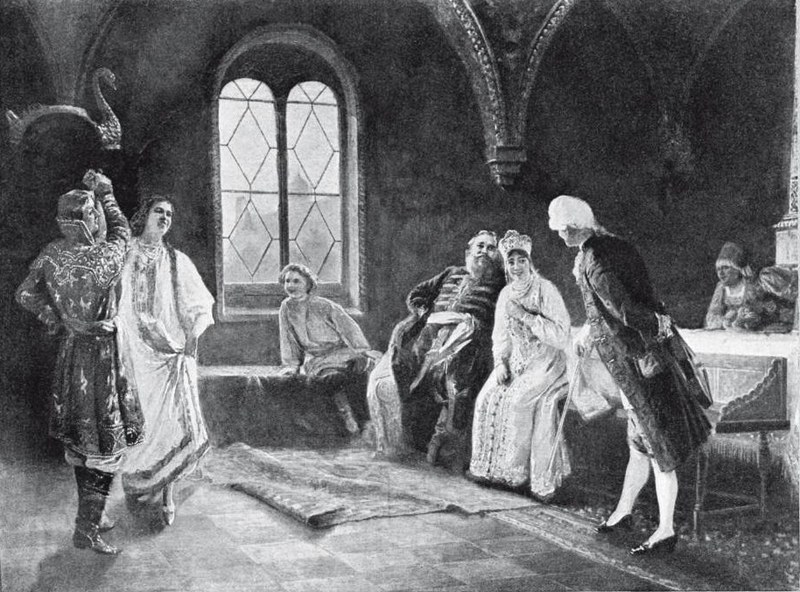
Lesson of dance in boyar family by I.Pass
И. Пасс.
- Medium:
- Oil Painting
- Era:
- Mid 1800s (Polka Era)
- Source:
- Wikimedia Commons
- Rights:
- Public domain — free to use, share and adapt.
- Recorded as:
- Public Domain
This is one of the few visual records of how 18th-century European court dances were actually taught in Russian noble households, capturing the master-pupil dynamic and the family's role in witnessing and enforcing social polish. It documents dance not as performance or entertainment, but as an instrument of class formation and national aspiration to European cultural standards.
What you are looking at
A dance lesson unfolds in a grand interior of a Russian noble household, likely from the 18th century. The scene is set in a vaulted stone chamber with a tall arched window admitting pale light. A dancing master in dark coat and white stockings demonstrates or instructs a young nobleman in the center of the floor, while family members—women in high-waisted white gowns and men in formal dress—observe from the sides. The composition frames the instruction as a formal ceremony of social refinement. A table laden with refreshments sits at the right; servants and attendants cluster in the background. The atmosphere is one of careful pedagogy, with the master's posture and gesture commanding attention, while the gathered family watches with the seriousness reserved for matters of status and breeding.
The dancing
The dancing master stands in profile, his body angled to show instruction or demonstration, one arm extended in what appears to be an instructional gesture. The pupil, a young man in lighter dress, responds with an attentive stance. The assembled family members stand in loose groups—some seated, some standing—in the formal postures of social observation rather than participation. Their arrangement suggests hierarchy: closer attention from those of higher rank, servants at a distance. No couple appears to be in a closed or open dance hold; this is demonstrative teaching rather than active social dancing.
The dance depicted
This depicts a dance lesson in the context of Russian noble education, a practice documented in 18th-century courtly life where French and European ballroom styles were taught as essential accomplishments. The formal setting, the master's authoritative position, and the family's arrangement as witness rather than partner all point to instructional dance of the historic-baroque or historic-regency period—likely French court dances (minuet, courante, or similar) transmitted through a European dancing master. The image records not a performance or social dance, but the domestic pedagogical moment in which noble youth acquired the bodily discipline and social grace required of their class.
How it was made
The catalogue records this as an oil painting. The monochromatic reproduction, however, obscures its original palette and cannot confirm medium by visual inspection alone. The technique shows strong chiaroscuro—light streaming from the window creates dramatic shadow across the vaulted interior, enhancing the formal gravity of the scene. The composition and narrative detail suggest academic history painting of the 19th century, a genre concerned with capturing moralizing or culturally significant moments from national or social history. This would have been a subject for exhibition and educated viewing rather than popular reproduction.
About this work
This is a 19th-century Russian history painting documenting the aristocratic practice of formal dance instruction. The work preserves a specific moment of cultural transmission—the moment at which European court dances were taught to Russian noble families as markers of refinement and status. It sits within a broader 19th-century European interest in depicting scenes of national character and historical life, and specifically reflects Russian artists' attention to their own noble traditions. The dance itself—likely a minuet or similar court form—matters less than the social act it represents: the disciplining of young bodies into courtly deportment.
How to look at it
Attend first to the master's body: his posture and arm gesture hold the narrative weight, as the viewer's eye is drawn to his instructional authority. Note how the family arranges itself as witness rather than participant—a deliberate compositional choice that emphasizes dance as a formal lesson rather than a social pleasure. The lighting from the high window reinforces the solemnity of the scene, treating the moment as ceremonially important. The still poses of the observers, the formal dress, and the noble interior all work together to frame dance instruction as a serious rite of class reproduction.
The artist
The artist is recorded as И. Пасс (I. Pass). Beyond the catalogue entry, no further biographical information is available from the source provided. The work's style and subject suggest a 19th-century academic painter working in the Russian tradition of historical and genre scenes, but firm attribution and biographical detail cannot be established from the image alone.
The period
This painting was likely executed in the mid-19th century, though the catalogue dates it to 1850. By this time, European court dances of the 18th century were already historical rather than living practice—the work looks back to an earlier age of Russian aristocratic formation. The 19th-century boom in history painting across Europe was partly driven by nationalism and nostalgia for aristocratic order in the face of social change. In Russia specifically, such scenes reflected a complex relationship to Western European culture: the nobility's desire to claim European refinement, combined with a retrospective romanticizing of native noble traditions. The formal interior and careful pedagogical framing reflect 19th-century values about discipline, order, and the transmission of culture through institutions.
Where it lives
The work is recorded as held in an unspecified collection; the catalogue provides only the artist's name, date, title, and medium. It is known through Wikimedia Commons, suggesting it may be in a public collection with online access, but its current location and acquisition history are not documented in the available record.
Dance in this work
Questions about this work
What dance is being taught in this scene?
The image does not show enough footwork or hold detail to identify a specific dance with certainty, but the formal interior, the presence of a paid master, and the date (ca. 1750s style) suggest a French court dance of the 18th century—likely a minuet, courante, or similar. The lesson format and the master's instructional posture are typical of how such dances were taught in European noble households.
Who was I. Pass?
I. Pass (И. Пасс) is known only through the catalogue record attached to this painting. No other biographical or bibliographic information is available from the source provided. The work's style is consistent with 19th-century Russian academic painting, but further research would be needed to establish the artist's training, career, or other works.
Why was this scene painted in the 19th century if it shows 18th-century practice?
History painting was a dominant academic genre in 19th-century Europe and Russia, and artists often looked backward to moments they considered culturally significant or morally instructive. A scene of noble youth receiving formal instruction in dance would have appealed as an image of order, refinement, and the proper transmission of culture—values the 19th-century educated class prized even as actual social practices were changing.
Is this a real historical moment or an invention?
Dance lessons were absolutely a documented part of Russian noble life in the 18th century, typically taught by imported European masters. Whether this painting depicts a specific known family and lesson, or rather a composite or generalized scene of the practice, cannot be determined from the image or catalogue alone.
More dance artwork