49 works in this view — arrow keys or swipe to move between them.
Dance in Art · 1915
Ludwig von Hofmann Frühlingstanz c1915
Ludwig von Hofmann
- Medium:
- Tempera
- Era:
- 1900-1920 (Ragtime/Early Jazz)
- Source:
- Wikimedia Commons
- Rights:
- Public domain — free to use, share and adapt.
- Recorded as:
- Public Domain
The painting documents an important moment in the history of the representation of dance—the period when European artists began to celebrate non-balletic, non-social movement as philosophically and aesthetically significant. The work illustrates how dance imagery was deployed to encode ideals of liberation, nature, and authentic feeling during the pre-war modernist period. For historians of dance and visual culture, it offers evidence of how the rise of free dance and Ausdruckstanz was reflected and celebrated in the visual arts.
What you are looking at
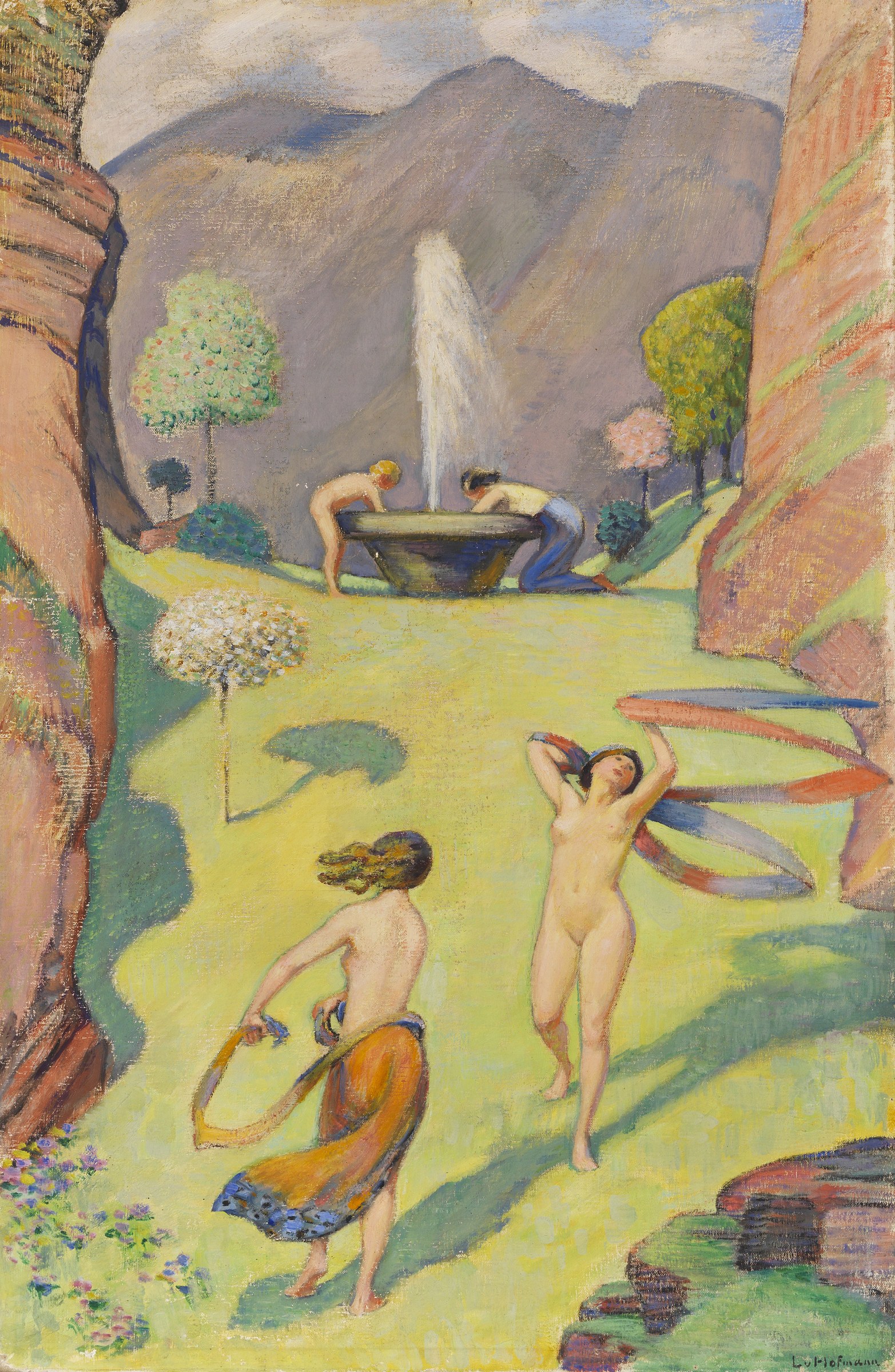
A mythological or allegorical spring scene set within a deep canyon or gorge formed by rust-red and ochre cliff walls. A luminous white fountain or water jet rises at center-back, framed by distant purple-grey mountains beneath a pale sky. The foreground is a broad lawn of vivid yellow-green, dotted with small flowering plants and shrubs; topiary or clipped trees with pale foliage stand at intervals. In the middle distance, two male figures bend toward a large basin or trough, their upper bodies bare. In the immediate foreground, two female nudes in pale flesh tones move across the grass—one at left wearing an orange-yellow draped garment around the hips, the other at right with raised arm in a lyrical pose, both barefoot. The composition suggests leisure, sensuality, and a Utopian natural sanctuary where formal dress has been abandoned.
The dancing
Four principal figures occupy the scene: the two males are stooped or crouching in symmetrical posture at the basin, their backs and shoulders prominent, suggesting labor or submission to the fountain's waters. The two females are upright and mobile, their bodies articulated in graceful, unconfined gestures—the rightmost with her left arm raised and head tilted back in a posture of abandon or joy, the other striding or pivoting with drapery in motion. No balletic line or turnout is evident; the movement is lyrical and improvisatory, with weight distributed across the bodies rather than held in a formal frame. The lack of shoes, the sparse or absent undergarment, and the gestural freedom suggest a style of movement far removed from classical technique.
The dance depicted
This is not a depiction of a codified dance technique or social dance form, but rather an idealized movement scene—a representation of dance as freedom, play, and natural expression within a utopian setting. The movement vocabulary evokes art-dance, free dance, or Ausdruckstanz of the early twentieth century, in which emotional and bodily spontaneity replaced formal steps. The title Frühlingstanz (Spring Dance) reinforces this interpretation: the scene celebrates the renewal and liberation associated with spring, rendered through the bodies of nudes in motion. The absence of musicians, spectators, or theatrical framing distinguishes this from theatrical dance; instead, the fountain and landscape are the dance's context and occasion.
How it was made
The work is executed in tempera on canvas, a medium that allowed the artist to achieve the luminous, almost ethereal color—particularly the vivid yellow-green lawn and the delicate pale tones of flesh and water—that characterizes the piece. Tempera's opacity and matte finish permit both bold, flat areas of color (the canyon walls, the grass) and subtle tonal modeling in the figures. The technique is suited to the work's dreamlike or visionary quality: tempera was often chosen by early-twentieth-century artists seeking to move away from oil painting's sensuality toward a more linear, spiritual, or symbolic aesthetic. This suggests the work was made for exhibition or private contemplation rather than as a study, though its tempera format places it at a remove from the monumental public muralism of the period.
About this work
Frühlingstanz is a tempera painting depicting a scene of mythological or utopian leisure in which nude and semi-nude figures move within an idealized landscape. Created around 1915, the work belongs to a wider European fascination with the representation of the body liberated from social costume and moral constraint, and with movement as an expression of inner life rather than social propriety or technical mastery. The painting reflects the early-twentieth-century interest in dance as a site of modernist renewal, where the natural human form and spontaneous gesture could stand for freedom, vitality, and spiritual regeneration. The work is characteristic of early-twentieth-century Symbolism and art-dance aesthetics, combining an Arcadian subject with a notably non-Academic formal language.
How to look at it
Attend to the asymmetrical arrangement of the four figures and how Hofmann uses the yellow-green lawn to unify them across depth. The two female figures are the focus: their upright posture, the articulation of their limbs, and the direction of their gaze create a sense of unguarded movement and pleasure. Notice how the male figures, bent and in shadow by contrast, seem to serve the scene—tending the fountain, attending to the waters—rather than participate in the dance proper. The luminous white jet of water at center-back is a compositional and symbolic anchor, drawing the eye upward and away; its presence suggests that the scene is one of transcendence and renewal rather than earthly sociability. The saturated colors of the landscape and the soft modeling of the bodies create an almost dreamlike atmosphere, flattening the usual recession into depth and emphasizing the painting's surface as a space of reverie.
The artist
Ludwig von Hofmann (1861–1945) was a German painter, sculptor, and decorative artist associated with Symbolism and the German version of Art Nouveau (Jugendstil). He was known for allegorical and mythological subjects, often featuring idealized nudes in harmonious natural or domestic settings. Hofmann was influenced by classical antiquity, the Italian Renaissance, and contemporary aesthetics emphasizing beauty, harmony, and the expression of inner states through form. His work was exhibited widely in German-speaking Europe and was associated with the more decorative and spiritually aspirational wing of modernism. Frühlingstanz is typical of his late oeuvre in its combination of mythological content, luminous color, and a vision of human life reconciled with nature.
The period
Frühlingstanz was created on the eve of World War I, at a moment when European culture was intensely preoccupied with ideas of natural renewal, the liberation of the body, and the critique of urban and social constraint. The 1910s saw the apex of the free-dance movement pioneered by Isadora Duncan and others, which rejected the formalism of ballet in favor of movement drawn from nature, emotion, and authentic bodily impulse. Visual artists, particularly in Germany, responded to these developments by creating images of dancing figures unbound by costume or convention. The painting also reflects the broader Symbolist and post-Impressionist interest in arcadian and mythological themes as vehicles for modern feeling. At the same time, the work's idealization of the nude and its emphasis on harmony and beauty situate it within a conservative aesthetic tradition, even as it engages with avant-garde ideas about the body and movement.
Where it lives
The work appears in Wikimedia Commons; no collection or current location is recorded. The catalogue description notes dimensions of 102 × 66.5 cm, tempera on canvas, signed lower right, and verso markings indicating a stretcher with old labels and handwritten numbering, suggesting it has passed through institutional or commercial care.
Dance in this work
Questions about this work
Is this a ballet scene?
No. Although the figures are moving gracefully, the painting depicts free dance or art-dance—a modernist movement that rejected the formal steps and positions of classical ballet. The nudity, the outdoor setting, the absence of a theatrical stage, and the emphasis on spontaneous, emotionally expressive movement all indicate a very different aesthetic from ballet, one associated with artists like Isadora Duncan and the German Ausdruckstanz.
What is the artist trying to say with nudity?
For Hofmann and many early-twentieth-century artists, the unclothed human body represented honesty, naturalness, and liberation from the hypocrisies of urban bourgeois life. In the context of spring and renewal, nudity also invoked classical mythology and a fantasy of return to an innocent, pre-social state. The painting is about the body as a vehicle for authentic feeling and movement, not primarily about eroticism, though sensuality is not absent.
What does the fountain signify?
The fountain is a source of renewal and life, consistent with the painting's spring theme. Its white jet and the attention of the male figures suggest vitality, spiritual cleansing, or sacred natural force. In classical and Renaissance art, fountains often mark enchanted or Utopian spaces; Hofmann invokes this tradition to frame the dance as part of an idealized, harmonious world.
When was this painted, and why then?
Dated to around 1915, the work was created at the height of the free-dance movement and just before World War I shattered European idealism. The painting reflects a pre-war vision of nature, freedom, and human wholeness that would soon seem impossibly distant. It belongs to a moment when artists across Europe were exploring dance and the liberated body as vehicles for modern spirituality.
More dance artwork