38 works in this view — arrow keys or swipe to move between them.
Dance in Art · 1925
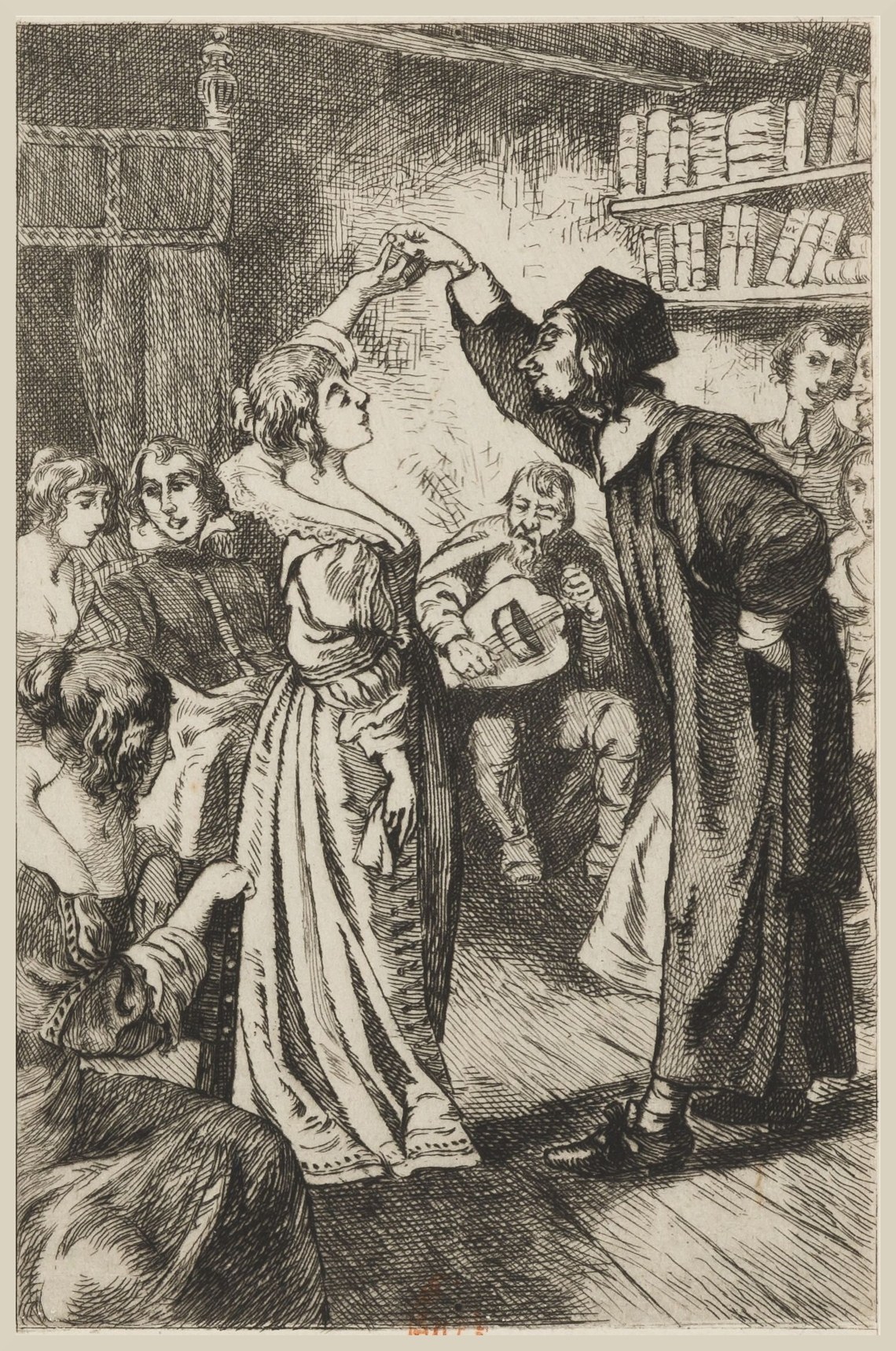
Martin van Maele - Francion 10
Martin van Maële
- Medium:
- Oil Painting
- Era:
- 1920-1950 (Swing Era)
- Source:
- Wikimedia Commons
- Rights:
- Public domain — free to use, share and adapt.
- Recorded as:
- Public Domain
This image documents the literary embedding of dance in seventeenth-century French culture, showing how dance functioned as a sign of courtship and social accomplishment rather than as an autonomous art form. It preserves the visual conventions by which dance was represented to an educated public through engraved illustration.
What you are looking at
An interior scene set in a library or study, identifiable by shelves of books lining the walls behind the figures. A woman in a flowing classical gown stands at the center-left, her body turned in profile, one arm raised gracefully upward while the other extends outward. She appears to be dancing or demonstrating movement to a gathered company. Around her stand multiple figures in 17th-century dress—men in dark coats and breeches, women in simpler garments—watching her intently. The composition is crowded and theatrical, with figures arranged in loose groups rather than formal rows. The engraving's fine cross-hatching creates deep shadows that give the scene an intimate, candlelit quality despite the daytime setting.
The dancing
The central female dancer has an elevated, theatrical port de bras with her raised arm curved gracefully above her head, her body held upright and turned. Her extended arm and the lift of her torso suggest a vocabulary of courtly or classical movement. The surrounding figures are static observers—their weight settled, bodies angled toward the dancer—creating a clear distinction between performer and audience. No partner holds her; the dance is a solo demonstration before gathered onlookers.
The dance depicted
This appears to be a depiction of a social or courtly dance demonstration, likely from the 17th century based on the dress and interior setting. The woman's raised arm position, the formality of her posture, and the attention of the assembled company suggest a court dance or similar aristocratic performance tradition. The image may illustrate a moment from a literary scene involving dance as courtship or entertainment—a common motif in 17th-century French literature. The exact dance form cannot be identified with certainty, but the elevated carriage and arm vocabulary point toward historic-baroque court dance conventions.
How it was made
This is an engraving, likely a steel or copper-plate engraving given its fine detail and crisp lines. The medium allows for intricate cross-hatching to create tonal depth and shadow without color, a technique well-suited to book illustration. Engravings of this kind circulated as illustrations within published texts, making them accessible to an educated reading public rather than a wealthy collector. The technical precision of the hatching suggests a skilled reproductive or interpretive engraver rather than a casual sketch.
About this work
This engraving illustrates a moment of dance within a social gathering, likely drawn from Charles Sorel's *Histoire comique de Francion*, a picaresque novel that includes scenes of courtship, entertainment, and social manners among the French aristocracy and bourgeoisie. The work documents not a specific historical dance but a literary and artistic convention: the woman dancer as a figure of grace, accomplishment, and social performance. It captures the 17th-century ideal of dance as a marker of refinement and courtship, embedded in narrative rather than presented as a formal spectacle.
The engraving belongs to a tradition of book illustration that visualizes social scenes from popular fiction. By 1925, when this edition was published, such illustrations served both documentary and aesthetic purposes—recording historical costume and gesture while engaging readers through visual narrative. The work preserves an early modern understanding of dance as a social practice inseparable from courtship, education, and entertainment.
How to look at it
Notice the contrast between the dancer's elevated, graceful posture and the static, observing bodies around her. The raised arm and extended reach show a classical vocabulary of movement in which the body moves upward and outward from the spine. The artist has chosen not a moment of rapid or complex footwork but a pose of display—a moment in which the dancer presents herself to view. The gathered onlookers, turned toward her with attention, frame dance as social performance rather than personal expression.
The artist
Martin van Maële (1863–1926) was a Belgian printmaker and illustrator known for his detailed engravings and etchings. He worked extensively as a book illustrator, creating imagery for literary texts throughout his career. His technique was characterized by precise line work and skillful use of hatching to create tonal effects, making him well-suited to illustrating historical and literary subjects that required period-appropriate costume detail.
The period
This engraving was created as an illustration for a 1925 republication of Sorel's early 17th-century novel, so it operates at a double historical distance: it depicts a scene imagined in the 1620s, rendered through the illustrative conventions of the 1920s. By the 1920s, baroque dance had become a subject of historical interest and artistic revival rather than living practice. The Swing Era context assigned by the catalogue is puzzling and appears to be an error; the image's subject matter, dress, and style all point to a representation of 17th-century courtly culture.
Where it lives
This is an illustration from the 1925 Jean Fort edition of Charles Sorel's *Histoire comique de Francion*, published in Paris. It was one of several illustrations created by van Maële to visualize scenes from the novel. The source is Wikimedia Commons; no holding institution is recorded.
Dance in this work
Questions about this work
What dance is being shown?
The image does not depict a specific, named dance form. Rather, it shows a courtly or social dance as a gesture of accomplishment and courtship within a narrative scene. The raised arm, upright carriage, and formal posture reflect 17th-century court dance conventions, but the artist's focus is on capturing a moment of social performance within a literary scene rather than documenting technique.
Why is this illustrated in the 1920s?
By the 1920s, Sorel's early 17th-century novel was a recognized work of French literary history. This edition, illustrated by van Maële, was a scholarly and aesthetic project: to preserve and visualize the social world the novel depicted, including its customs, dress, and practices. The engraving thus serves as both historical documentation and artistic interpretation.
Is this from a real historical dance?
The movement vocabulary reflects real 17th-century court dance practice—the raised arm, the upright frame, the focus on composed posture are all authentic to that tradition. However, the image is an illustration of a fictional scene rather than a record of an actual performance or a step-by-step dance manual.
More dance artwork