49 works in this view — arrow keys or swipe to move between them.
Dance in Art · 1910
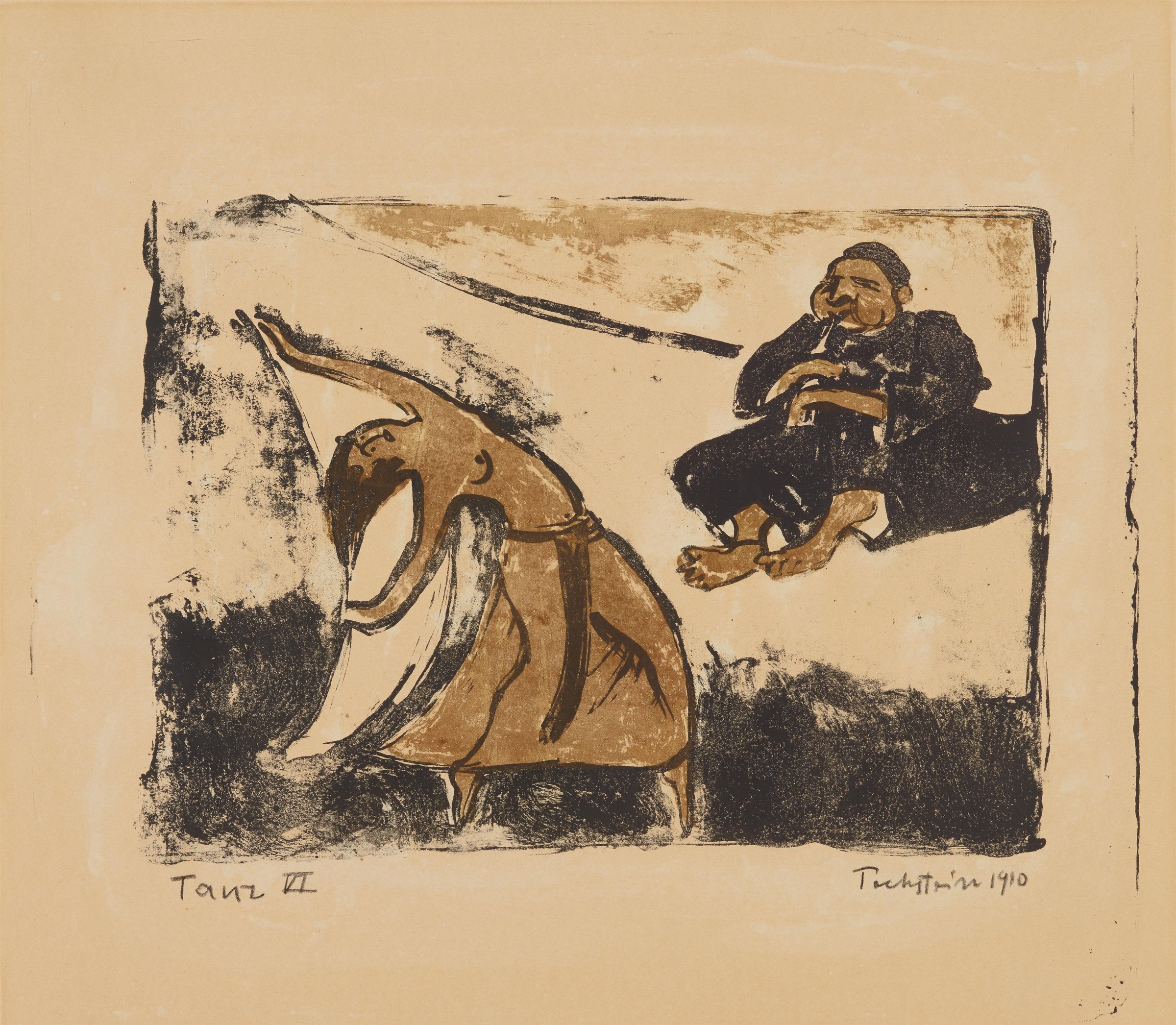
Max Pechstein Tanz VI 1910
Max Pechstein
- Medium:
- Lithograph
- Era:
- 1900-1920 (Ragtime/Early Jazz)
- Source:
- Wikimedia Commons
- Rights:
- Public domain — free to use, share and adapt.
- Recorded as:
- Public Domain
Pechstein's *Tanz* series is a foundational document of early 20th-century artistic engagement with dance, predating and paralleling similar investigations by other Expressionists. The suite demonstrates that dance was not merely a subject for representation but a paradigm through which modernist artists rethought the relationship between form, motion, and expression. For dance historians, the work offers rare visual evidence of how contemporary dance was actually practiced in European studios circa 1910—not the classical ballet codified in academic training, but the exploratory, weight-based movement that would become central to modern dance.
What you are looking at
A lithograph depicting two figures in a study of dance and repose. On the left, a dancer in a ochre-toned garment with dark outlines executes a dynamic pose, weight shifted with the torso tilted and one leg extended or kicking, the body captured mid-movement. On the right, seated in profile and looking toward the dancer, is a second figure in dark clothing, rendered in heavier black ink, watching with hand raised to face in a gesture of concentration or contemplation. The composition is sparse—minimal background detail, with dark gestural marks suggesting ground or shadow. The lithographic surface itself is worked expressively, with visible grain and variable ink saturation creating a sense of immediacy. The frame is bordered by a bold rectangular line, and the artist's signature and date appear below.
The dancing
The left figure demonstrates an active, unbalanced stance with weight on one leg and the other extended or lifted, the torso leaning forward and away from the supporting leg in a posture of propulsive motion. The right figure sits in a compact, inward-focused position, one hand raised toward the face in a gesture of watchful attention or absorption. The two are related not by contact but by the direction of the seated figure's gaze toward the dancer—a classic studio composition of performer and observer. The drawn line is spare and economical, defining form through contour rather than modeling.
The dance depicted
The work belongs to Pechstein's *Tanz* series (Dance series), a suite of eight original lithographs exploring dance as a subject of expressive movement and form. The left figure's extended posture and weight distribution suggest modern or contemporary dance practice rather than academic ballet, consistent with early 20th-century European Expressionism's interest in the body liberated from classical constraints. The seated observer—likely the artist or a dance partner—establishes the work as a document of the artist's engagement with dance as lived, physical practice. No specific named dance is depicted; rather, the work captures the relationship between body in motion and the act of witnessing.
How it was made
This is an original-color lithograph (Farblithographie) on smooth paper, a medium that allowed Pechstein to exploit the tactile quality of the stone surface. The technique is visible in the variable saturation and the organic irregularity of the ink, particularly in the darker passages and the gestural marks. Lithography in this period was a medium of both studio intimacy and broader circulation—original-color lithographs could be pulled in small editions and distributed to collectors and galleries, making them more accessible than unique paintings while retaining the hand-made quality. The work's modest scale (22.5 × 31.6 cm plate; 41 × 54 cm sheet) and intimate subject matter suggest it was conceived as a portfolio piece for educated collectors.
About this work
This is the sixth print in Pechstein's eight-part *Tanz* suite of 1910, an Expressionist meditation on dance and the body in motion. The print captures a studio moment: a figure executing a dynamic, unbalanced pose while a second figure sits watching, hand raised in concentration. The composition privileges the relationship between movement and observation, and the expressionistic line work—economical but charged with energy—conveys both the dancer's momentum and the psychological intensity of witness. The work belongs to a crucial moment in early modernism when European artists were discovering in dance a new language for representing the body, consciousness, and the drama of artistic creation itself.
How to look at it
Attend to the moment frozen in the left figure's body: the composition captures not a stable position but an unstable, off-balance moment of transit—weight shifted, leg extended, the body in the act of changing position. This is not the turned-out, symmetrical stance of ballet but an asymmetrical, weight-driven posture closer to walking or falling than to classical alignment. Notice also how the seated figure's raised hand and inward gaze create a secondary narrative—the work documents not just movement but attention, the consciousness of the one watching the one moving. The expressionistic line and variable ink are not decorative but functional, conveying both physical force and psychological intensity.
The artist
Max Pechstein (1881–1955) was a German Expressionist painter, printmaker, and sculptor associated with the Die Brücke movement. Working across oil, watercolor, woodcut, and lithography, Pechstein was drawn to expressive distortion of form and to non-European art and cultures. Dance fascinated him as a subject of bodily expression unfettered by naturalism; the *Tanz* series reflects his broader interest in rhythm, movement, and the primacy of feeling over form. Pechstein was also a dancer himself and collaborated with dancers and choreographers, deepening his investment in dance as both subject and lived practice.
The period
In 1910, European modern dance was in its infancy. Isadora Duncan had performed across Europe in the 1900s, liberating the body from corset and toe shoe; Mary Wigman's German Expressionist dance was emerging; and Vaslav Nijinsky's revolutionary performances with the Ballets Russes were only two years away. Simultaneously, German Expressionism was at its height, with Die Brücke (founded 1905) and Der Blaue Reiter (founded 1911) both mining intense emotion and primitive or non-naturalistic form. The artistic avant-garde was discovering in dance—particularly modern, non-classical dance—a model for authenticity, urgency, and the liberation of human expression from academic constraint.
Where it lives
The work was sourced from Wikimedia Commons and is identified in the catalogue as plate VI of the eight-plate *Tanz* series. The work is catalogued in the Pechstein catalogue raisonné (Krüger L 130) and is dated and signed by the artist on the stone. Current holding institution is not recorded.
Dance in this work
Questions about this work
Is this ballet?
No. The posture, weight distribution, and asymmetrical stance of the left figure indicate modern or contemporary dance practice, not classical ballet. The extended leg and forward-tilted torso show a body in motion through space rather than held in a turned-out, formally composed position. This is consistent with the modern dance revolution of the early 20th century, when European artists and dancers rejected classical codification in favor of expressive, weight-based movement.
What is the seated figure doing?
The seated figure appears to be watching the dancer, hand raised to face in a gesture of concentration or absorption. In the context of Pechstein's *Tanz* series—a studio-based exploration of dance and artistic practice—this likely represents the artist or a fellow dancer observing. The composition emphasizes the relationship between movement and witness, between body and consciousness.
Why did Pechstein make a series of dance prints?
Pechstein was fascinated by dance as a subject of authentic, unmediated human expression. Dance, especially modern dance, offered modernist artists a model for breaking free from academic constraint and convention. The *Tanz* series reflects Pechstein's belief that the body in motion could convey emotion, vitality, and psychological truth more directly than any other subject.
More dance artwork