49 works in this view — arrow keys or swipe to move between them.
Dance in Art
Meunier - Café del Buzero, Sevilla - with frame
Constantin Meunier
- Medium:
- Oil Painting
- Source:
- Wikimedia Commons
- Rights:
- Public domain — free to use, share and adapt.
- Recorded as:
- Public Domain
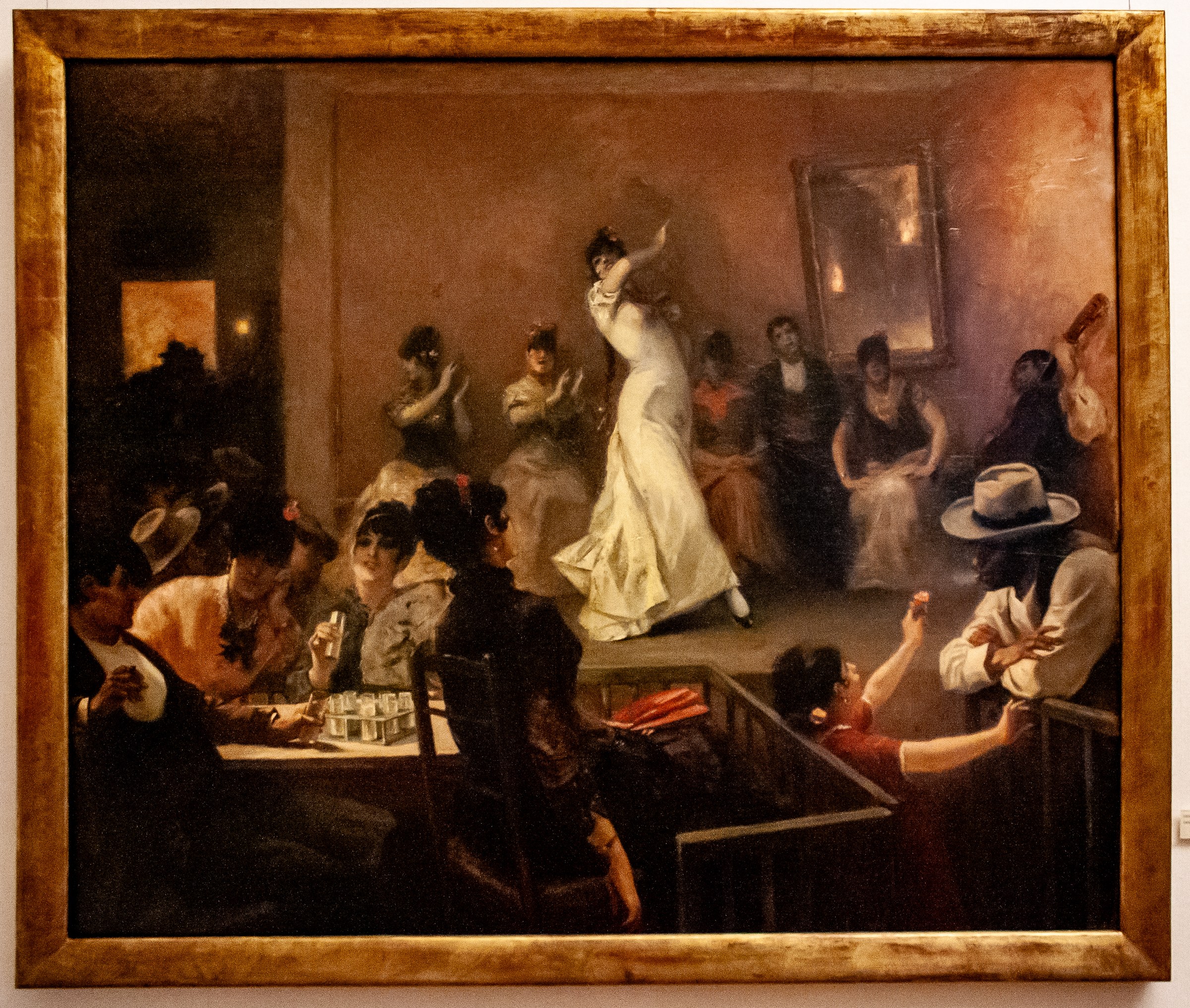
The painting documents an important but often invisible context for dance history: the tavern or café as a site of performance and social gathering. It shows a woman dancer commanding an audience's attention in a popular venue, raising questions about gender, labor, and artistic authority in nineteenth-century performance. The image also preserves evidence of a specific movement vocabulary—the acrobatic flexibility and expressive arm work—that may represent vernacular Spanish or flamenco practice of the period.
What you are looking at
A woman in a white dress performs a solo dance before an assembled crowd in what appears to be a tavern or café interior. The setting is intimate and theatrical: dimly lit by warm amber tones, with brick or terracotta walls and a low ceiling that creates a sense of enclosure. The dancer stands elevated, her body arched backward in a dramatic curve, one arm extended upward and the other across her torso, her white skirts billowing around her. She wears what appears to be a black bodice or corset beneath the white fabric. Around her stand some fifteen to twenty figures—men and women in nineteenth-century dress, several wearing hats. Most onlookers are seated or standing in informal postures; a man in the right foreground wears a straw hat and watches intently. The composition captures a moment of performance within everyday social space: this is not a concert hall but a popular venue where dance happens as part of social life. The lighting suggests evening or artificial light, and the smoke or haze visible in the air adds to the tavern atmosphere.
The dancing
The central dancer's pose shows extreme flexibility and an arched, almost contorted back—her body weight appears to be supported on one leg while the other is extended or raised, and her spine is dramatically extended backward. This is not the upright carriage of academic ballet but something more acrobatic and earthbound. Her arm extension is loose and expressive rather than formally held. The onlookers are rendered in looser brushwork and remain somewhat anonymous, their attention directed toward the performer; no one dances with her. The woman's isolation as a solo performer is the spatial and compositional fact of the image.
The dance depicted
The dance cannot be identified with certainty from the image alone. The extreme flexibility, the tavern setting, the loose expressive arm position, and the nineteenth-century Andalusian context (the title references Seville) suggest flamenco or a related Spanish regional dance, but the acrobatic arching and the theatrical solo presentation—dancing for observers rather than as part of a social exchange—could also indicate circus or music-hall performance. The woman's bodice and the cut of her white skirt are consistent with nineteenth-century performance costume rather than everyday dress. The setting and subject matter align with the romantic-era fascination with working-class or 'authentic' entertainment venues, making this a document of how dance was consumed by urban audiences in the period.
How it was made
Oil painting on canvas, executed in a style consistent with late nineteenth-century realist or naturalist practice. The artist uses warm, moody tonality—browns, terracottas, and amber—broken by the white of the dancer's dress, which becomes the visual anchor of the composition. The brushwork is relatively loose and atmospheric, particularly in rendering the crowd and the ambient space, while the figure of the dancer receives more precise definition. This technique allows the artist to capture both the specificity of the dancer's pose and the social context—the tavern crowd—that frames her performance. The handling suggests this is a work intended for exhibition and sale within the art world, not a documentary sketch.
About this work
This is an oil painting depicting a solo female dancer performing in a tavern or café setting, likely in nineteenth-century Seville based on the title. The work documents a moment of popular performance—dance as entertainment for an urban audience in a non-theatrical venue. The dancer's extreme flexibility and expressive pose, combined with the tavern setting and her isolation as a performer, suggest either flamenco or circus-influenced acrobatic dance. The painting is a record of how dance functioned in nineteenth-century social life: not confined to concert halls, but embedded in cafés and taverns where working-class and bohemian audiences gathered.
The work belongs to a tradition of nineteenth-century art that romanticized and documented popular or folk entertainment. Paintings of dancers, guitarists, and singers in Spanish or Mediterranean settings were popular among collectors of the period, appealing to a taste for exotic local color and the aesthetic of 'authenticity.' This work participates in that market while also capturing genuine information about how and where people danced.
How to look at it
Attend first to the dancer's spine and the impossibility of her curve—this is the key to understanding what kind of movement the artist chose to capture. The arch is not a moment within a flowing sequence but a held position, possibly a climactic point or a display of virtuosity. Notice how the onlookers do not participate: they are consumers of the performance, not dancers themselves. The composition privileges the white dress and the lit face as they emerge from the darker crowd, making the viewer's eye follow the same path the tavern audience's attention takes. The warm, smoky tonality is not incidental: it is the sensory fact of the space, the air thick with tobacco and warmth.
The artist
Constantin Meunier (1831–1905) was a Belgian painter, sculptor, and printmaker known for his depictions of working-class life, industrial labor, and social realism. Though primarily celebrated for his monumental sculptures of miners and laborers, Meunier was also a painter of genre scenes, particularly of theatrical and popular entertainment. His interest in Spanish subject matter and his frequent travels to Spain and North Africa informed works like this one. Meunier's approach combined academic training with a commitment to rendering the dignity and specificity of everyday and working-class subjects.
The period
The nineteenth century saw growing interest among European artists and collectors in Spanish culture, flamenco, and Mediterranean 'authenticity,' often filtered through a Romantic lens that emphasized exoticism and emotional intensity. By the 1870s–1890s, dance in taverns and cafés was becoming a subject for serious artists; this coincided with flamenco's emergence as a formalized performance genre (distinct from its earlier social contexts) and with the rise of café cantante culture in Andalusia. At the same time, academic ballet was consolidating its dominance in concert settings, making popular or vernacular dance a subject of artistic interest precisely because it existed outside institutional frameworks. Meunier's engagement with this subject reflects both his commitment to social realism and the period's broader fascination with 'primitive' or non-academic forms of artistic expression.
Where it lives
The work is recorded as an oil painting by Constantin Meunier with the title 'Café del Buzero, Sevilla' (Café of the Buzero, Seville). It was sourced to this documentation from Wikimedia Commons. The current location and institutional holding are not recorded.
Dance in this work
Questions about this work
Is this flamenco?
The title references Seville and the work is set in a Spanish tavern, making flamenco or a related Andalusian dance the most likely identification. However, the acrobatic arch and the solo, frontal presentation also suggest circus or music-hall performance. The painting does not provide enough detail of footwork, hand position, or musical accompaniment to be certain. What we can say is that this documents a form of solo female performance in a working-class Spanish venue of the nineteenth century.
Who is this dancer?
The painting does not identify the individual performer. She is rendered as a type—the Spanish dancer in a tavern—rather than as a portrait. The work is a genre scene documenting a social practice, not a commission to memorialize a specific performer.
What was a café cantante?
Cafés cantantes were popular entertainment venues in nineteenth-century Andalusia, particularly in Seville and Cádiz. They were taverns or cafés where singers, guitarists, and dancers performed for paying audiences. They were important sites for the professionalization and formalization of flamenco, and they were also places of social gathering, drinking, and courtship. This painting appears to document exactly this kind of venue.
Why paint a tavern dancer?
By the late nineteenth century, artists interested in social realism and popular culture were drawn to tavern and café scenes as subjects. These venues were seen as sites of 'authentic' expression, unconstrained by academic convention. The contrast between the formality of concert-hall ballet and the raw energy of tavern performance made the latter aesthetically compelling to artists seeking alternatives to institutional art.
More dance artwork