49 works in this view — arrow keys or swipe to move between them.
Dance in Art · 1839
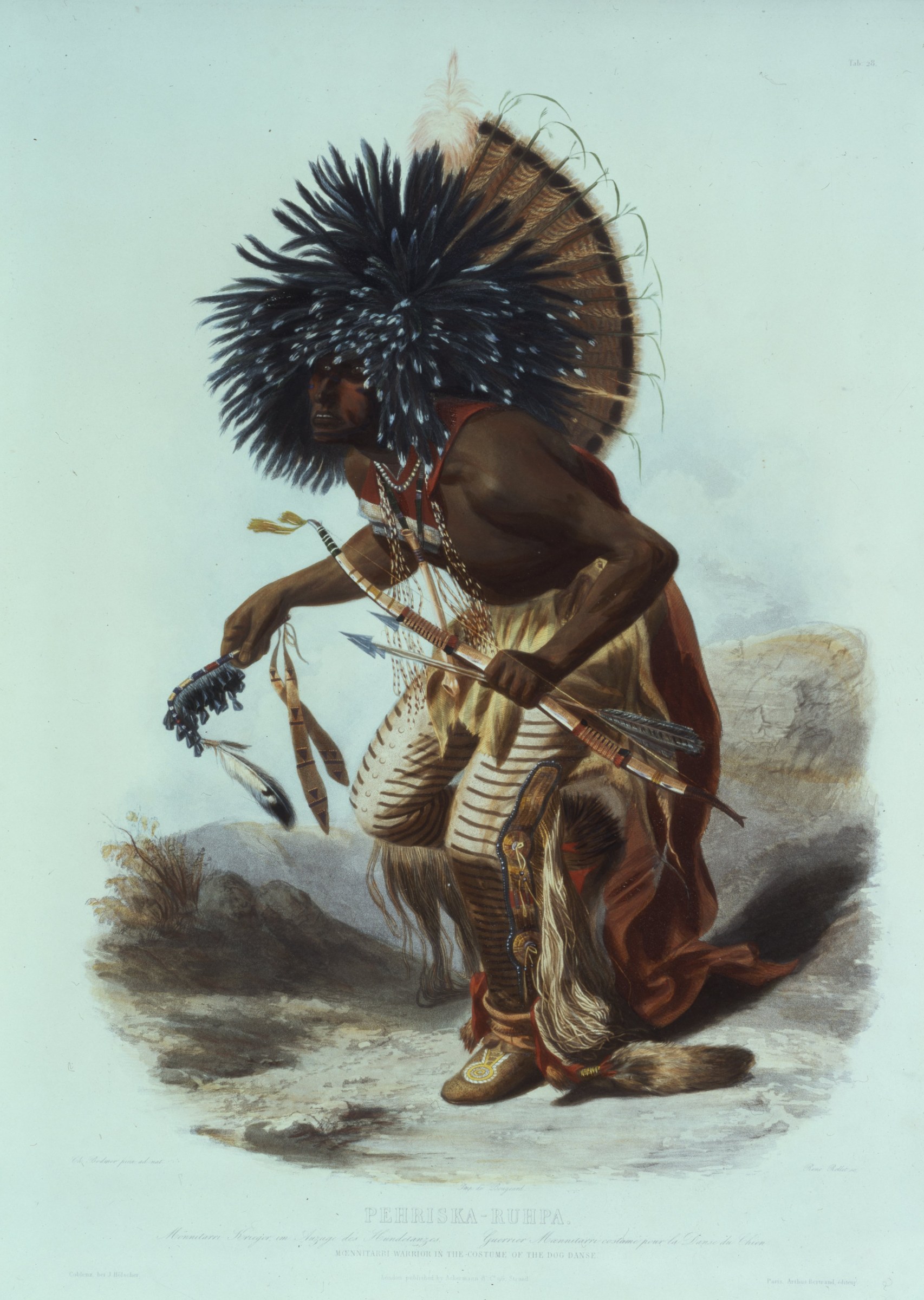
Moennitarri warrior in the costume of the dog danse
Karl Bodmer
- Medium:
- Oil Painting
- Era:
- Mid 1800s (Polka Era)
- Source:
- Wikimedia Commons
- Rights:
- Public domain — free to use, share and adapt.
- Recorded as:
- Public Domain
This image is one of the earliest detailed European artistic records of a specific named Native American warrior dance and a specific dancer. For historians of Plains Indian dance, it provides rare visual evidence of Dog Dance regalia and its construction at a time before photography and before the suppression of these ceremonies. For art historians, it exemplifies the colonial-era practice of indigenous portraiture as ethnographic documentation—a genre that shaped European and American understanding of Native peoples while erasing the agency and living context of the people depicted.
What you are looking at
A Moennitarri (Mandan) warrior stands in three-quarter view against a pale sky with rocky terrain below. He wears an elaborate headdress of black feathers standing upright in a dramatic fan, with white feathers or fur at the crown. His torso is bare and darkly painted or toned. He wears a red cloth draped across one shoulder and down his back. His lower body is dressed in fringed hide leggings with geometric patterns in earth tones and white, decorated with what appear to be hair locks or fur strips hanging at the sides. He holds a curved staff or coup stick in one hand and wears multiple strands of beaded or shell necklaces across his chest. His feet are visible in decorated moccasins. The figure is posed in a dynamic stance, weight shifted, suggesting active movement or dance posture rather than a static standing position.
The dancing
A single male figure is captured mid-movement or in a posed display stance. His weight appears shifted, with his body angled and slightly twisted, suggesting rotational movement through the torso. His arms are positioned asymmetrically—one extended outward holding a staff or dance implement, the other positioned near his body. His head is held high, tilted slightly, with the massive feathered headdress contributing to an upright, proud carriage. The overall frame suggests the explosive, vertical lift characteristic of warrior or ceremonial dance, with the body organized for force and presence rather than flow.
The dance depicted
This image documents the Dog Dance (likely *Heloúska* or a similar warrior society dance) of the Mandan people, one of the Plains Indian nations. The artist has identified this as the costume of Pehriska-Ruhpa, a known Mandan warrior, worn during this specific ceremonial performance. The Dog Dance was a warrior society dance associated with the Mandan Dog Soldiers, performed during gatherings and ceremonies. The image shows the extraordinary visual investment in the costume—the feathered headdress, hide regalia, and war implements—that marked these dances as prestige events. However, as a single-figure portrait study rather than a scene of dancing bodies in relationship, it documents the appearance rather than the kinematics or social structure of the dance itself.
How it was made
This work is hand-colored or possibly watercolor-enhanced engraving or lithograph on paper, likely from a series documenting North American indigenous peoples. The technique allowed for the fine rendering of surface textures—the individual feathers, beadwork patterns, fringe, and hair ornaments—with a clarity that serves ethnographic documentation. The colored medium (hand application or early color printing) gives presence to the darkly painted body and brilliant feather display. As a printed image, this was circulation-ready: it reached audiences in Europe and America without requiring access to the original artwork, making it a significant tool for shaping 19th-century perceptions of Native American ceremony and dress.
About this work
This is a portrait study of a Mandan warrior in full ceremonial regalia for the Dog Dance, one of the most prestigious warrior society dances of the Plains Indian nations. Created by Karl Bodmer, the Swiss artist who traveled to North America in the 1830s, it documents both the visual splendor and the cultural specificity of Plains Indian ceremony at a moment of rapid change. The image belongs in a dance gallery not as a depiction of choreography or movement technique, but as a crucial visual record of how a specific dance tradition was embodied, costumed, and honored by its practitioners. It represents a moment when European artists and institutions were beginning to document indigenous dance practices, though often in ways that flattened living performance into museum-ready costume study.
How to look at it
The artist has chosen to freeze the figure in a moment of maximum visual impact—not at rest, but in the alert, lifted posture of ceremonial performance. Attend to how the weight is organized: the slight hip shift and spinal rotation suggest the explosive readiness of a warrior dance rather than the relaxed symmetry of ordinary standing. The feathered headdress is rendered at its full height and spread, commanding the composition; this is not a portrait of a man's face but a portrait of a man as a bearer of regalia. The printed and hand-colored technique allows you to see the distinction between the natural hues of hide and feather and the applied pigments of body paint—a distinction central to understanding how the dancer's body itself became part of the costume.
The artist
Karl Bodmer (1809–1893) was a Swiss painter and lithographer who traveled to North America from 1832 to 1834 as part of Maximilian, Prince of Wied-Neuwied's scientific expedition up the Missouri River. Bodmer produced hundreds of watercolor sketches and detailed studies of Native American peoples, focusing on portraiture, dress, and material culture. His work was subsequently engraved and published, becoming one of the most widely circulated visual records of Plains Indian life in the early 19th century. Bodmer worked in the tradition of natural-history illustration and ethnographic documentation, combining artistic skill with an apparent commitment to accurate rendering of specific individuals and their regalia.
The period
This work dates to the 1830s, a period of intensive European and American scientific interest in documenting indigenous peoples before anticipated assimilation or displacement. The Dog Dance and other Mandan ceremonies were among the most elaborately documented Native American dances by Euro-American observers, precisely because they were visually distinctive and associated with warrior prestige. This was also a period before photography became the primary tool of ethnographic documentation, so hand-drawn and engraved images carried both scientific authority and aesthetic value. The work predates the Indian Removal Act (1830) and the later suppression of ceremonial dance by the U.S. government, making it a record of practices that would face increasing restriction in the decades following its creation.
Where it lives
The work comes from Karl Bodmer's expedition documentation, published in engraved and lithographed form in the 1840s as part of the record of Maximilian's Missouri River journey. The source is listed as Wikimedia Commons; the current holding institution is not recorded in the catalogue.
Dance in this work
Questions about this work
Was the Dog Dance a real dance or a European invention?
The Dog Dance was a real and significant Mandan ceremony, part of a warrior society system that structured male prestige and military training among Plains Indian nations. Euro-American observers documented it extensively, but their documentation often simplified or aestheticized it. The dance was performed before, during, and after hunts and wars, and carried meanings about courage, lineage, and community status that are largely lost to us now. What we see in Bodmer's image is a record created by an outsider observer, not a complete account of the dance's meaning or performance.
Is this a portrait of a real person?
Yes. The work is titled with the name Pehriska-Ruhpa, a Mandan warrior known to have interacted with Bodmer's expedition. However, Bodmer likely worked from sketches or memory rather than painting from direct observation in full costume; the level of detail and finish suggests studio work. The image is both a specific portrait and a generalized ethnographic record of the Dog Dance costume as understood by a European artist.
What is the feathered headdress made of?
The image shows black feathers (likely from eagles or ravens) standing in a radiating fan, often attached to a leather or hide cap or frame. The white material at the crown may be fur, hair, or down. Such headdresses were labor-intensive to construct and were markers of high status. The exact materials and construction would have varied by individual and date, and Bodmer's rendering may not capture all technical details.
Did European audiences understand this as a dance image?
Likely not in the way we use the term now. To 19th-century viewers in Europe, this was primarily an ethnographic portrait—evidence of exotic dress, warrior culture, and indigenous costume. The dynamic posture reads to us as a dance stance, but Bodmer's primary audience probably saw it as a portrait of a man and a record of material culture. The categorization of this as dance imagery is a modern act of recontextualization.
More dance artwork