45 works in this view — arrow keys or swipe to move between them.
Dance in Art · 1568
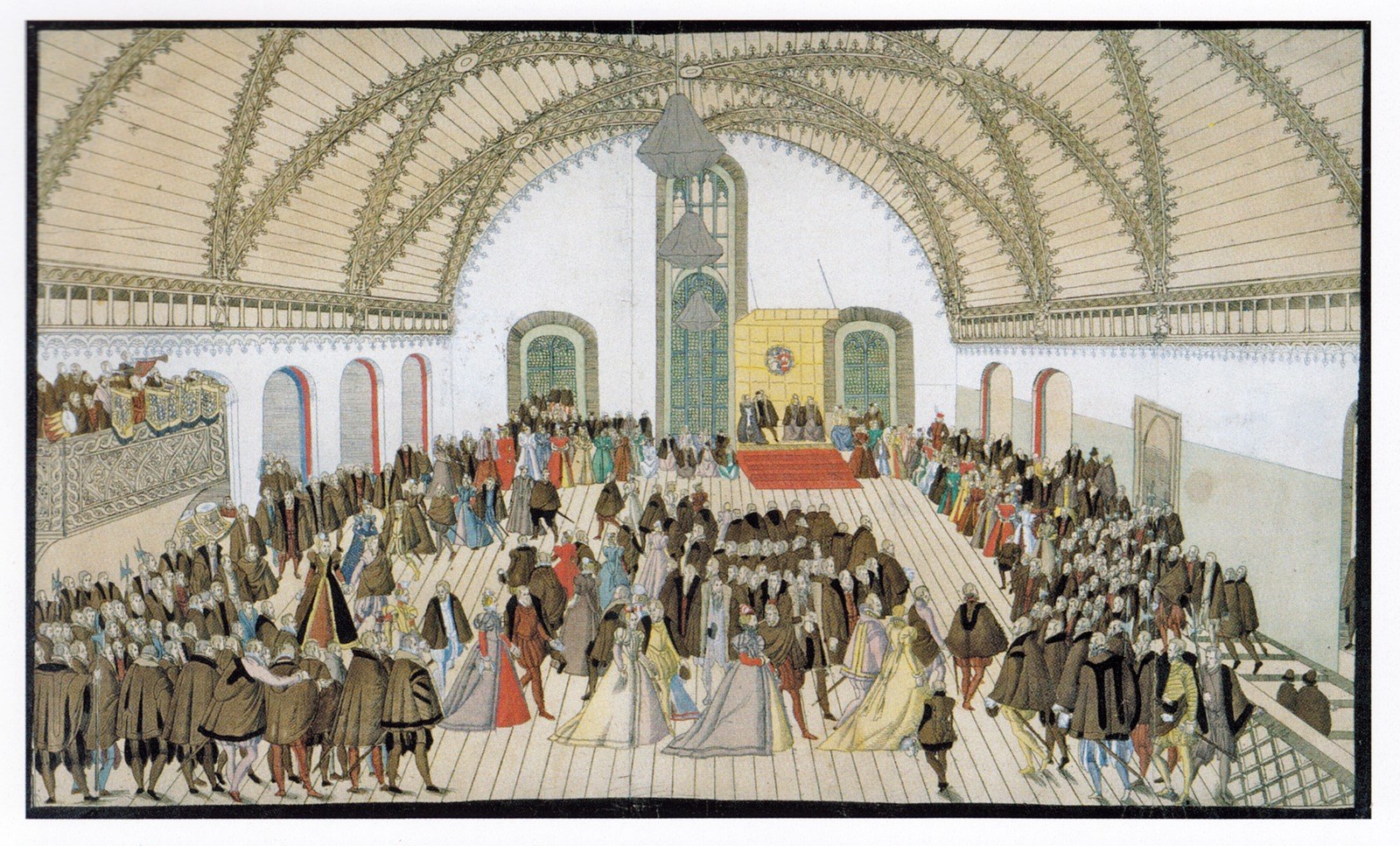
Nikolaus Solis Tanz mit hoefischen und patrizischen Teilnehmern im Saal
Nikolaus Solis
- Medium:
- Oil Painting
- Era:
- Pre-1700 (Renaissance/Baroque)
- Source:
- Wikimedia Commons
- Rights:
- Public domain — free to use, share and adapt.
- Recorded as:
- Public Domain
This image is one of the few surviving visual records of a specific court dance occasion in the German Renaissance, documenting both the social function of dancing in dynastic celebration and the architectural grandeur within which it took place. It shows that Renaissance court dance was a mode of political display and social organization, not merely entertainment—a distinction essential to understanding how dance functioned in early modern power structures.
What you are looking at
A vast ceremonial hall filled with hundreds of courtiers and patricians witnesses an elaborate dance at the wedding feast of Duke Wilhelm V of Bavaria. The vaulted ceiling, decorated with geometric patterns and supported by ribbed arches, dominates the composition and creates a sense of monumental scale. The crowd, rendered in precise miniature, stands densely packed along the sides of the hall and on elevated platforms, dressed in the rich wools and velvets of 16th-century Munich court fashion—deep browns, reds, blues, and golds. At the center, a raised stage or dais holds the principal dancers and musicians, with a tall ornate tower or pavilion structure rising at the back, crowned with a pyramidal roof and decorated with green metalwork and a large window. The foreground shows the dancing floor in light wood or stone, and the composition creates dramatic depth through the receding architectural perspective and the gradual scale diminution of the watching crowd.
The dancing
The dancers visible on the central dais appear to be moving in paired or group formations, though the miniature scale and distance make precise gestural analysis difficult. The crowd surrounding them stands or moves in loose clusters; some figures gesture or point toward the dancers. The dominant postures are upright and formal rather than deeply bent or extended—consistent with stately court dance of the period. The density and stationary quality of most of the crowd suggests this is a moment of display and spectacle rather than participatory social dancing, with the principal dancers separated from the watching courtiers by architectural and social hierarchy.
The dance depicted
This is almost certainly a formal court dance (Hofftanz) of the German Renaissance, likely a pavane, allemande, or similar processional and stately form typical of aristocratic wedding celebrations in the 1560s. The Munich court under Wilhelm V was known for elaborate ceremonial dancing as part of court ritual. The image documents not the style of movement—which is too small to read clearly—but the social and spatial context: that such dances were highly staged, hierarchical spectacles performed by a select group of courtiers before a much larger assembled court. The formal nature of the occasion, the architectural grandeur, and the composition all emphasize ceremony over intimacy.
How it was made
This appears to be a hand-colored woodcut or engraving, rendered with meticulous detail and linear perspective. The technique allowed for the precise architectural rendering and the deliberate miniaturization of hundreds of figures, which serves a documentary purpose—recording the scale and splendor of the occasion. The hand coloring in gouache or watercolor adds richness and helps distinguish costumes and social position. The high finish and careful execution suggest this was a prestige object, likely commissioned to commemorate the ducal wedding, and its circulation would have been limited to court circles and elite audiences.
About this work
This is a ceremonial document disguised as art: a visual record of a ducal wedding feast at Munich in 1568, with an emphasis on the architectural setting and the assembled court rather than on the details of the dance itself. The work belongs to a German Renaissance tradition of court celebration imagery that combined topographical precision with heraldic and dynastic significance. The painting or print records the social position of dance in court life—a highly formal, visually orchestrated display of rank and ritual, presided over by architecture and hierarchy. For historians of Renaissance court culture, it is invaluable; for dance historians, it illustrates the context and scale of courtly spectacle but offers limited information about movement or technique.
How to look at it
Attend first to the architectural framing: the soaring vault creates a theater of ceremony, and the tall tower or baldachin at the center marks the focal point. Observe how the crowd is organized—standing, watching, ranked by position—rather than participating. Note the precision of perspective, which recedes sharply toward the pavilion; this creates a sense of monumental occasion and vast scale. The moment chosen is one of display, not action; the painting freezes the ceremonial instant rather than capturing movement. The absence of dynamic gesture or extended limbs underscores that this is court dance as ritual performance, governed by decorum and formal line rather than virtuosity or spontaneity.
The artist
Nikolaus Solis (fl. 1560s–1580s) was a court painter and likely also a designer or documenter of court ceremonies at the Munich court of Duke Wilhelm V. Little is known of his biography beyond his work in Munich, but his meticulous attention to architectural detail and his ability to coordinate complex compositions suggest he had training in both painting and possibly print design. His works appear to have been primarily documentary in purpose, recording court events for posterity and prestige.
The period
This painting dates to the reign of Duke Wilhelm V (r. 1579–1626), a major patron of the arts and court ceremony in the Catholic Reformation. The 1560s saw the flourishing of elaborate court dance across Europe as a sign of sophistication and ducal power. The German courts, including Munich, adopted Italian and French court dance styles and integrated them into complex ceremonial programs. The architectural language of the painting—the vaulted hall with its Renaissance proportions—reflects the aspirations of the Bavarian court to rival the great courts of Italy and France. At the same time, the composition's emphasis on order, hierarchy, and geometric precision reflects the Renaissance humanist ideal of dance as an expression of cosmic and social harmony.
Where it lives
The work is recorded as an oil painting attributed to Nikolaus Solis and dated 1568, commemorating the wedding of Duke Wilhelm V of Bavaria held in the Munich Rathaus (city hall). The current holding location is not recorded in the available catalogue.
Dance in this work
Questions about this work
What dance is being performed?
The specific dance form cannot be identified from the image; the figures are too distant and small. It is most likely a pavane, allemande, or another formal court dance appropriate to a ducal wedding feast. The image documents the occasion and setting rather than the dance technique itself.
Why is the crowd so large and the dancers so small?
This composition emphasizes the ceremonial and hierarchical nature of court dance. The dancers occupy a privileged, elevated position, while the hundreds of courtiers and patricians witness the performance. The scale difference reflects social and political rank: this is not participatory social dancing but a formal display of ducal power and artistic refinement.
What building is this, and is it accurate?
The painting depicts the great hall of the Munich Rathaus (city hall), though the architectural details are stylized and dramatized for effect. The tall pavilion or baldachin at the center may be a ceremonial structure erected for the occasion, or it may be an artistic convention emphasizing the centrality and importance of the dancers.
How would historians use this image?
The painting is valuable as evidence of court ceremonial practice, the role of dance in dynastic celebration, the architectural settings in which formal dance took place, and the dress and social composition of the Munich court in the 1560s. For dance technique, it provides limited detail; for the social history and visual culture of Renaissance court dance, it is invaluable.
More dance artwork