49 works in this view — arrow keys or swipe to move between them.
Dance in Art · 1912
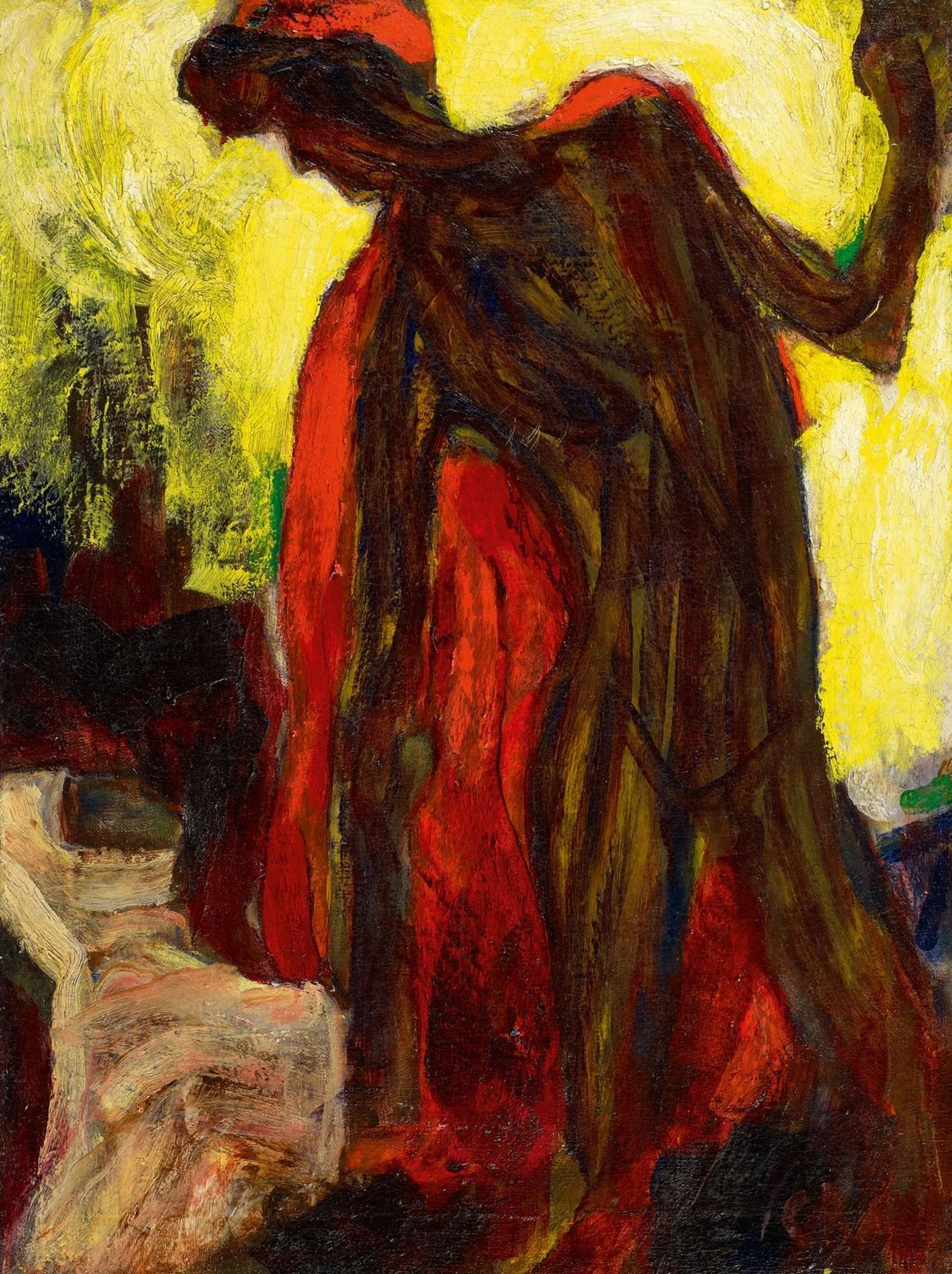
Christian Rohlfs - Tänzerin mit rotem Schal (1912)
Christian Rohlfs
- Medium:
- Oil Painting
- Era:
- 1900-1920 (Ragtime/Early Jazz)
- Source:
- Wikimedia Commons
- Rights:
- Public domain — free to use, share and adapt.
- Recorded as:
- Public Domain
This work is a rare early visual document of modern dance at the moment of its crystallization—before Diaghilev, before the Ballets Russes, in the world of studio practice and private exploration. It shows how artists outside the dance world itself understood and valued the new movement forms emerging in the early 1900s, and how painting could capture what photography could not: the felt experience, the inner life, of a dancer in motion.
What you are looking at
A solitary female dancer dominates a luminous yellow interior, her body pitched forward in dynamic motion. She wears a dark brown or maroon dress with a striking red shawl or cape that sweeps dramatically behind and around her—the shawl catches the light in vivid scarlet, creating the painting's emotional center. Her dark hair is pulled back, and her posture suggests urgent, almost frantic movement: the torso leans sharply forward, one arm extended, the other raised, as though she is either grasping at something or pushing away. The background dissolves into vertical streaks of pale and acidic yellow, with darker ochre and black marks suggesting an interior space—perhaps a studio or bedroom—rendered in broad, expressive brushstrokes. A small seated figure appears at the lower left, barely resolved from the paint, watching or present. The overall mood is one of intensity and psychological urgency rather than decorative display.
The dancing
The dancer's frame is markedly modern: the spine curves forward from the hips in an arched, vulnerable posture that reads as contemporary or expressive rather than classical. Both arms are raised and active, the upper body twisted; the legs are obscured but the weight appears to be in motion, feet off-balance. The extended red fabric acts as a second body, a visual extension of the emotional state. The seated onlooker suggests a studio or private viewing rather than a public stage, introducing an intimacy and watchfulness to the moment.
The dance depicted
This appears to be a representation of early modern or expressionist dance rather than classical ballet or ballroom technique. The raw, unpolished quality of the movement—the forward-folding spine, the emotional urgency, the relationship to fabric as expressive tool—suggests Isadora Duncan's influence or the broader early 20th-century Ausdruckstanz (German Expressionist Dance) movement. The red shawl as prop and emotional signifier places it squarely within early modernism's embrace of drapery as a vector of feeling. The precise dance form cannot be identified from technique alone, but the painting documents a moment of emotional expression through the body.
How it was made
This is oil paint applied in visible, gestural strokes. Rohlfs employs color expressively rather than descriptively: the acid yellows of the background are not observed light but emotional temperature. The paint surface is active and immediate, built up in layers that do not hide the brushwork. This technique signals the work is meant to be read as feeling-first, documentation-second—appropriate to the subject of modern dance, which itself prioritized authentic emotional expression over technical display.
About this work
This 1912 oil painting documents a moment in the emergence of modern dance, capturing a solo female dancer in what appears to be a private or studio setting. The work combines portraiture of a specific body in motion with expressionist technique—raw color, visible brushwork, emotional intensity—to create a document of early 20th-century avant-garde dance practice. The red shawl is both costume element and expressive language, a visual marker of the subjective, feeling-based approach that distinguished early modern dance from classical ballet. Rohlfs's painting sits at a historical threshold: the dawn of artistic interest in unadorned, authentic human movement, and the simultaneous emergence of expressionism as the aesthetic language to represent it.
How to look at it
Attend to the angle of the spine and the position of the arms: this is a body caught mid-phrase, in a state of emotional release rather than technical display. The shawl is not costume ornament but a continuation of the body's expressiveness—it moves with the gesture, extends the reach, visualizes the emotional trajectory. The yellow background, rather than creating spatial depth, flattens and pressurizes the space, making the figure's intensity feel contained and urgent. The presence of the seated witness reminds us this is a studio moment, not a stage moment—we are seeing the work of modern dance not as public spectacle but as private research.
The artist
Christian Rohlfs (1849–1938) was a German expressionist painter who worked across Impressionism, Symbolism, and eventually abstraction. Active from the 1870s onward, he was a founding member of the Die Brücke expressionist group and worked extensively with bold color and gestural mark-making. His subject matter ranged across landscape, still life, and figure studies; this painting sits within his broader engagement with human emotion and the expressive capacity of paint itself.
The period
In 1912, modern dance was in its infancy as an organized artistic movement. Isadora Duncan had been performing and teaching for a decade; the Russian Imperial Ballet still dominated institutional dance, but young dancers across Europe were experimenting with unadorned bodies, emotional authenticity, and release from corsetry and pointe work. Expressionism in painting was simultaneously reaching its peak intensity in Germany. Rohlfs's painting aligns with the broader expressionist moment—which included the 1905 founding of Die Brücke and the rise of German Expressionist cinema and theater—in treating the human body as a vehicle for inner psychological states rather than surface beauty.
Where it lives
The work is recorded as an oil painting from 1912 and is accessible through Wikimedia Commons. The holding collection is not currently documented in the available record.
Dance in this work
Questions about this work
Is this a portrait of a specific dancer?
The catalogue record does not identify the sitter. The painting is titled generically as 'Dancer with Red Shawl' (Tänzerin mit rotem Schal), suggesting it may be a study of the type or moment rather than a named individual. Without further documentation, we cannot determine whether this depicts a known figure or a studio model or an imagined dancer.
What dance style is this?
The painting does not depict any codified dance technique recognizable in the body position or frame. It instead documents the aesthetic of early modern dance—the emphasis on authentic emotional expression, the use of simple costume and drapery, the private or studio setting—without specifying a particular school or named form.
Why is the background so yellow?
Rohlfs is using color expressively. The acidic, intense yellow is not a naturalistic rendering of light but an emotional temperature—it conveys urgency, intensity, perhaps isolation. This is central to expressionist technique: color communicates psychological state.
Who is the seated figure on the left?
The figure is barely articulated—barely more than a dark shape. It could be a teacher, a musician, another dancer, or a studio companion. Its presence suggests this is a teaching or rehearsal moment rather than a public performance, but the specific identity is not recoverable from the image.
More dance artwork