49 works in this view — arrow keys or swipe to move between them.
Dance in Art · 1882
John Singer Sargent - El Jaleo
John Singer Sargent
- Medium:
- Oil Painting
- Era:
- Late 1800s (Victorian Ballroom)
- Source:
- Wikimedia Commons
- Rights:
- Public domain — free to use, share and adapt.
- Recorded as:
- Public Domain
This is one of the most iconic representations of flamenco in 19th-century Western art, influencing how flamenco has been visualized and understood internationally. For dancers and historians, it documents the performance context, costuming, and emotional register of flamenco in its native setting—not as a theatrical export but as a living cultural practice. The painting's theatrical treatment of light and atmosphere established visual conventions for depicting flamenco that persisted well into the 20th century.
What you are looking at
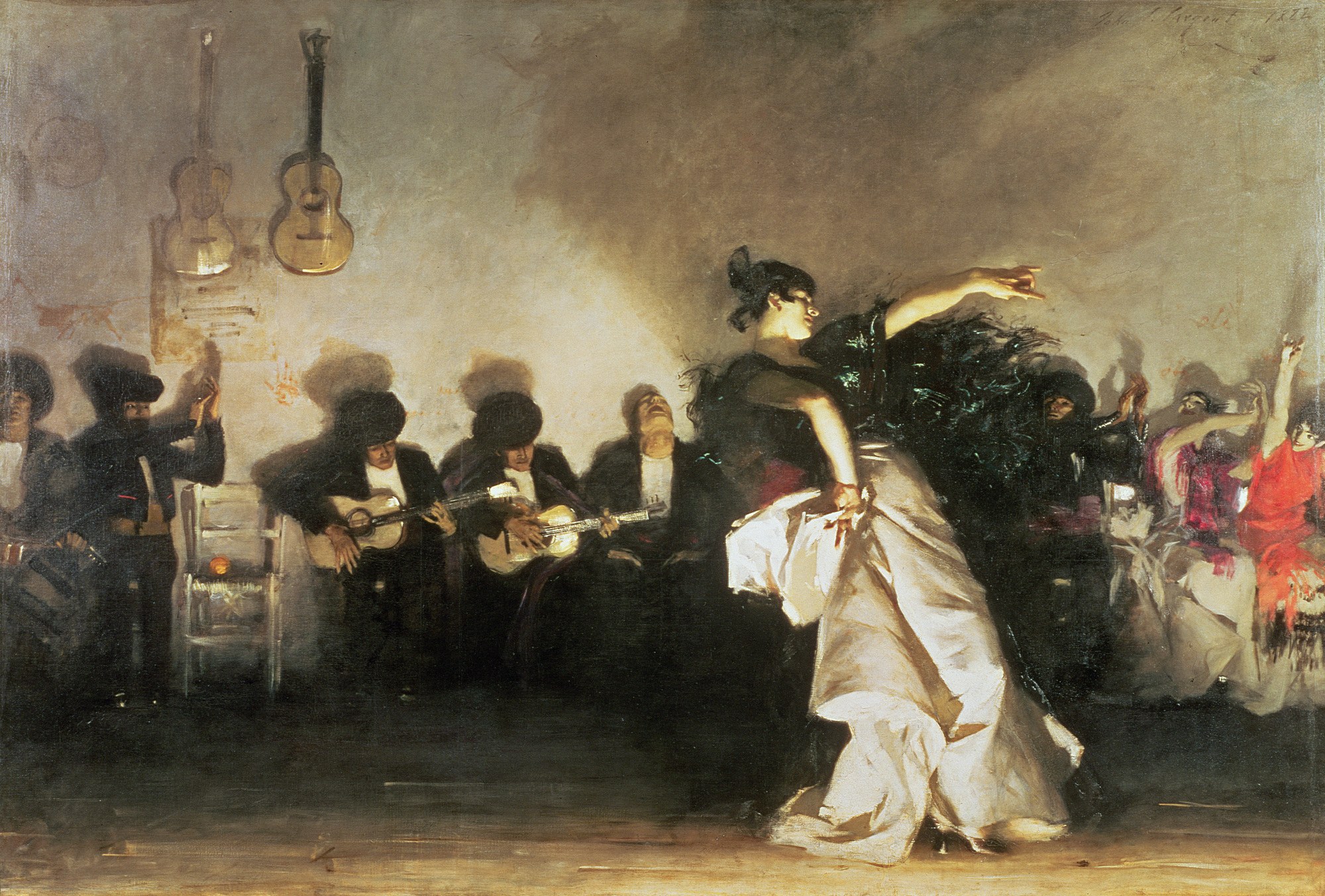
A flamenco dancer in white dress dominates the center foreground, captured mid-performance with one arm extended upward and her body in a dramatic, arched pose. She wears a long white skirt with a black jacket or shawl draped across her shoulders, her dark hair adorned with flowers. Behind her, seated musicians in dark formal dress play guitars, their forms somewhat dissolved into shadow and atmospheric haze. The background dissolves into a crowded, indistinct crowd rendered in warm ochres and browns—an audience or gathering of onlookers barely suggested through loose brushwork. Two guitars hang on the wall above, silhouetted against the luminous, smoky background. The lighting is theatrical and dramatic, with a warm golden glow emanating from an unseen source, creating strong contrasts between the illuminated dancer and the shadowed figures around her. The composition pulls the eye toward the solitary performer while the atmospheric background conveys the energy and intimacy of a live performance space.
The dancing
The central dancer's body is extended in a distinctive pose: her torso arches backward, her raised arm reaches upward with expressive hand articulation, while her lower body appears grounded in a strong stance. This asymmetrical position—one side active and elevated, the other anchoring—is characteristic of flamenco movement. The seated guitarists maintain formal, contained postures, their bodies bent toward their instruments in supporting roles. The surrounding crowd figures are rendered as passive silhouettes or partial forms, establishing spatial depth and the performance context rather than active participation.
The dance depicted
This depicts flamenco dancing at an intimate venue or celebration, most likely from the mid-to-late 19th century Spanish tradition. The solitary female dancer, the live guitar accompaniment, the mixed audience, and the informal lighting all suggest a juerga—a spontaneous flamenco gathering in a private or semi-public space. The dancer's extended, arched line and upward reach are consistent with styles of emotional, expressive flamenco such as cante jondo or alegrías, where the body becomes a vehicle for intense expression. The emphasis on a single figure against a supporting cast of musicians and audience indicates the dancer's role as principal interpreter or celebrated performer.
How it was made
Oil painting on canvas, executed with impressionistic and romantic sensibilities. Sargent used loose, atmospheric brushwork in the background to suggest crowd and space without defining individual figures, while reserving precise articulation for the central dancer and foreground musicians. This technique creates a spotlight effect—the viewer's attention is optically drawn to the sharp rendering of the dancer's form against the deliberately undefined surroundings. The warm, glowing palette and the use of shadow to model form are consistent with late 19th-century salon painting and theatrical subject matter.
About this work
This is Sargent's *El Jaleo*, a large-scale oil painting that captures a moment of flamenco performance in its vital, lived context. The work stands at the intersection of orientalism, Spanish romanticism, and late 19th-century artistic fascination with 'authentic' folk and popular culture. The painting commemorates flamenco not as a technical achievement in the modern ballroom sense but as an intensely personal, emotionally charged performance tradition embedded in Spanish social life. For audiences in 1882, the work offered a glimpse into a world perceived as exotic and passionate—Spain's Andalusian interior, with its guitars, dark-eyed dancers, and bohemian energy. The composition privileges the individual dancer's expressive gesture over the structured partnering or geometric formations of ballroom or court dance.
How to look at it
Attend to the moment Sargent has chosen: the dancer is not in a static pose but captured mid-phrase, her body expressing an emotional peak rather than a held position. The upward reach and backward arch suggest abandonment, ecstasy, or intense feeling—a moment of climax rather than beginning or transition. Notice how the warm light rakes across her body, emphasizing the white dress and the articulation of her limbs, while the background falls into atmospheric obscurity. This compositional choice—sharp focus on the principal dancer, softness everywhere else—was not the default in 1882 and reflects Sargent's interest in photographic and theatrical lighting effects. The guitars on the wall and the seated musicians ground this as a real performance space rather than an imagined or orientalist fantasy.
The artist
John Singer Sargent (1856–1925) was an American painter trained in Paris and known for his society portraits and his ability to capture both physical likeness and psychological presence. He worked extensively in Spain and had deep engagement with Spanish visual culture, particularly during the 1880s when he travelled extensively. Sargent was among the leading painters of his generation and maintained a studio practice that combined portraiture with ambitious subject paintings, often drawn from travel, literature, or historical subjects. His work with flamenco and Spanish themes contributed to the broader 19th-century European fascination with Spanish identity and Andalusian culture.
The period
In the 1880s, flamenco was undergoing significant transformation in Spain itself—moving from purely informal, participatory practice toward staged performance for paying audiences, a shift partly driven by touring dancers and the commercial cabaret. Simultaneously, European and American artists were intensely interested in Spanish culture as a source of authenticity, passion, and exoticism. This was the era of late Romanticism and the rise of orientalism and regionalism in art. Sargent's painting coincides with the early professionalization and internationalization of flamenco performance, and it captures the moment just before the dance became fully commodified for export. The painting's emphasis on the performer's emotional intensity rather than technique reflects 19th-century aesthetic values that prized authentic feeling and individual expression over formal mastery.
Where it lives
The painting's current holding collection is not recorded in the catalogue data provided. The work is known to exist and is accessible through major museum collections and reproductions; the image comes from Wikimedia Commons.
Dance in this work
Questions about this work
Is this a real performance or a fantasy?
Sargent based this on observed flamenco performance in Spain and depicted recognizable elements of actual performance practice: the formal guitarist accompaniment, the solitary dancer, the mixed audience, and the informal venue. However, the painting romanticizes and heightens the emotional intensity of the moment. This is a document of a real tradition rendered through a 19th-century romantic lens, not an invented scene.
What is 'el jaleo'?
Jaleo refers to an excited, celebratory atmosphere—the energy and encouragement of a crowd during flamenco performance. It can also denote a specific joyful, rhythmic style within flamenco. Sargent's title invokes this sense of infectious energy and emotional communality around the solitary dancer.
Why are the guitars hanging on the wall?
The guitars are both a functional element—instruments available for playing—and a symbolic one, marking this as a space dedicated to musical performance. Their placement suggests an informal venue, possibly a private home or tavern, rather than a formal theater. This reinforces the sense of flamenco as an intimate, participatory tradition.
What is the dancer wearing?
A long white skirt with a black jacket, shawl, or fitted bodice—a costume that differs from both street dress and the heavily decorated flamenco dresses of later theatrical tradition. This suggests the formal-yet-intimate context of a juerga, where dancers wore their best clothing but not specialized stage costumes.
More dance artwork