41 works in this view — arrow keys or swipe to move between them.
Dance in Art · 1925
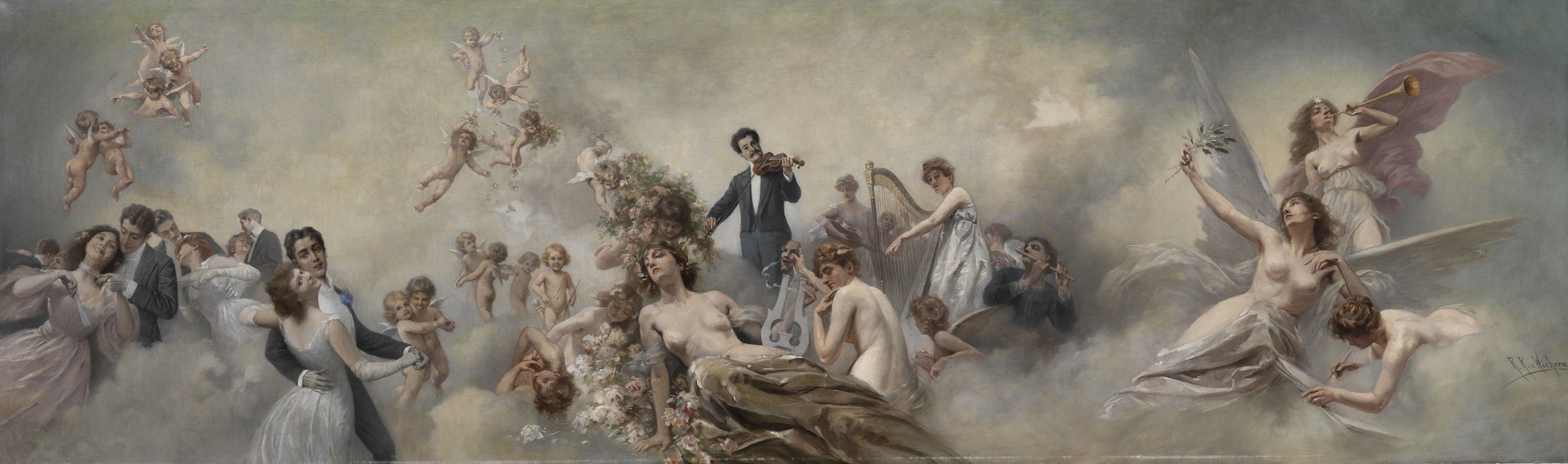
R R von Wichera Verträumte Ballszene
Raimund von Wichera
- Medium:
- Oil Painting
- Era:
- 1920-1950 (Swing Era)
- Source:
- Wikimedia Commons
- Rights:
- Public domain — free to use, share and adapt.
- Recorded as:
- Public Domain
This work is valuable evidence of how formal ballroom dance was visualized and mythologized in the 1920s — not as mere entertainment but as an activity worthy of allegorical treatment. It documents the clothing, etiquette, and social composition of the European ball at a moment when such events were still central to upper-class life, even as broader social change was beginning to transform dance and society.
What you are looking at
A heavenly ballroom scene painted in soft, luminous tones dominated by pale cream and gray clouds. A formally dressed couple occupies the center — a man in black tailcoat and a woman in white gown — surrounded by an assembly of figures in evening dress and classical drapery. The setting blurs the boundary between a 1920s formal ball and an allegorical heaven: earthly musicians with instruments (harp visible) mingle with partially draped classical figures and cherubs. The composition is organized in loose tiers rising upward, with the central couple as anchor point, while attending figures gesture, converse, and make music. The entire scene is rendered in soft chiaroscuro, with warm light suggesting interior artificial illumination typical of a grand ballroom, yet the floating arrangement and classical elements suggest this is an imagined or transcendent space. The palette is predominantly whites, creams, pale grays, and muted flesh tones, with touches of gold and warm brown.
The dancing
The central couple stand in a formal dance position: the woman faces left in a white gown with her partner in evening dress attending her. Around them, figures are arranged in varied poses of conversation, performance, and spectatorship. Several women wear classical drapery or flowing white garments; men appear in contemporary evening wear. The poses are predominantly upright and dignified — some seated or standing in conversational groups, others gesturing expressively. Musicians hold instruments (harp, possibly violin) in performance gesture. Arms are extended in graceful, open positions; the overall mood is one of refined leisure rather than energetic movement. The composition suggests social interaction and formal social dance rather than virtuosic or vigorous technique.
The dance depicted
This is a depiction of formal ballroom dance in an idealized, allegorical register. The scene represents a society ball — a major event in European upper-class life — but transposed into a dreamlike, transcendent setting. The central couple appear to be waltzing or in a formal closed position associated with court dances or the contemporary ballroom waltz. The presence of live musicians and the assemblage of formally dressed witnesses reflect the actual conduct of such events, where a ball was both social dance and theatrical spectacle. The title *Verträumte Ballszene* (Dreamlike Ball Scene) indicates the work deliberately merges the worldly social dance with an ethereal, imaginative realm. The style cannot be precisely determined from posture and footwork alone; the image shows that the artist understood the formal, upright carriage and social hierarchy of early twentieth-century ballroom culture.
How it was made
Oil painting on canvas, executed in a Romantic and Symbolist idiom characteristic of early twentieth-century academic and salon art. The soft, diffused light and blended forms are achieved through glazing and careful modulation of tone rather than sharp definition. The technique allows the artist to create an atmospheric, dream-like quality by dissolving boundaries between figures and cloud, and by using light itself as a unifying element. This style of painting was well-established in salon and society portraiture, and would have been circulated through exhibition and reproduction in art journals and books. The scale and refinement suggest a work made for exhibition or a private collector of means.
About this work
This is an oil painting from 1925 by Raimund von Wichera depicting a formal ball scene elevated into an allegorical space. The artist merges the social reality of a 1920s ballroom — couples in evening dress, live musicians, formal social dance — with a transcendent, heavenly realm rendered through classical and allegorical iconography. The work sits at the intersection of social realism and Symbolism, documenting a historical moment in dance culture while investing it with imaginative and spiritual significance.
Wichera's painting captures a pivotal moment in European social life: the formal ball as both social ritual and spectacle. The image documents the clothing, posture, and social arrangements of the 1920s ballroom while transforming them into something timeless. The gentle merging of the earthly and the transcendent suggests that formal social dance was understood as an elevated activity — a space where social order, physical grace, and something approaching the sacred could coexist.
How to look at it
Attend first to the central couple and their formal, upright posture — this is the anchor of the composition and the clearest indication of the dance being depicted. Notice how the artist has used light and cloud to dissolve the boundary between ballroom and heaven, suggesting that formal social dance was understood as an elevated or semi-sacred activity. Look at the distribution of musicians and figures: the harp player, the formally dressed witnesses, the mix of classical and contemporary dress. This layering tells you that the artist is collapsing historical and imaginative time — making the ballroom simultaneously contemporary (1920s) and timeless (classical, allegorical). The soft focus and luminosity are deliberate: they signal dream, memory, or spiritual elevation rather than documentary realism.
The artist
Raimund von Wichera (dates not confirmed in catalogue) was a painter working in German or Austrian tradition in the early twentieth century. The work demonstrates familiarity with academic salon painting, Symbolism, and the decorative conventions of Romantic tradition. His choice to render a contemporary social scene — the 1920s ball — in allegorical and classical register reflects a broader early twentieth-century tendency to invest modern social life with timeless or mythic significance.
The period
In 1925, the ballroom was entering a period of transition. The formal ball remained central to upper-class European social life, governed by strict etiquette and prescribed dances. Yet jazz was beginning to influence popular dance in urban centers, and the post-World War I era brought social and moral questioning of traditional forms. Academic painters and salon artists were still depicting formal society life, but increasingly in retrospective or elegiac tones — commemorating a world under pressure. Wichera's choice to render the ball as a dream or transcendent space suggests awareness that this form of social dance and society was becoming historically charged, perhaps already feeling fragile or nostalgic.
Where it lives
The work is recorded as offered for sale by Hampel (a major German auction house), suggesting it was a private collection item in the German-speaking art market. The source for this page is Wikimedia Commons. No current holding institution is recorded in the catalogue.
Dance in this work
Questions about this work
What kind of dance is this?
This depicts a formal ballroom ball, likely a waltz or similar formal closed-position dance of the European salon. The specific style cannot be determined with certainty from the posture and positioning alone, but the setting, dress, and formal assembly make clear this is upper-class social dance, not theatrical or folk dance.
Why is this called a 'dreamlike' scene?
The German title *Verträumte Ballszene* points to the artist's deliberate blending of the earthly ballroom with a heavenly or allegorical realm. Classical figures, cherubs, and diffused light suggest this is a memory, fantasy, or transcendent vision of a ball — not a documentary record but an imaginative vision of social dance as something elevated or spiritually significant.
What can this tell us about 1920s ballroom dance?
The image documents the formal dress (white gown, tailcoat for men), the presence of live musicians, the upright posture and closed-position partnering, and the social structure of the event — all hallmarks of upper-class European ballroom culture in this period. It also suggests that by 1925, painters were beginning to treat the formal ball as historically significant or even nostalgic, a world worth memorializing.
More dance artwork