42 works in this view — arrow keys or swipe to move between them.
Dance in Art · 1925
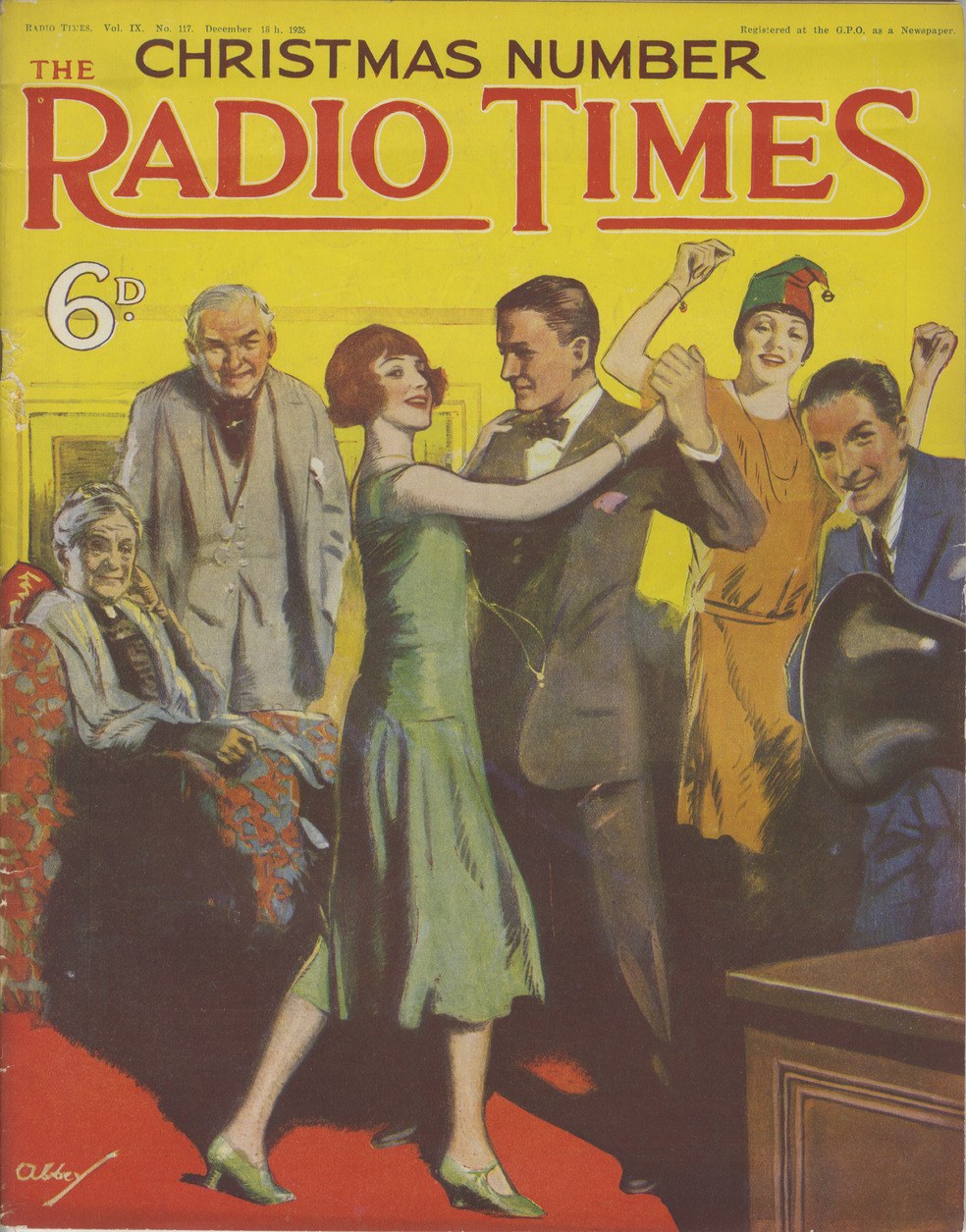
Radio Times - 1925-12-18 - cover
Salomon van Abbé (illustrator)
- Medium:
- Oil Painting
- Era:
- 1920-1950 (Swing Era)
- Source:
- Wikimedia Commons
- Rights:
- Public domain — free to use, share and adapt.
- Recorded as:
- Public Domain
This is a primary source for how dancing was understood and depicted in 1920s popular culture. It shows ballroom dance not as a formal competitive practice but as spontaneous domestic pleasure, and it documents the visual language magazine artists used to represent movement to a mass audience. The work is also significant as a record of the Christmas entertainment and social ritual of the period.
What you are looking at
A festive Christmas party scene rendered in bright oils on a warm yellow background. Seven figures in fashionable 1920s dress occupy a stylised interior: an elderly woman in a patterned robe sits at left, while behind her stands an older man in a grey suit observing the gathering. At centre, a young woman in a pale green dropped-waist dress dances with a man in a brown suit who supports her raised arm. To the right, a woman in a gold dress with arms aloft laughs with abandon, and a man in a blue jacket grins beside her. A festive paper crown sits on one figure's head. The floor is a deep red, and the composition suggests the exuberant energy of a house party in full swing. The illustrator uses bold outlines and simplified forms typical of magazine cover art of the period.
The dancing
The dancing couple at centre hold a modified ballroom frame: the man's hand supports the woman's raised right arm while his other arm is at her waist, but the pose is relaxed and social rather than formally closed. The woman's body twists slightly as her arm lifts, suggesting a sprightly turning movement. The adjacent figure in gold has both arms raised high in an unstructured, celebratory gesture. The standing figures watch with engaged, smiling expressions, indicating participation in social merriment rather than formal spectatorship.
The dance depicted
This depicts ballroom or social dancing as it was practiced in fashionable house parties of the 1920s. The posture, dress, and setting suggest the quick, animated dances popular in the Swing Era: likely a foxtrot, quickstep, or similar social ballroom style of the period. The informality of the frame and the exuberant arm positions indicate the looser, more playful interpretation of ballroom technique that characterised social dancing alongside the more rigid competitive forms. The Christmas setting suggests this is amateur social dancing rather than professional performance.
How it was made
The work is identified in the catalogue as an oil painting, and the image confirms this: the illustration demonstrates the flat colour planes, bold linear definition, and slightly stylised perspective typical of magazine cover art of the 1920s. The technique—relatively loose brushwork with crisp outlines—was well suited to colour reproduction in print, and the work served as the cover of the Radio Times Christmas edition. The painting's style prioritises clear, readable imagery over naturalistic depth, appropriate for a mass-audience publication.
About this work
This is the cover illustration for the Christmas edition of Radio Times magazine (20–26 December 1925), painted by Salomon van Abbé. It captures the spirit of holiday entertainment and domestic gaiety at a moment when radio was transforming popular culture and the living room had become a site of entertainment and social gathering. The dancing figures are situated within a context of radio-age modernity: the magazine itself promoted broadcasts of dance music and entertainment that listeners could enjoy at home. The work celebrates both the new medium and the social practices—dancing, socialising, celebration—it enabled and encouraged.
How to look at it
Observe the dancing couple at centre: the woman's raised arm and the man's supporting hand capture a moment of upward momentum and turning, the kind of lift and rotation characteristic of quickstep or foxtrot. Notice how the artist has chosen a moment of animation rather than a posed tableau—the woman's body is in motion, the nearby figure's arms are flung up in unrestrained joy, and the onlookers' expressions suggest laughter and participation. This is a snapshot of pleasure in action, not a formal portrait of dance technique. The bold outlines and flat colour planes also signal this is magazine illustration made for rapid consumption and recognition by a mass audience, not fine art.
The artist
Salomon van Abbé (1883–1951) was a prolific illustrator and graphic designer who worked extensively for British publications in the 1920s and 1930s. He specialised in cover art and editorial illustration, with a distinctive style characterised by bold outlines, simplified forms, and vibrant colour. His work appeared regularly in Radio Times and other periodicals, and he was skilled at capturing contemporary dress, leisure, and social life in imagery accessible to a broad readership.
The period
The 1920s saw a boom in ballroom dancing and social dancing culture in Britain and Europe. The era was defined by newer, faster dances—the foxtrot, quickstep, and charleston—that displaced the stately waltzes of the Victorian and Edwardian eras. Radio was revolutionising entertainment: dance music broadcasts became a central part of radio programming, and home listening encouraged amateur dancing in the living room. This Christmas illustration sits at the intersection of two transformations: the new informality and speed of 1920s dance, and the domestic, mediated experience of entertainment via radio.
Where it lives
This is the cover (wrap-around with unnumbered pages) of the Christmas edition of Radio Times magazine, published 20–26 December 1925. Radio Times was the BBC's official programme journal and the most widely circulated periodical of its kind in Britain. Magazine covers of this era were ephemeral objects, mass-produced and intended for disposal after reading, which makes surviving copies historically significant.
Dance in this work
Questions about this work
What dance style is being shown?
This depicts social ballroom dancing of the 1920s, most likely a foxtrot or quickstep—the faster, more animated dances that defined the Swing Era. The loose arm positions and playful energy distinguish it from the formal competitive ballroom technique that would crystallise in the 1930s. It is emphatically a house party, not a competition or theatrical performance.
Why is this a Radio Times cover?
Radio Times was the BBC's weekly programme guide and a major cultural publication. Christmas was a key moment in the broadcasting calendar, and entertainment and domestic socialising were central to the BBC's promotion of radio as a medium for home leisure. This cover celebrated both the festive season and the role of radio in enabling and soundtracking domestic pleasure.
Who was Salomon van Abbé?
Van Abbé (1883–1951) was a Dutch-born illustrator who worked extensively for British publications in the interwar period. He was known for accessible, energetic illustration of contemporary social life, and his covers for Radio Times and other periodicals made his style recognisable to millions of ordinary readers.
Is this oil painting or print?
The catalogue records it as an oil painting. However, it was created as a magazine cover and would have been reproduced in colour print for mass distribution. The loose, flat style and bold outlines are typical of illustration designed for reliable colour reproduction on the page.
More dance artwork