49 works in this view — arrow keys or swipe to move between them.
Dance in Art
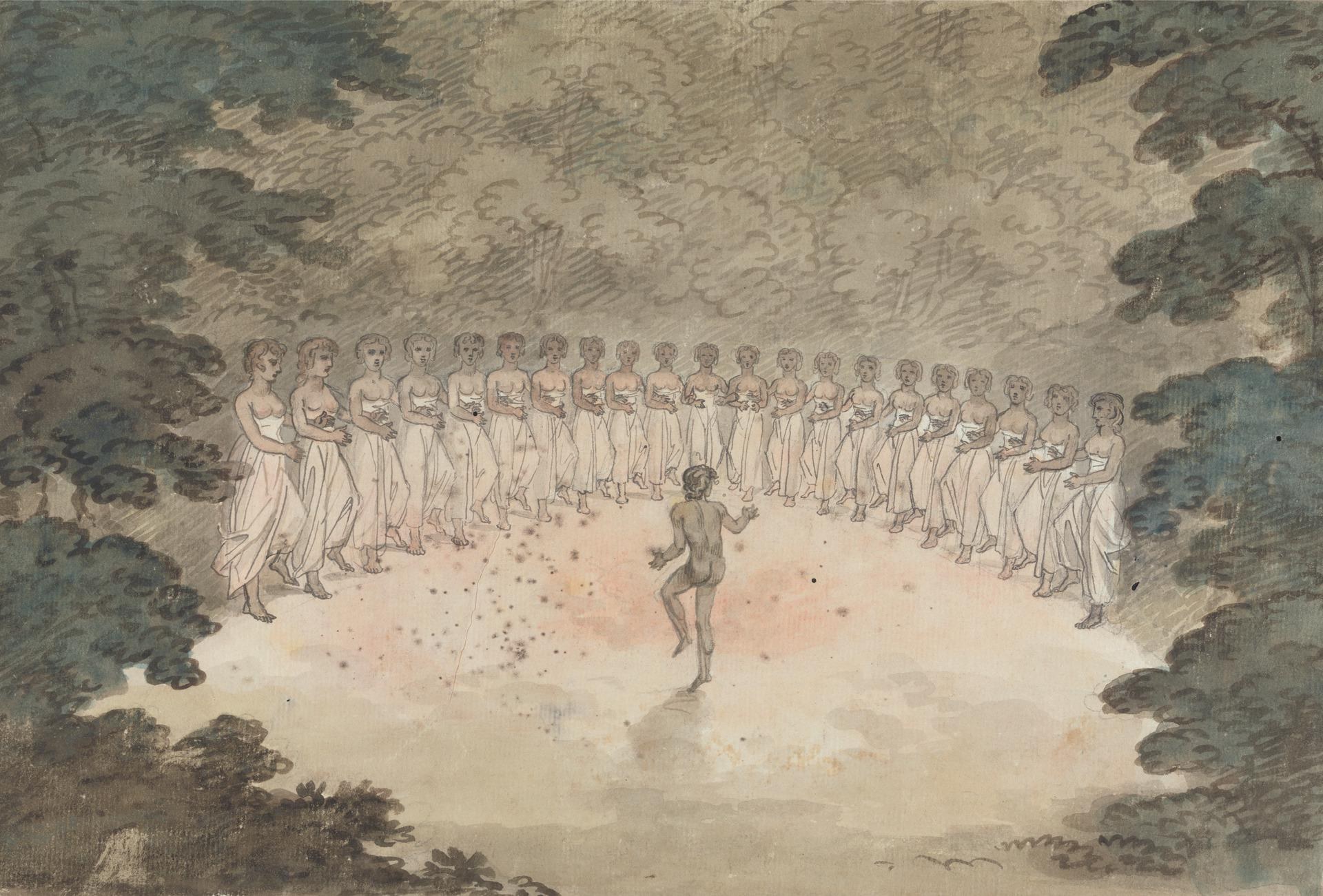
Robert Mabon - Female Dancers - B1977.14.22428 - Yale Center for British Art
Robert Mabon
- Medium:
- Oil Painting
- Source:
- Wikimedia Commons
- Rights:
- Public domain — free to use, share and adapt.
- Recorded as:
- CC0
This image is essential evidence of how Romantic ballet was conceived and marketed: the idealization of the female corps de ballet as a harmonious, otherworldly ensemble, and the dramatic supremacy of a singular (male) figure as the source of action and meaning. For historians, it demonstrates the visual strategies by which ballet created and commodified the fantasy of the ethereal, interchangeable female dancer—a convention with profound consequences for the art form. For performers and choreographers, it illustrates a foundational vocabulary of ballet staging that remains influential.
What you are looking at
A large ensemble of female dancers in classical dress occupies the center of a clearing ringed by dense, dark foliage. The women wear pale, high-waisted gowns typical of early 19th-century Romantic ballet—long, translucent skirts and fitted bodices—and stand in a loose semi-circular formation facing inward. At the center stands a single male figure, unclothed or nearly so, gesturing expressively with arms raised and spread. The composition suggests a moment of encounter or revelation: the women are still and attentive, their bodies aligned in a choreographed arrangement, while the central figure animates the scene with dynamic, open-armed gesture. The setting is sylvan and atmospheric—the surrounding trees create a frame of shadow and texture that isolates this gathering, lending the scene an otherworldly or supernatural quality. The palette is dominated by pale ochres and warm grays in the clearing, contrasting sharply with the deeper greens and blacks of the enclosing woodland.
The dancing
The ensemble dancers maintain a formal, aligned posture with bodies erect and arms held at their sides or loosely at the front of the torso, suggesting a moment of pause in an ordered arrangement rather than active movement. Each woman is rendered individually but anonymously, with attention to the fall of their gowns but not to individual personalities. The central male figure is isolated, depicted in a contrapposto stance with both arms raised and extended outward, his body weight shifted and his pose suggesting vocalization or ecstatic utterance. The relationship between the still, watching ensemble and the expressive central figure proposes a hierarchical structure of attention and agency.
The dance depicted
This appears to depict a scene from Romantic-era ballet, most likely from a narrative work in which a supernatural or otherworldly male figure encounters a corps de ballet of female dancers. The composition and dress are consistent with early 19th-century European ballet, where such ensemble scenes—often representing spirits, nymphs, or maidens in an enchanted place—were a standard theatrical device. The women's posture suggests the formal, linear placement typical of ballet corps work, while the central figure's expressive pose implies a moment of dramatic action or song. Without documentation, the specific ballet cannot be confirmed, but the visual vocabulary points clearly to Romantic ballet convention.
How it was made
The work is executed in oil paint with fine pen-and-ink line work, creating a hybrid technique common in theatrical and literary illustration of the early 19th century. The artist has used thin washes of color—ochres, greens, and grays—over a detailed linear underdrawing, which allows for both precise definition of forms (especially the gowns and faces) and atmospheric effects in the landscape. This technique was well-suited to reproductive purposes: such works were often engraved or lithographed for wider circulation as ballet souvenirs or theatrical records. The combination of meticulous figure drawing with looser, more expressive landscape treatment is characteristic of artistic practice for documenting or imagining performance.
About this work
This drawing or small painting records a moment from Romantic-era ballet, depicting a clearing in which a male figure, possibly supernatural, addresses a corps de ballet of women in classical dress. The work is typical of early 19th-century theatrical imagery, produced to preserve, promote, or elaborate upon the spectacles of the Romantic stage. Its primary interest lies in documenting the visual conventions of ballet during its most popular and influential period: the formal arrangement of the corps, the ethereal costume, the staged encounter between a solitary, expressive figure and a harmonious ensemble. The work likely served as a record or fantasy image of a performance, circulating among theater enthusiasts and collectors.
How to look at it
Attend to the absolute stillness of the ensemble and the dynamism of the central figure: the artist has captured not a moment of synchronized movement, but a moment of theatrical presentation, in which the corps provides a background for a solitary protagonist. Notice how the artist has rendered each dancer as an individual body while denying them individual expression or agency—they are a visual unit, defined by their alignment and dress rather than by gesture or personality. The surrounding forest creates a frame that insulates this gathering from the everyday world, a visual convention that signals to the viewer that something otherworldly or imaginary is taking place.
The artist
Robert Mabon (or Maboni) was a London-based theatrical illustrator and painter active in the early 19th century, known for recording and imagining scenes from contemporary ballet and opera. Little biographical detail survives, but his work circulated among theater patrons and collectors as both documentation of celebrated performances and artistic elaborations on theatrical themes. His technique—combining fine pen work with watercolor or oil wash—was standard among theatrical illustrators of the period and suggests training in both fine art and the reproductive arts.
The period
This work dates to the height of European Romantic ballet (approximately 1830–1850), when the art form was at the apex of its cultural prominence and influence. The sylvan setting, the supernatural subject matter, and the visual emphasis on the ethereal female dancer reflect the Romantic movement's fascination with nature, the otherworldly, and the idealization of femininity. In the theater, this period saw the development of the corps de ballet as a unified visual force, with women arranged in symmetrical, often diamond-shaped formations. The pale, long tutu—seen here in its early form—became the iconic costume of Romantic ballet and symbolized the dancer as an ethereal, almost inhuman being.
Where it lives
The work is held at the Yale Center for British Art (accession B1977.14.22428), where it is catalogued as an oil painting by Robert Mabon. No further provenance details are recorded in the catalogue.
Dance in this work
Questions about this work
What ballet is this from?
The specific ballet cannot be determined from the image alone. The costume, setting, and composition are consistent with several Romantic-era works—possibly La Sylphide, Giselle, or similar ballets in which a male character encounters a corps de ballet in an enchanted or supernatural space. Documentary evidence (a title, inscription, or provenance note) would be required to identify the exact source.
Why are all the women dressed alike?
In Romantic ballet, the corps de ballet—the ensemble of female dancers—wore identical or nearly identical costumes as a visual strategy: it unified them into a single, harmonious visual force and emphasized their role as a backdrop for the principal dancers or the dramatic action. The uniformity was also practical: it simplified costume production and created a striking theatrical effect on stage.
Who is the male figure?
Without documentation, the identity of this figure cannot be confirmed. Given the pose, the enchanted setting, and the context of Romantic ballet, he is likely a supernatural being—a spirit, god, or otherworldly visitor—rather than a human lover or hero. Such figures were common protagonists in the narrative ballets of this era.
Is this a record of an actual performance or an imagined scene?
This is likely an artistic elaboration or interpretation rather than a precise record of a specific production. Theatrical painters of the period often created idealized or imaginative versions of performances, combining observed elements (costumes, formations) with their own compositional and narrative choices. Such works were valued both as souvenirs and as artworks in their own right.
More dance artwork