49 works in this view — arrow keys or swipe to move between them.
Dance in Art · 1835
Rugendas lundu 1835
Johann Moritz Rugendas
- Medium:
- Oil Painting
- Era:
- Mid 1800s (Polka Era)
- Source:
- Wikimedia Commons
- Rights:
- Public domain — free to use, share and adapt.
- Recorded as:
- Public Domain
Lundu is a foundational dance in Brazilian and Afro-diasporic dance history, yet visual documentation of its performance in its own time is scarce. Rugendas's image is one of the few surviving contemporary depictions and shows the dance as a lived, embodied practice in a specific social context, not a later theatrical reconstruction. For dancers and historians, it is an invaluable record of posture, spacing, and setting that reveals how this dance was integrated into colonial Brazilian social life.
What you are looking at
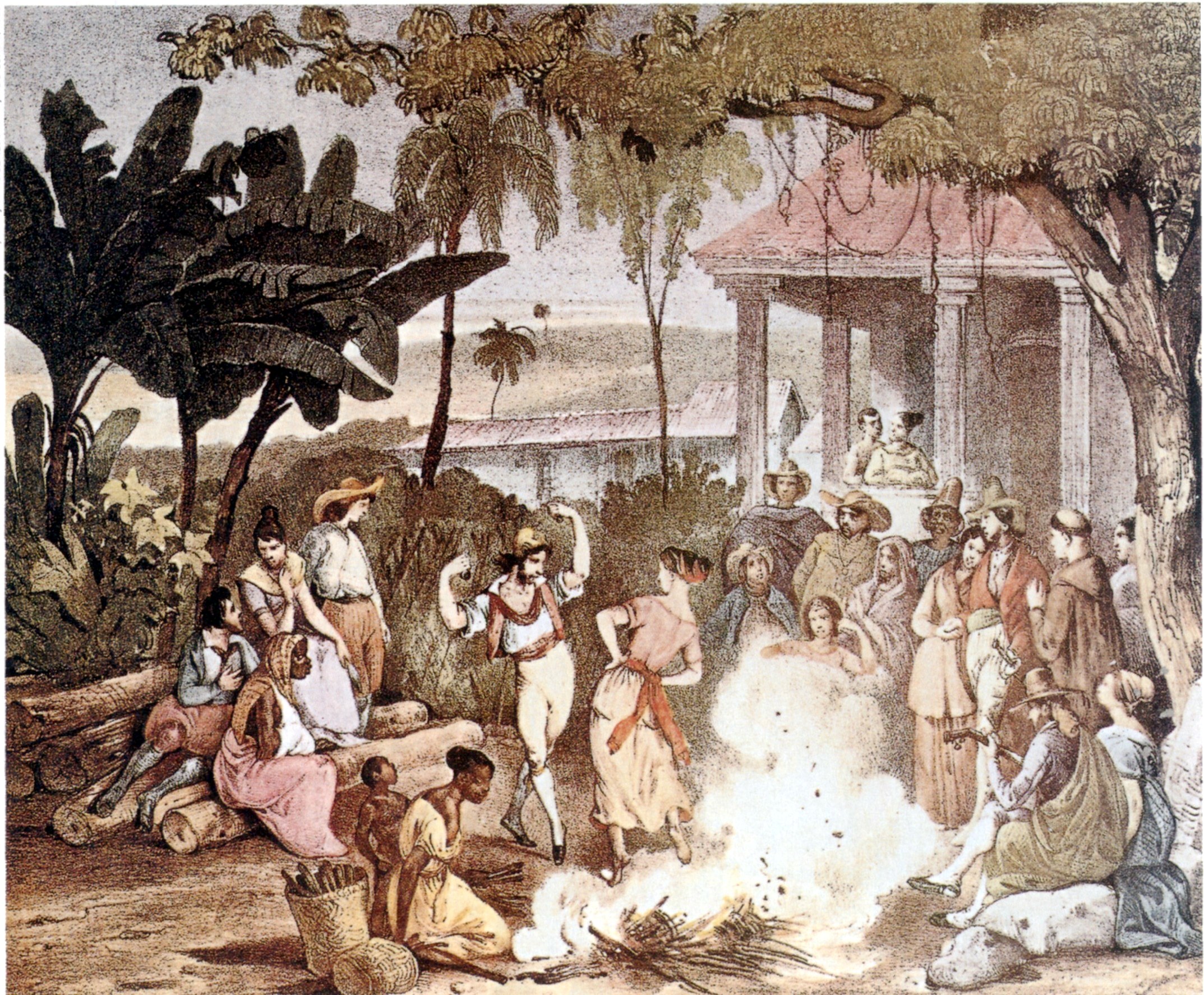
A colonial Brazilian scene centered on a bonfire around which figures dance and gather in the evening. The composition divides into two zones: at left, a small group of enslaved people and free persons dance near large tropical plants and the fire; at right, European colonists and their companions sit or stand on a verandah of a substantial house, observing. The foreground shows the dancers in lighter dress, their bodies in motion; the background recedes to water and distant landscape. The artist has rendered the scene in hand-colored engraving or aquatint, with atmospheric perspective and careful attention to the architectural setting. The moment captures a social interaction across racial lines in Portuguese colonial Brazil, with the fire as focal point and the dancing as entertainment for the watching colonists.
The dancing
The dancers at left show varied postures: some stand with arms raised or extended, others bend or sway. The figures near the fire display the characteristic hip-forward, fluid torso movement of lundu—one woman in a salmon-pink dress leans back with arms gesturing upward, her weight appearing to shift through the hips. The pose suggests rhythmic, sensual movement with emphasis on the lower body and spine rather than the formal carriage of European court dance. No closed holds are visible; the dancers appear to move individually or in loose formation, with significant space between bodies.
The dance depicted
This is a lundu, a Brazilian social dance of African origin that became popular in the 18th and early 19th centuries among enslaved and free people of color, and eventually among all classes in colonial Brazil. The lundu was characterized by rhythmic hip and torso movement, often performed solo or in pairs facing each other, with music provided by percussion and voice. The image captures the dance in a domestic or plantation setting, which aligns with historical accounts of lundu as an informal, social dance performed at evening gatherings. The painting documents lundu as a lived practice in colonial society, not as a theatrical or formalized style.
How it was made
The work is a hand-colored engraving or aquatint, a reproductive print technique that allowed for wide circulation in the early 19th century. Rugendas likely worked from a drawing made during his travels in Brazil (1822–1831); the technique implies this was intended as a documentary record for a European audience unfamiliar with Brazilian colonial life. The hand-coloring—particularly the salmon and ochre tones of the dancers' clothing and the golden firelight—was applied after printing and varies among impressions. The precision of line combined with the atmospheric wash of color creates a theatrical but observational quality.
About this work
This is one of a series of Brazilian scenes by German-Brazilian artist Johann Moritz Rugendas, documenting colonial society and dance practices he witnessed during his travels. The image shows lundu, an African-rooted Brazilian dance, performed at an evening gathering on what appears to be a plantation or colonial dwelling. The composition stages a cultural encounter: enslaved and free Black Brazilians dancing for the entertainment and edification of European colonists watching from the verandah. The work is valuable both as visual documentation of how lundu was actually performed in the early 19th century and as evidence of the social hierarchies and racial dynamics through which European observers framed Brazilian dance.
How to look at it
Attend to the contrast between the two groups: the dancers' open, mobile postures and the colonists' seated, enclosed positions. The artist has frozen the lundu at a moment of clear movement—the woman in pink leans back, suggesting the rhythmic undulation of the hips that defined the dance. Notice how the firelight illuminates the dancers while leaving the colonists in shadow; this compositional choice reflects both the practical lighting of an evening gathering and the ideological positioning of the colonists as observers rather than participants. The tropical plants framing the left side anchor the scene geographically while the neoclassical architecture of the house asserts European presence and control.
The artist
Johann Moritz Rugendas (1802–1858) was a German painter and naturalist who traveled throughout the Americas documenting landscape, indigenous peoples, and colonial society. His Brazilian sojourn (1822–1831) produced a large body of sketches and painted studies that he later refined into engravings and published series. Rugendas worked in the tradition of scientific illustration and ethnographic documentation, combining artistic skill with observational intent. His Brazilian works are now primary sources for understanding early 19th-century colonial society, though they are filtered through his European perspective and the aesthetic conventions of the print market for which they were made.
The period
The early 19th century was a period of heightened European interest in the Americas following independence movements and increased travel. In Brazil specifically, the Portuguese royal family's flight to Brazil during the Napoleonic Wars (1808) had opened the colony to European observers and influences. Lundu itself was at a transitional moment: it had emerged in the 18th century among enslaved people and free people of color, and by Rugendas's time was spreading upward through Brazilian society, though it remained coded as vulgar or indecent by conservative European standards. The dance occupied an ambiguous space between folk practice and emerging national identity. In art, the period saw growing appetite for ethnographic and documentary prints of colonial territories, feeding European curiosity about 'exotic' peoples and customs.
Where it lives
The work is recorded as a Rugendas study from 1835, held in Wikimedia Commons. The catalogue record provides minimal information; the work may be part of a larger series or publication of Brazilian scenes, but no collection location or accession number is currently recorded.
Dance in this work
Questions about this work
What is lundu and why is it important?
Lundu is a Brazilian social dance with African roots that emerged in the 18th century among enslaved and free people of color. It is characterized by rhythmic movement of the hips and torso, often performed solo or in pairs. Lundu became foundational to Brazilian identity and is an ancestor of later dances like samba. This image is a rare contemporary visual document of how the dance was actually performed and integrated into colonial society.
Why are the colonists and the dancers separated in this composition?
The spatial division reflects the racial and social hierarchies of colonial Brazil. The dancers are positioned in the foreground and near the fire—visible, entertaining, but distinct—while the colonists occupy the architecture and the background, watching from a position of authority. This arrangement documents not just a dance, but a social relationship in which dance was a form of entertainment for the colonizing class.
How does Rugendas's style of documentation work?
Rugendas combined direct observation with artistic skill, creating images intended for European circulation and consumption. He worked in the idiom of scientific illustration and ethnographic print, using precision of line and atmospheric color to lend authority to his observations. However, his images are always mediated through his European perspective and the aesthetic and social expectations of his intended audience.
Is this a painting or a print?
The catalogue lists it as an oil painting, but the image shows characteristics of a hand-colored engraving or aquatint—a printed and colored work rather than a unique painting. This discrepancy is noted in the record flags. Rugendas typically worked from drawings made during his travels, then refined them as engravings for publication, so the original may be a study or sketch in another medium.
More dance artwork