49 works in this view — arrow keys or swipe to move between them.
Dance in Art · 1835
Rugendascongada
Johann Moritz Rugendas
- Medium:
- Oil Painting
- Era:
- Mid 1800s (Polka Era)
- Source:
- Wikimedia Commons
- Rights:
- Public domain — free to use, share and adapt.
- Recorded as:
- Public Domain
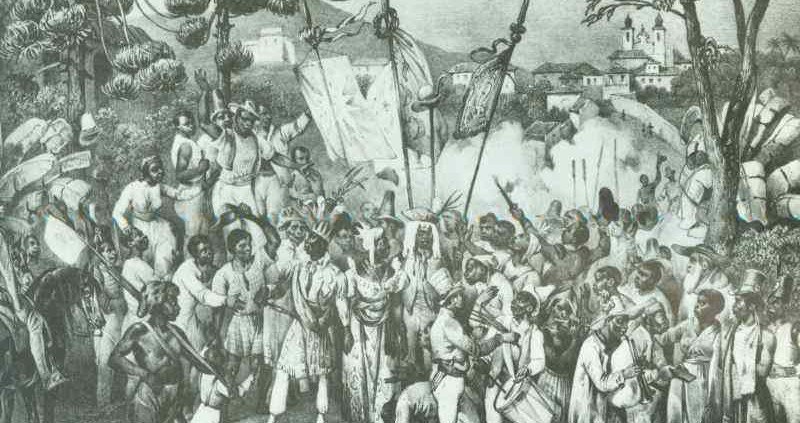
For dancers and historians, this print is valuable evidence of how the congada appeared and was understood in the early 19th century, and of how European artists chose to depict African and Afro-Brazilian movement in colonial and post-colonial contexts. It raises important questions about perspective, documentation, and the representation of Black bodies and practices in European visual culture during the period of slavery and its immediate aftermath.
What you are looking at
A densely populated outdoor gathering in a tropical or subtropical landscape, dominated by a large gathering of figures in white clothing arranged around a central open space. In the middle distance, a tall pole or staff is erected, with what appears to be a flag or banner at its top. The setting includes palm trees and vegetation; in the far background, a church or chapel with a distinctive dome is visible on a hillside, suggesting a colonial Brazilian settlement. The composition is crowded and dynamic, with figures distributed across the entire canvas in loose groupings rather than formal ranks. The print technique creates strong contrasts between the white garments of the dancers and the darker ground, trees, and sky, giving the scene both clarity and a sense of movement despite the static medium.
The dancing
The figures are shown in varied postures of movement and stillness, many with arms raised or extended, suggesting active participation in a collective celebration. Bodies are oriented in multiple directions across the composition, with no single unified front or formation. Several figures appear to be in motion with limbs extended, while others stand or gesture toward the central pole. The dress is predominantly white garments (chemises, simple tunics) worn by figures of various skin tones and ages, with some darker clothing visible on a few central figures. The overall impression is of spontaneous, uncoordinated movement rather than the precise positioning of formal European dance.
The dance depicted
This is almost certainly the congada, a processional and celebratory dance tradition of colonial and early-independent Brazil, rooted in African and Afro-Brazilian ritual and devotional practice. The congada historically involved enslaved and freed Africans and their descendants, often associated with the crowning of Congo kings in colonial festivals and Afro-Catholic celebrations. The gathering around the central pole, the white dress, the outdoor setting, and the church in the background are all consistent with congada processions. However, the specific choreography or movement vocabulary of the congada is difficult to discern from this print—whether it involved processional walking, rhythmic stepping, turning around the pole, or other structured forms remains unclear from the image alone.
How it was made
This is a steel or copper engraving, identifiable by the fine parallel hatching used to create tone and shadow, the delicate linear detail, and the characteristic uniform black line quality. The technique required cutting lines into a metal plate and inking the incised lines for printing, which allowed for wide circulation as a reproducible image. Engravings of this period and subject matter were often created by European artists documenting colonial life and indigenous or African practices for European audiences, making this a visual document intended for circulation in Europe as much as a record of Brazilian practice. The tight hatching and careful rendering of individual figures suggest a hand-engraved plate rather than a lithograph.
About this work
Rugendas's *Congada* documents a Brazilian festival gathering, centering on a celebratory and ritualistic assembly of figures in white dress around a central pole and flag, with a colonial church visible in the distance. The scene captures a moment in the congada tradition, an Afro-Brazilian festive and processional form with African roots, though it does so from the perspective of a European artist and print culture. The work is historically significant as visual evidence of Afro-Brazilian cultural life in the early 19th century, yet it is also a product of European ethnographic and picturesque conventions—a representation made for external consumption rather than an insider account.
How to look at it
Attend to the composition's deliberate informality: Rugendas has scattered his figures across the canvas rather than arranging them in the formal geometric patterns of European dance or processional imagery. Notice the raised arms and varied body orientations, which suggest participation and movement without the synchronized or paired formations of European ballroom or court dances. Look at the central pole and flag as a focal point and likely axis of the gathering, and consider how the church in the background frames the event as both a festive celebration and a Christian (or Christianized) occasion. The print's technical detail allows close reading of individual gestures, dress, and posture—elements that together construct the artist's interpretation of Afro-Brazilian collective movement.
The artist
Johann Moritz Rugendas (1802–1858) was a German painter and lithographer who traveled extensively in Latin America between 1821 and 1848, producing drawings, watercolors, and prints documenting landscapes, peoples, and customs. He worked in the tradition of European ethnographic and picturesque art, creating images intended for European audiences curious about colonial and post-colonial societies. His works were widely circulated as engravings and formed the basis for published illustrated travel accounts, making him influential in shaping European visual understanding of the Americas in this period.
The period
In 1835, Brazil was in the early decades of independence (1822) and in the midst of the slave economy's final flourishing before abolition (1888). The congada and similar Afro-Brazilian festivals were thriving traditions, often tolerated or even encouraged by colonial and post-colonial authorities as safety valves for social tension and as picturesque cultural attractions. In European art, the 1820s–1840s saw a vigorous expansion of ethnographic and travel imagery, fed by expanding colonial contact and the commercial appetite for visual documentation of distant peoples and places. Engravings and lithographs were the primary technology for circulating such images to middle-class European audiences.
Where it lives
The work is recorded as an oil painting in the catalogue, but the image itself is clearly a print—an engraving or steel engraving. The holding collection is not recorded. The work circulated widely as a reproductive print, part of Rugendas's documented output from his American travels.
Dance in this work
Questions about this work
What is a congada?
The congada is a celebratory and processional dance and festival tradition rooted in Afro-Brazilian and African practice, particularly associated with the crowning of Congo kings and Afro-Catholic celebrations. It developed in colonial Brazil among enslaved and freed Africans and their descendants. The tradition involved gathering, processional movement, the use of flags and poles, and often took place around churches or in public spaces, as shown here.
Why is the church visible in the background?
The congada, while rooted in African cultural and spiritual practice, was often integrated into Christian (Catholic) festivals and celebrations in colonial Brazil. The visible church signals the Christianized context in which these Afro-Brazilian traditions were performed and tolerated. Many congada celebrations took place on saints' days or in connection with church-sponsored festivals.
Who danced the congada?
The congada was danced by enslaved Africans, freed Africans, and their descendants—the Afro-Brazilian population. It was an important tradition of cultural and spiritual expression, community gathering, and resistance within the constraints of colonialism and slavery. By the 19th century, when this print was made, both enslaved and free Black Brazilians participated.
Is this image reliable as documentation of the congada?
The image is a valuable historical document but should be read critically. Rugendas was a European artist creating for European audiences, and his perspective and conventions shaped what he chose to depict and how. The print shows the congada's setting, participants, and general character, but may simplify, exoticize, or reframe the movement and meaning according to European picturesque conventions.
More dance artwork