47 works in this view — arrow keys or swipe to move between them.
Dance in Art · 1582
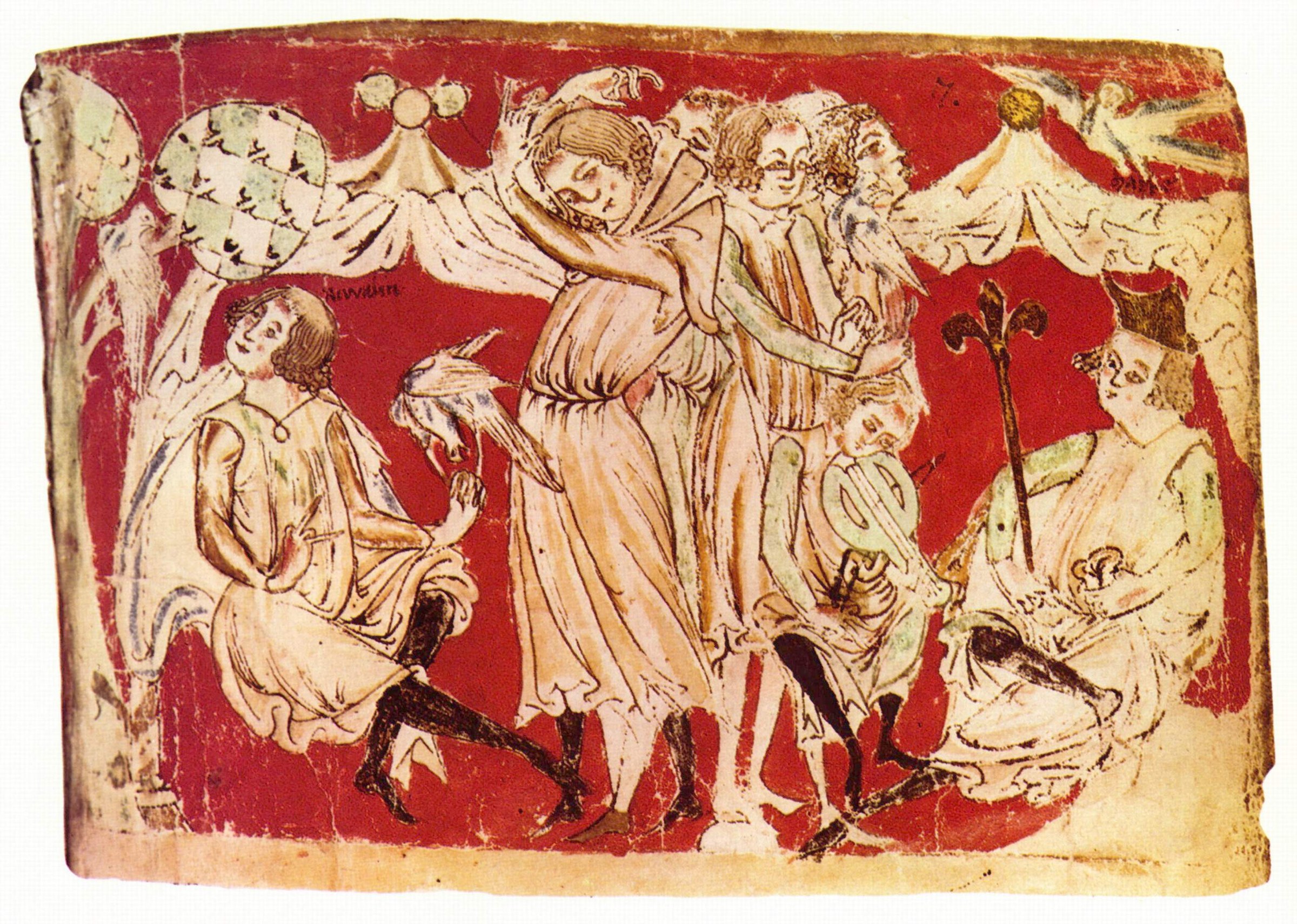
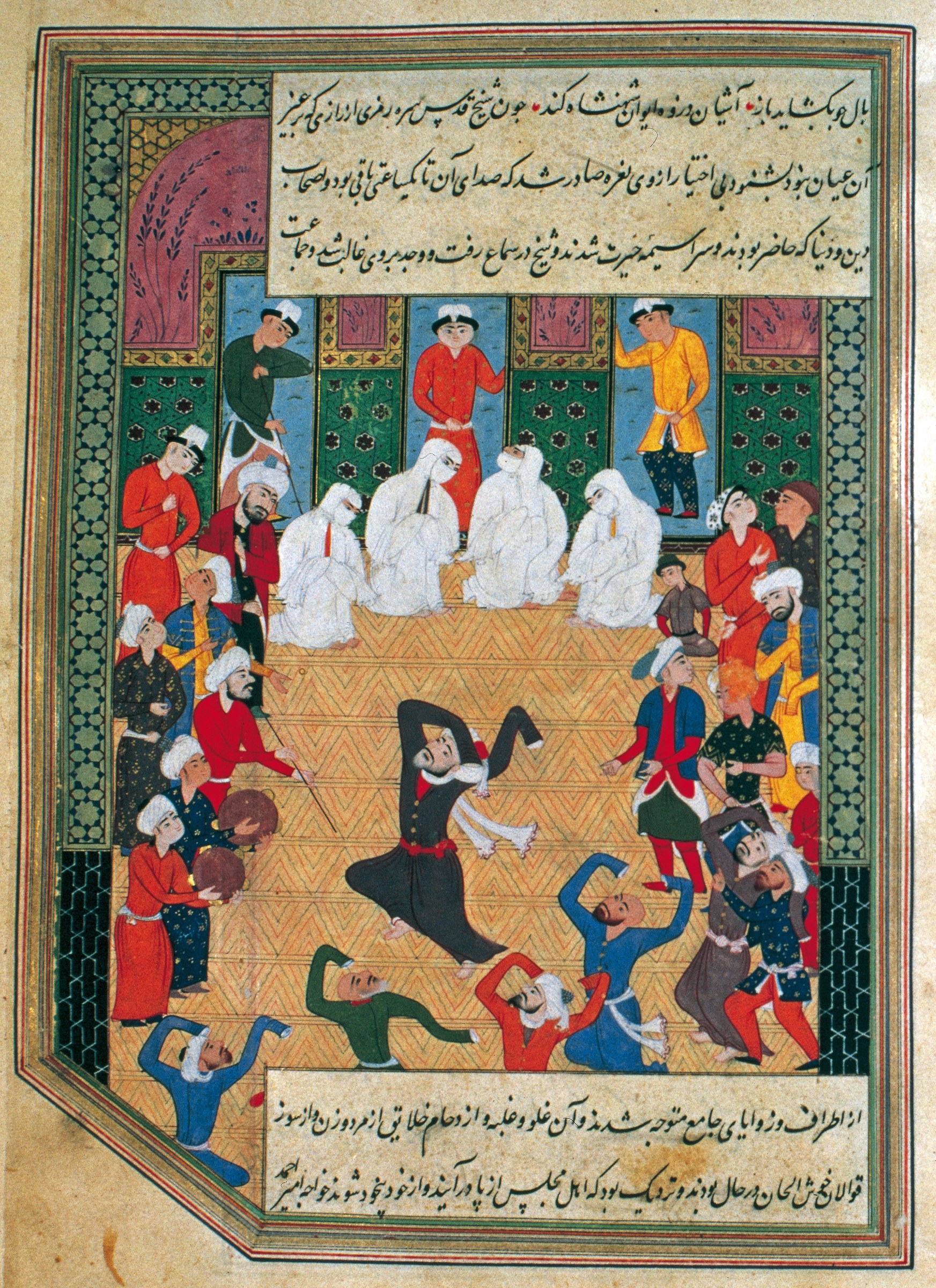
Shaykh Safi dancing in a sama
Unknown artistUnknown artist
- Medium:
- Watercolour
- Era:
- Pre-1700 (Renaissance/Baroque)
- Source:
- Wikimedia Commons
- Rights:
- Public domain — free to use, share and adapt.
- Recorded as:
- Public Domain
This image is crucial evidence that women were active participants in Sufi spiritual practices in sixteenth-century Iran, contradicting the assumption that such devotional spaces were exclusively male. It also provides one of the clearest visual records of how *sama* was understood and performed in the Safavid period—not as choreography but as a state of spiritual openness in which the body responds to presence rather than following steps.
What you are looking at
A gathering in a palace or ceremonial hall rendered in the Shirazi manuscript style. Shaykh Safi al-Din stands at the center of a geometric patterned floor, his body inclined forward in a posture of deep devotion or ecstasy. Around him, arranged in a loose circle, stands an assembly of followers in red and blue robes, turbans, and white head coverings—including women and a child, whose presence is noted as unusual. The space is framed by blue walls with red and pink ornamental panels, and several figures are positioned at windows above, looking down. The composition suggests a moment of collective spiritual practice rather than social dancing: the gathered figures are turned inward toward the Shaykh, their postures watchful and absorbed. The floor's precise geometric pattern grounds the scene in the ordered, sacred geometry of Islamic design.
The dancing
The Shaykh's body shows a forward lean with arms extended low, suggesting a stance of submission or absorbing divine presence—characteristic of Sufi practice. His followers stand upright in varied arrangements around him, some with hands clasped, others with arms at their sides; none appear to mirror the Shaykh's movement. The inclusion of women (one in dark robes, others in white or colored dress) and a child indicates that this is not an all-male initiatory practice. The overall impression is of participants in different states of attention rather than synchronized dancers following a choreography.
The dance depicted
This depicts *sama*, the Sufi spiritual music and movement practice associated with devotional ecstasy and communion with the divine. *Sama* involves listening to music and poetry while in a state of spiritual receptivity, and may include movement—which can range from subtle swaying to vigorous turning (as in the later Mevlevi tradition). The Shaykh's forward incline and the absorbed stillness of the witnesses suggests this image captures a moment of *wajd* (ecstatic state) rather than choreographed movement. The presence of women and a child is historically significant: it indicates that by the 1580s, women were participating in Safavid Sufi orders' devotional practices, challenging assumptions about segregation in these spaces.
How it was made
Watercolor on paper in the Shirazi style, a sophisticated manuscript painting tradition. The medium allowed for brilliant flat color, fine linear detail in the geometric patterns, and subtle gradation in the figures' faces and garments. This was not a work for wide circulation but part of an illuminated manuscript—the *Safvat al-Safa* (Purity of the Pure), a hagiographic text—suggesting an audience of elite patrons and educated readers who could read Persian. The style's conventions include the compressed, frontal perspective and the arrangement of figures in a shallow pictorial space, which emphasizes the spiritual hierarchy and the centering of the Shaykh.
About this work
This is a page from a 1582 Persian hagiographic manuscript illustrating the spiritual practice of *sama* centered on Shaykh Safi al-Din, the legendary founder of the Safavid Sufi order. The work documents not a performance or secular social dance, but a devotional assembly where listening, prayer, and movement merge in pursuit of mystical experience. The manuscript painting records how *sama* was practiced in sixteenth-century Safavid Iran: as a gathering of the Shaykh's followers, male and female, in a sacred interior space, where the Shaykh's body becomes a vessel for divine presence and the assembly witnesses and participates in that transformation. The work is historically rare because it depicts women's participation in Sufi devotional practice at a moment when such inclusion was apparently still noteworthy enough to record.
How to look at it
Attend first to the Shaykh's posture—the forward lean and extended arms—which is the spiritual center and organizing principle of the entire composition. Notice how all the figures around him are oriented toward him, their stillness in contrast to his inclined gesture. Look at the women's faces and dress: they are rendered with the same care as the men, indicating their full participation in the scene. The geometric floor pattern is not merely decorative but symbolic, representing the ordered cosmos that *sama* aims to access. The compressed perspective—where figures at different distances from the viewer are stacked rather than receding—is typical of Safavid painting and emphasizes the primacy of the spiritual event over naturalistic space.
The artist
The work is attributed to the Shirazi manuscript painting school active in sixteenth-century Iran under Safavid patronage. The manuscript was completed in Sha'ban 990 AH (September 1582) in Shiraz. The artist is unknown, as was common for manuscript illuminators of the period, who often worked as part of a court atelier. The *Safvat al-Safa* was written by Isma'il ibn Bazzaz, a Safavid hagiographer, and the manuscript's illustrations served to visualize the sacred history and spiritual authority of the Safavid order for elite readers.
The period
The Safavid Empire (1501–1736) had made Twelver Shia Islam the state religion and elevated Sufi mysticism as a central spiritual practice. The sixteenth century saw the consolidation of Safavid power and the integration of Sufi orders into the empire's religious and political structure. *Sama* was a living practice, though often controversial; some Islamic jurists opposed it as unorthodox, while Sufi shaykhs defended it as essential to the mystical path. The 1580s, when this manuscript was produced, marked a period of relative stability and cultural flourishing under Shah Abbas I's reign (which began in 1588). Manuscript illumination was at its height; the Shirazi and Safavid court schools produced some of the finest Persian painting of the Islamic world.
Where it lives
The work is from an illustrated manuscript copy of the *Safvat al-Safa* by Isma'il ibn Bazzaz, completed in Sha'ban 990 AH (September 1582) in Shiraz. The current holding collection is not recorded. The source is Wikimedia Commons.
Dance in this work
Questions about this work
What is sama and is it the same as whirling dervish dancing?
*Sama* is the Sufi spiritual practice of listening to music and poetry with the aim of achieving mystical union or ecstatic states. It can involve movement, but it is not choreography. The Mevlevi whirling dervish tradition, which emerged later in Ottoman Turkey, developed a specific formal structure with the characteristic spinning turn, but *sama* itself is a broader and older practice with many regional and sectarian variations. This image shows *sama* in its Safavid form, which emphasizes the assembly and the Shaykh's role as a conduit of divine presence.
Why is it significant that women are present in this sama gathering?
Women's participation in Sufi devotional practices was contested and often restricted, varying by order, region, and period. The inclusion of women (and a child) in this image of *sama* suggests that the Safavid Shaykh Safi al-Din's order admitted female followers to at least some devotional gatherings. This challenges common assumptions about gender segregation in Islamic religious spaces and provides rare visual evidence of women's spiritual authority and access in sixteenth-century Iran.
How was this manuscript used?
The *Safvat al-Safa* was a hagiographic text designed for elite readers—courtiers, patrons, and educated Persians who could read. The illuminated manuscript would have been a precious object kept in a library or court collection, likely consulted for devotional inspiration and as a historical record of the Safavid order's spiritual lineage. The detailed illustrations served to make the Shaykh's spiritual power visually tangible and to document Sufi practice for posterity.
What does the Shaykh's posture tell us about the moment depicted?
His forward lean and extended arms suggest a state of deep receptivity or *wajd*—the Sufi term for ecstatic overwhelming of the self by divine presence. This is not a pose he is demonstrating for instruction, but a spontaneous physical manifestation of spiritual experience. The gathered figures around him are witnesses to and participants in this moment of grace, not followers imitating choreography.
More dance artwork