49 works in this view — arrow keys or swipe to move between them.
Dance in Art · 1700
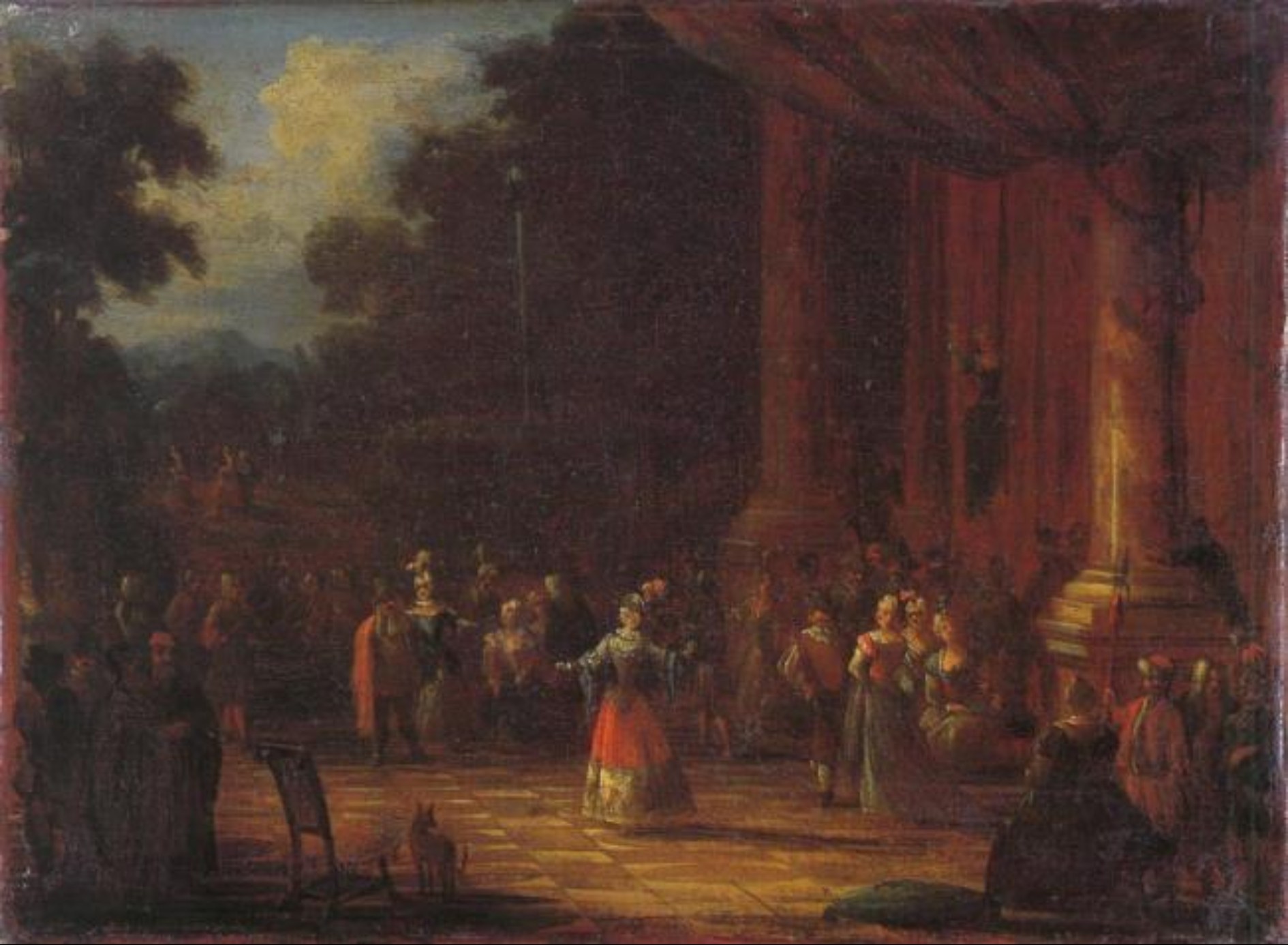
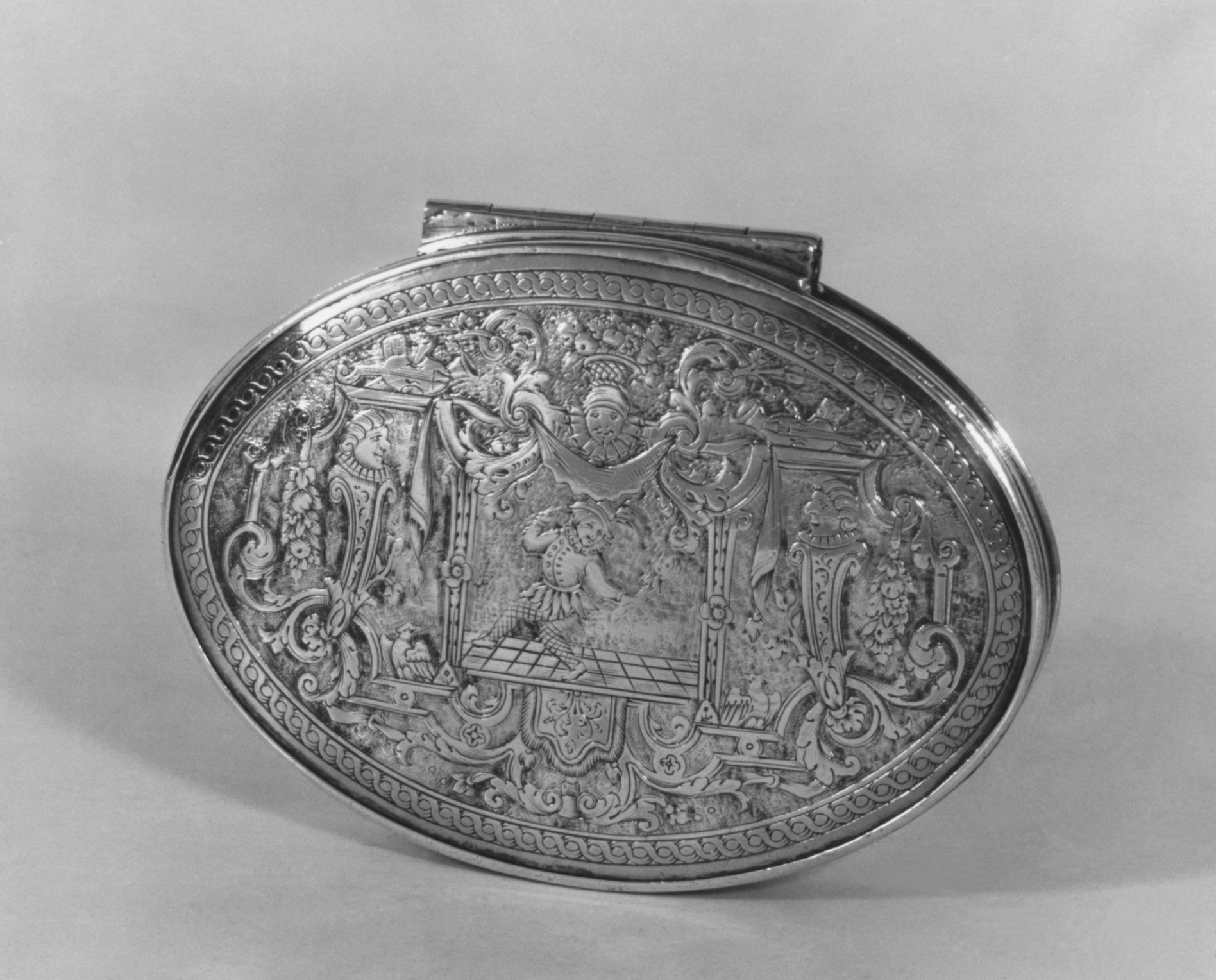
Snuffbox MET 100779
Unknown artist
- Medium:
- Oil Painting
- Era:
- 1700s (Enlightenment/Minuet Era)
- Source:
- Wikimedia Commons
- Rights:
- Public domain — free to use, share and adapt.
- Recorded as:
- CC0
Snuffboxes with dance scenes offer rare evidence of how elite patrons wanted dance represented in their intimate material world—what moment they found worth preserving, what pose seemed elegant, what setting seemed desirable. The object itself tells us that Baroque dance was not primarily about spectacle or virtuosity for this audience, but about grace, decorum, and the choreography of social interaction.
What you are looking at
This is an ornate oval silver snuffbox, likely German, circa 1700, displaying an elaborate engraved scene within an ornamental border. The central narrative occupies the lid: a theatrical or ballroom interior with classical architecture, including tall fluted columns and arched doorways. A male figure in period dress stands at center-right, gesturing toward a female figure in an elaborate gown who appears to be dancing or in motion to the left. A second male figure observes from the right side. The scene is framed by dense decorative scrollwork, cartouches, and floral ornaments typical of Baroque metalwork. The composition uses fine parallel hatching and cross-hatching to create depth and shadow, a technique suited to precious metal engraving. The objects of daily luxury—snuffboxes—often bore scenes of courtship, music, and dance, marketed to an elite European clientele.
The dancing
Three figures occupy the scene. The central female dancer wears a voluminous skirt and appears to be in a moment of movement or curtsy, her posture suggesting a formal, controlled pose rather than energetic motion. The male figure nearest her is upright, gesturing with an open arm—a pose suggesting encouragement, invitation, or admiration. A third figure, also male, stands apart observing. The spatial arrangement and body positions suggest a moment of courtly interaction rather than partnered dance.
The dance depicted
The image appears to depict a moment from aristocratic social dance of the late 17th or early 18th century, most likely a minuet or courtly dance of the Baroque era. The formal indoor setting, the ornate dress, the presence of observing figures, and the controlled, upright bearing of the dancers all point to the conventions of court dance. The female figure's pose—the curved line of the body and the controlled presentation of the skirt—is consistent with Baroque dance posture. However, the artist has chosen a moment of stillness or transition rather than a dynamic step sequence, making precise identification impossible.
How it was made
This is a silver snuffbox with engraved decoration, not an oil painting as the catalogue record states. The image shows fine line engraving, a technique requiring specialized tools and considerable skill, where an image is incised into the metal surface and often filled with ink or left in relief. Engraved snuffboxes were luxury goods produced by European metalworkers, particularly in Germany, and required access to precious materials and guild training. The level of detail and the refined composition suggest this was created for a wealthy patron.
About this work
This snuffbox presents a scene of courtly dance rendered in the intimate luxury format of personal metalwork. Snuffboxes were among the most prized portable luxury objects of the 18th century, and their decoration often celebrated courtship, music, and social pleasures. The choice to engrave a dance scene onto a snuffbox—an object opened and handled in social settings—made the image a topic of conversation and a demonstration of the owner's cultivation and access to fashionable European taste. The work belongs to a large tradition of Baroque decorative arts that treated courtly dance as emblematic of civilization, refinement, and proper social order.
How to look at it
Look at the posture of the female dancer: note how her spine is held and how the artist has rendered the controlled presentation of her skirts, feet, and arms—all hallmarks of Baroque dance etiquette. Observe the spatial relationship between the figures: this is not a moment of dynamic partnering or vigorous movement, but a formal presentation, a pose held for observation. The ornamental border itself is worth attention—the density and refinement of the decoration signals the value of the object and the sophistication expected of its owner.
The period
In the late Baroque and early 18th century, the minuet dominated aristocratic social dance across Europe. Minuet masters published detailed instructions emphasizing turnout, alignment, and small precise footwork executed in a slow 3/4 time. Dance was central to courtship rituals and social hierarchy—the ability to dance well marked one's breeding and education. Simultaneously, decorative arts celebrated dance imagery as a marker of sophisticated leisure. German metalworkers, particularly in Augsburg, were renowned for small precious objects with elaborate figural scenes, which circulated among European nobility and wealthy merchants. The snuffbox format—small enough to hold, large enough to display—made it an ideal vehicle for fashionable imagery.
Where it lives
The object is catalogued at the Metropolitan Museum of Art (accession 100779) and is presented via Wikimedia Commons. It is a metal snuffbox, a functional luxury object from the 18th century.
Dance in this work
Questions about this work
Is this really oil painting?
No. The catalogue record incorrectly lists the medium as oil painting. The object is a silver snuffbox with engraved decoration. Engraving is an intaglio process where the image is cut into the metal surface; it is not a painting technique.
What is a snuffbox and why does it have a dance scene?
A snuffbox is a small hinged container for powdered tobacco (snuff), which was inhaled as a luxury habit among 18th-century elites. These portable objects were prime candidates for elaborate decoration and were often given as prestigious gifts. A dance scene appealed to wealthy owners as a symbol of refinement, leisure, and courtly sophistication.
What dance is this?
The formal setting, dress, posture, and composition suggest a court dance of the Baroque era, most likely the minuet. However, the artist has chosen a moment of stillness rather than a specific step sequence, so identification remains probable rather than certain.
Why is the female figure posing rather than dancing?
In Baroque dance, the distinction between pose and motion was less fixed than in later eras. Dancers held controlled positions and moved through small, precise steps. The artist may have captured a moment of presentation or transition, or may simply have chosen a graceful static pose as more elegant for a luxury object.
More dance artwork