49 works in this view — arrow keys or swipe to move between them.
Dance in Art · 1700
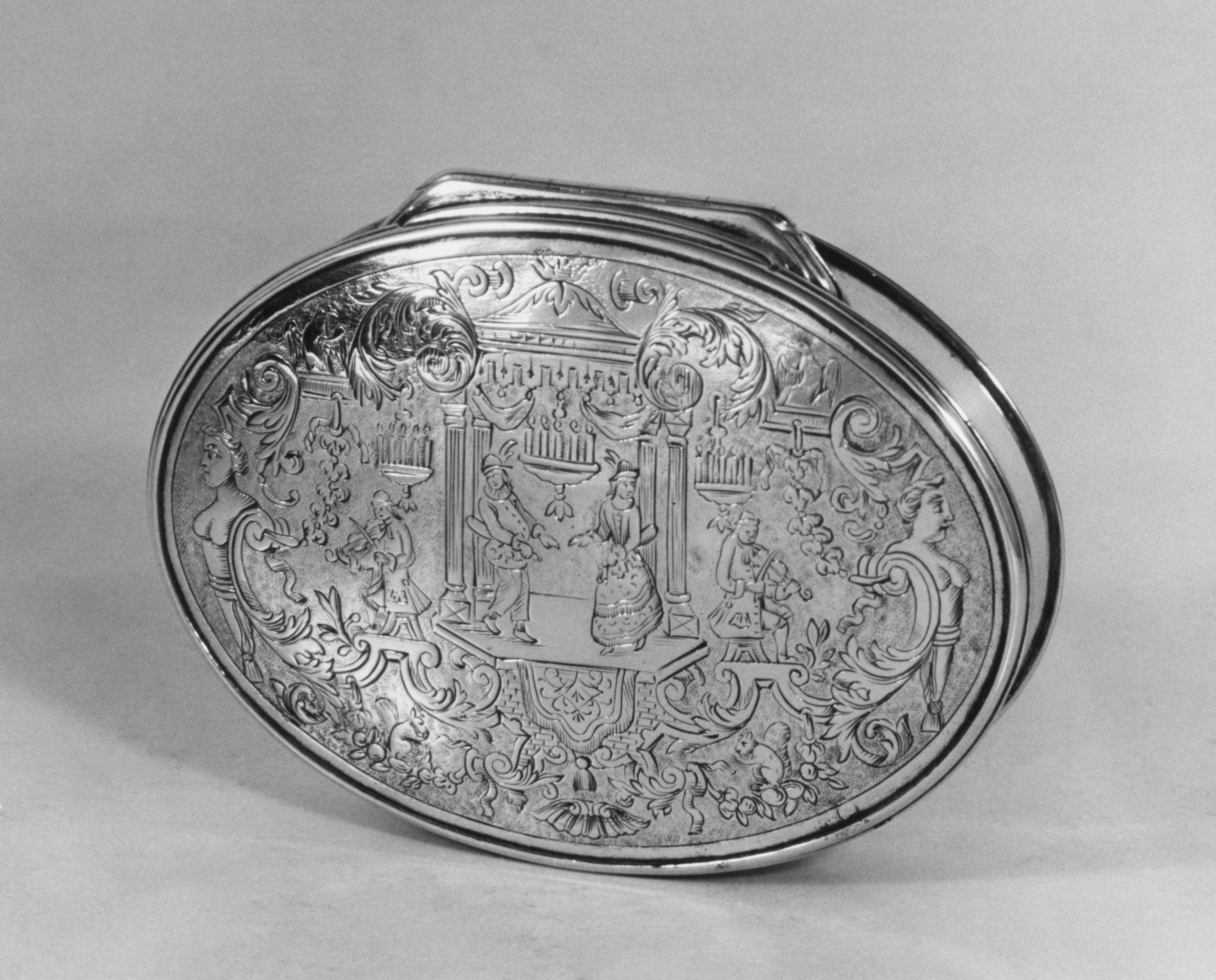
Snuffbox MET 100780
I.S.
- Medium:
- Oil Painting
- Era:
- 1700s (Enlightenment/Minuet Era)
- Source:
- Wikimedia Commons
- Rights:
- Public domain — free to use, share and adapt.
- Recorded as:
- CC0
This object provides material evidence of how Baroque court society understood and valued dance as a central element of aristocratic display and social order. The investment in such a finely worked object—a functional luxury item whose lid was decorated with a scene of courtly leisure—shows that dance and courtly social life were worthy of the most prestigious metalworking techniques. For historians of dance, the piece documents the visual conventions through which courtly entertainment was represented and circulated within elite European society.
What you are looking at
This oval silver snuffbox depicts an elaborate interior scene of courtly entertainment rendered in high relief. The composition is densely populated with figures arranged around a central architectural feature—a columned structure with urns and draped fabrics that dominates the middle distance. To the left and right, richly dressed figures in 18th-century costume occupy the foreground and middle ground. The scene is framed by ornate rococo scrollwork, acanthus leaves, and decorative flourishes that fill every margin. Tall fluted urns with classical proportions sit atop the central structure, flanked by columns. The entire composition suggests a moment of refined leisure within an aristocratic interior, with musical or theatrical entertainment underway. Light catches the high points of the relief work, creating strong shadows that enhance the three-dimensional quality of the metalwork.
The dancing
The figures are depicted in the elegant, restrained posture typical of 18th-century courtly deportment. Several appear to be in conversational groups rather than active movement; their bodies are upright and composed, with arms held gracefully at their sides or gesturing in refined discussion. The dresses are voluminous, with full skirts suggesting the silhouettes of 1700–1730s fashion. No figure appears to be executing vigorous or athletic movement; the overall impression is of social gathering and promenade rather than dynamic dance. The figures distribute themselves informally around the space, suggesting a moment of leisure between dances or entertainment.
The dance depicted
This is a representation of aristocratic social life during the Baroque era, most likely depicting a moment within or around a dance event—possibly a minuet or other formal social dance. The architectural setting, the formal dress, and the gathering of elaborately costumed figures are consistent with the ballroom scenes of 18th-century German court life. However, no figures are shown in the actual execution of a recognizable dance form; instead, the work captures the social context in which dance took place. The minuet and other courtly dances of this period were as much about refined conversation, display of dress, and social ritual as about movement itself. The image likely represents an idealized vision of courtly leisure rather than a specific dance moment.
How it was made
This is a snuffbox crafted in silver with a deeply worked relief surface. The technique—likely repoussé (raising the design from the reverse) combined with chasing (surface detail work)—allows for the intricate architectural and figural detail visible throughout. The oval form and hinged lid are typical of functional luxury objects produced for German and Central European courts in the early 18th century. Such boxes were expensive, prestigious objects owned by the wealthy, and their lids offered a premium surface for narrative or allegorical scenes. The labor-intensive relief work indicates that this was a commissioned piece of high status, probably created in an established metalworking workshop. The technique allowed for fine detail in costume and setting that would have impressed its owner and demonstrated both the skill of the maker and the taste of the patron.
About this work
This is a silver snuffbox with an oval hinged lid, dated to around 1700 and attributed to an artist signing as I.S., likely of German origin. The relief scene on the lid depicts an elaborate aristocratic gathering set within a classical interior, surrounded by ornate rococo foliage. While no active dance is depicted, the image represents the social and ceremonial context of courtly dance during the Baroque period—the formal dress, the architectural setting, and the leisured gathering of elaborately costumed figures all speak to the world of minuet and courtly entertainment. The work belongs in a dance gallery not because it shows movement, but because it captures the visual culture, dress codes, and spatial arrangements through which court dance was understood and performed.
How to look at it
Study the distribution of the figures and the spatial arrangement: note how they occupy the scene not in motion but in conversation and repose, suggesting the social rather than purely kinetic aspects of courtly dance. Observe the extreme care lavished on costume detail—the texture of fabrics, the fall of skirts, the positioning of arms—which indicates how central dress and visual display were to courtly self-presentation. Pay attention to the architectural framing of the scene and the way the classical urns and columns establish a setting of refined, regulated elegance. The ornamental border is not merely decorative but part of the message: the rococo scrollwork signals wealth, taste, and connection to Continental fashion.
The artist
The artist is identified in the record only as I.S., likely a goldsmith or metalworker active in Germany in the early 18th century. The competent handling of the relief work and the ambitious narrative composition suggest training in a major court workshop. Without further documentation, little more can be said, but the quality of execution indicates a maker of established reputation working for wealthy patrons.
The period
This snuffbox was created during the height of the Baroque court culture in early 18th-century Germany, a period when the minuet and other formal courtly dances dominated elite social life. Dancing was integral to the rituals of court, and visual representations of courtly leisure were widely circulated through decorative arts and printmaking. The rococo ornamental language visible in this work—the scrolling acanthus and shell forms—was emerging in Germany during this period, marking a shift toward lighter, more playful decoration. Snuffboxes themselves became ubiquitous luxury objects in the 18th century, with decorated lids serving as miniature galleries for courtly imagery.
Where it lives
The work is held in the Metropolitan Museum of Art (accession MET 100780). It was found in Wikimedia Commons, suggesting it is in the public collections of the museum and documented in their database. The work is classified in the catalogue record as German metalwork, likely from the early 18th century.
Dance in this work
Questions about this work
Is anyone actually dancing in this image?
No—the figures are depicted in conversation, repose, and social gathering rather than in the execution of specific dance steps. This reflects the Baroque understanding of court dance as part of a larger social ritual that included music, conversation, and display of dress. The image represents the world in which dance took place rather than a specific moment of choreographed movement.
Why would a snuffbox be decorated with a scene of courtly life?
Snuffboxes were luxury status objects, and their lids were premium surfaces for display. A wealthy courtier carrying such a box would be advertising both their refined taste and their access to skilled metalworkers. The decoration reinforced the owner's identity within the world of court culture and courtly leisure.
What does the style of dress tell us about when this was made?
The full skirts, the fitted bodices, and the overall silhouettes visible in the relief are consistent with women's fashion from approximately 1700–1730. Men's coats and breeches are depicted in the formal styles of the same period. These details, along with the rococo ornamental language, place the work firmly in the early 18th century.
More dance artwork