32 works in this view — arrow keys or swipe to move between them.
Dance in Art · 2011
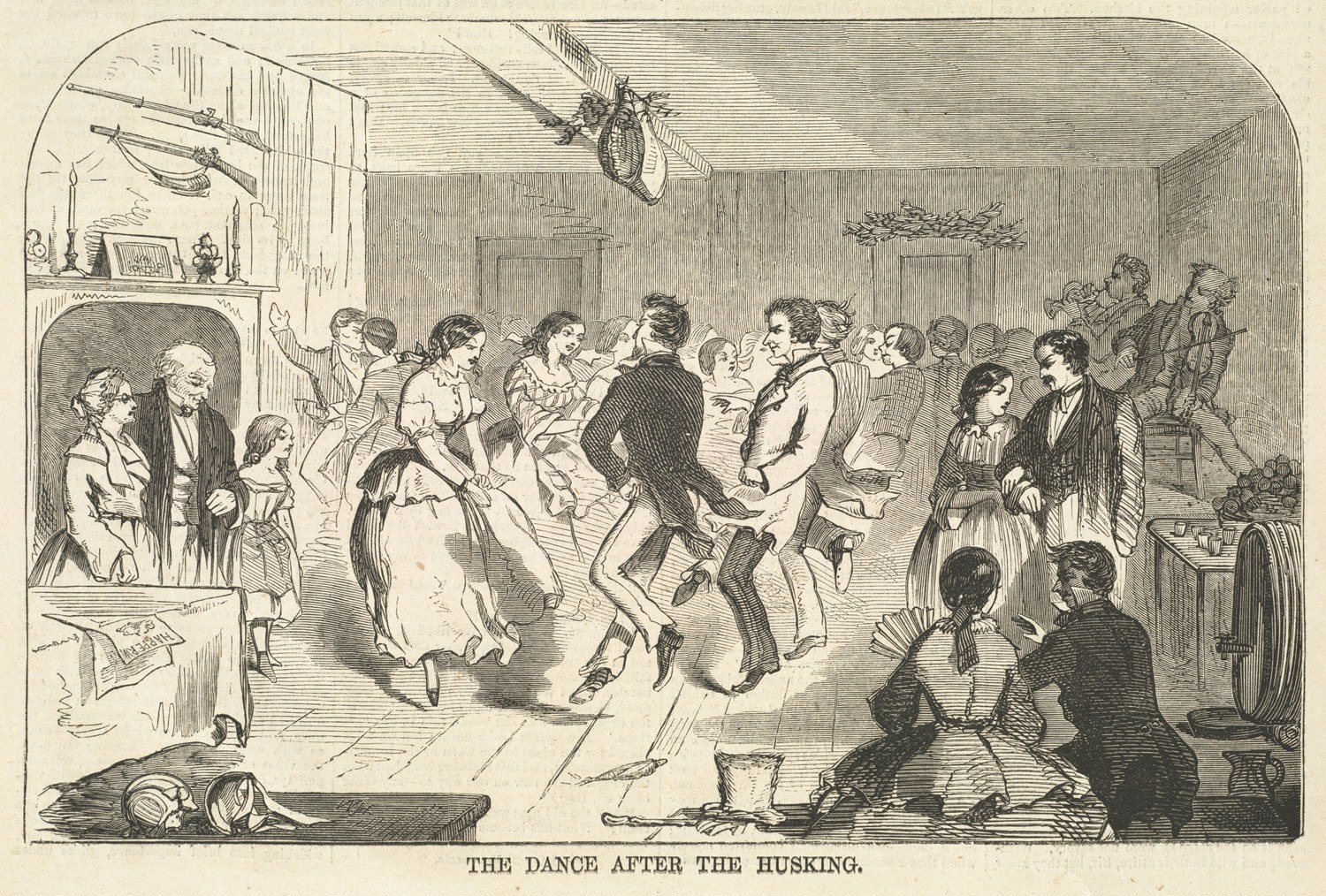
The dance after the husking (Boston Public Library)
BPL
- Medium:
- Engraving
- Dance:
- Folk/Country
- Source:
- Wikimedia Commons
- Rights:
- Public domain — free to use, share and adapt.
- Recorded as:
- Public Domain
This image is among the earliest and most vivid documentary records of American folk dancing in its actual social context—not on a stage, not for an elite audience, but as part of community work and celebration. For historians of American dance, it provides rare evidence of how contra and square dancing were performed, dressed, and valued by rural communities before these dances became either codified or nostalgic.
What you are looking at
A wood-engraved illustration of a lively indoor social gathering, likely a barn or communal hall, with a fireplace visible on the left wall. A crowd of men and women in mid-19th-century dress occupies the center and right of the composition, many engaged in dancing or watching. The figures wear dark coats and light-colored dresses typical of the 1850s. The setting is domestic and informal: corn husks and vegetables litter the floor in the immediate foreground, and a basket sits to the right, confirming the title's reference to a harvest husking bee. The composition captures a moment of social animation—some dancers are mid-step, others gesture animatedly, and spectators cluster at the edges. The lighting and tone are warm and convivial, typical of genre scenes recording rural American social life.
The dancing
The dancers occupy an open floor space and move in loose groupings rather than formal couples. Several figures display the weight shifts and leg extension consistent with folk reels and country dances: one man in dark coat has his leg extended in what appears an energetic stride, while nearby women in gathered skirts show the upright, bouncing carriage of vigorous social dancing. The dancers are not in closed ballroom holds; instead they move with arms free or loosely coupled, suggesting the improvisational, contact-rich style of American folk dance. The variety of postures—some upright and stepping, some bent or turning—suggests simultaneous participation rather than synchronized unison.
The dance depicted
This is a depiction of social dancing at an American husking bee, a harvest gathering combining work (corn husking) with festive socializing and dancing. The dance style appears to be contra or square dancing, the dominant forms of American folk social dancing in rural communities of the 1850s. The informal dress, mixed-age gathering, and loose group arrangement all confirm this is vernacular American social dance rather than ballroom or theatrical practice. The artist has captured the moment after the work was done, when the husking debris remains on the floor but the community has transitioned to celebration, a custom well-documented in 19th-century American life.
How it was made
This is a wood engraving, a relief printing technique that was the primary method for mass-producing illustrations in mid-19th-century periodicals. The fine parallel lines (hatching) create tone and shadow, visible particularly in the fireplace, the figures' clothing, and background walls. Wood engraving allowed rapid reproduction and circulation in weekly magazines like Harper's Weekly, where this piece was published in November 1858. The technique constrains detail and requires bold compositional clarity, which here serves the genre scene well: the busy crowded figures read as a unified social moment rather than individual portraits.
About this work
This is Winslow Homer's illustration of an American social custom: the harvest husking bee, a communal work gathering that concluded with dancing. Published in Harper's Weekly in 1858, it documents both the labor tradition and the dance culture of rural 19th-century America at a moment when such customs were beginning to fade with industrialization. Homer, who became famous for oil paintings of American life and landscape, began his career as an illustrator of contemporary social scenes, and this work captures his acute eye for the particular character of American vernacular practice—the mix of work and play, the informality of rural sociability, the gender dynamics of a mixed gathering.
How to look at it
Attend to the composition's energy: Homer has not posed his figures in neat tableau, but caught them in motion, with varied postures, overlapping bodies, and the visual jostle of a crowded space. Notice the floor—the corn husks and basket anchor the scene in its particular labor context and create visual texture. Look at the dancers' bodies: the leg extensions, the upright spines, the arm positions are those of vigorous, unschooled social dancing, not ballroom technique. The fireplace and informal domestic setting establish this as a community gathering, not a public dance hall or theatrical event.
The artist
Winslow Homer (1836–1910) began his career as a freelance illustrator for Harper's Weekly during the 1850s–60s, covering social scenes, sporting life, and later the American Civil War. He was trained as a lithographer and became one of the most accomplished illustrators of his era before turning to painting in oils. His illustrations are marked by precise observation of American life—rural and urban, leisure and labor—and his transition from illustration to fine art painting is documented in works that maintain this documentary quality. Homer's illustrated scenes are valued by historians for their accuracy and particularity.
The period
In the 1850s, American rural life and folk culture were subjects of growing interest to urban audiences, who encountered these scenes through illustrated magazines like Harper's Weekly (founded 1857). The husking bee was a genuine seasonal custom in Northern agricultural communities, and it represented a form of social life—mixed-gender, age-diverse, combining work with festivity—that was already beginning to disappear as farming became more commercialized and urbanization accelerated. The same decade saw the rise of minstrelsy and popular entertainment that drew on or caricatured vernacular dance. Homer's illustration sits in a documentary mode distinct from both minstrel caricature and later nostalgic folklorism: it records the custom as a living social practice.
Where it lives
The work is held in the Winslow Homer Collection at the Boston Public Library, Print Department. It was published in Harper's Weekly, Volume II, on November 13, 1858, page 729, and is signed lower left on the tabletop with the initials 'WH.' As a mass-circulation periodical illustration, it would have reached thousands of readers across the United States.
Dance in this work
Questions about this work
What was a husking bee?
A husking bee was a communal work gathering, typically held in autumn, in which neighbors gathered to help a farmer husk and prepare the corn crop. After the work was done, the event concluded with socializing, food, and often dancing. It was a common custom in rural Northern America in the 18th and 19th centuries, combining labor efficiency with social bonding.
What kind of dance would have been danced at this event?
The dancers would have performed contra dances, square dances, or other forms of American folk social dancing—energetic group dances with live music (likely fiddle or similar instruments, though not visible here). These dances required no special training and allowed mixed-age, mixed-gender participation, making them ideal for community gatherings.
Why is this illustration historically important?
This is one of the earliest published documentary illustrations of American folk dancing as a living social practice. It shows how people actually danced, dressed, and socialized in rural communities before such customs were either formalized or lost to historical memory. It is a primary source for the history of American social dance.
Who was Winslow Homer?
Homer was an American artist (1836–1910) who began as an illustrator for Harper's Weekly and became one of the most celebrated American painters of the 19th century. He was known for his direct, observant depictions of American life and landscape, and his illustrations are valued by historians for their accuracy and particularity.
More Folk/Country artwork