49 works in this view — arrow keys or swipe to move between them.
Dance in Art · 1766
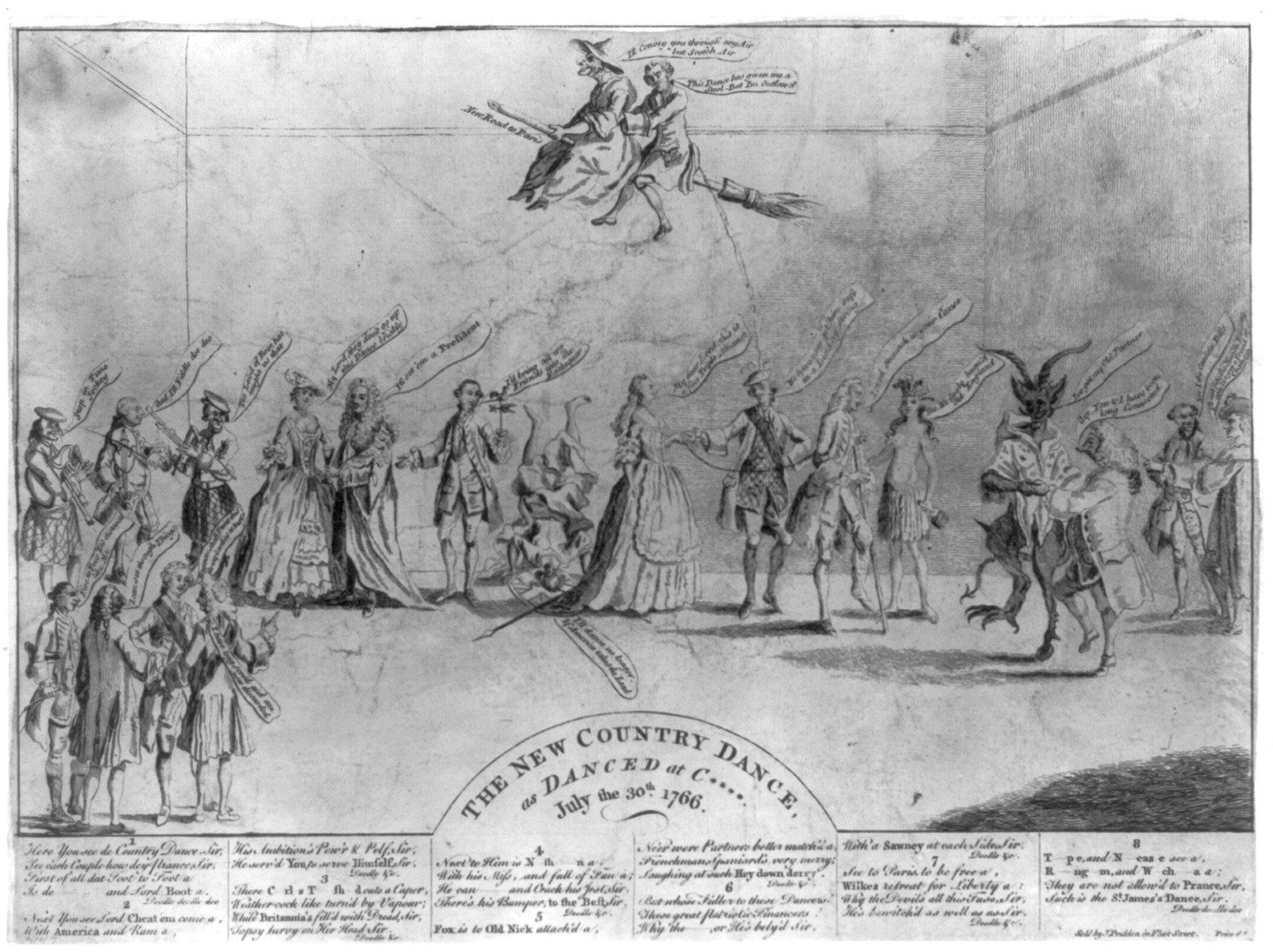
The new country dance, as danced at C****, July the 30th 1766 LCCN2004672612
British Cartoon Prints Collection
- Medium:
- Etching
- Era:
- 1700s (Enlightenment/Minuet Era)
- Source:
- Wikimedia Commons
- Rights:
- Public domain — free to use, share and adapt.
- Recorded as:
- Public Domain
This work preserves evidence of country dance as it was actually danced in the 1760s—the body positions, spacing, and sequential formation that characterized the style—while simultaneously demonstrating that dance, even a popular social form, was conscripted into political discourse and could serve purposes far removed from pleasure or community. For historians of dance, the etching is valuable precisely because the satire depends on the viewer's familiarity with country dance conventions; the artist assumes the audience will recognize the dance form and use that recognition to decode the allegory.
What you are looking at
This is a satirical etching depicting a procession of fashionable figures arranged in a long line across the composition, each identified by inscribed labels and accompanied by scrolled speech balloons. The figures are rendered in 18th-century dress—women in elaborate gowns with wide skirts, men in coats and breeches—and they appear to be executing a country dance formation. The setting is minimal: a flat ground line with no interior or landscape detail, allowing the focus to remain entirely on the figures and their supposed identities. At the top of the composition, two figures ride on a broomstick in the sky, engaged in a scatological act directed downward at the line of dancers below, establishing the print's obscene political allegory. The entire scene is framed as a "country dance," using the formal structure of an actual social dance as the vehicle for lampooning prominent political figures of 1766.
The dancing
The figures stand and move in a linear formation typical of country dance, with bodies oriented downstage and positioned at intervals along a single file or double file. Individual dancers are shown with arms extended or held at the sides, their postures suggesting the processional, rhythmic movement of a line dance rather than the intimate partnered holds of a minuet. The women's full skirts occupy substantial space, and the men stand upright in formal posture. The variety of stance and arm position across the line suggests sequential movement through a dance figure, though no two bodies are in identical positions—the artist has captured different moments in the progression rather than a frozen moment of unison.
The dance depicted
This is a country dance, a popular social form of the 18th century in which multiple couples or a larger group progressed through coordinated figures in a line or set formation. Country dances were performed at all social levels but were especially prominent in provincial assemblies and country houses; they were more relaxed and less formally choreographed than the minuet, allowing for greater variety and audience participation. The print uses the country dance structure not to document its actual steps but as a framework for political caricature—the formal orderliness of the dance serves as the organizing principle for the satire. The title's reference to the specific date and location (July 30, 1766) suggests this depicts or alludes to an actual occasion, though the engraving's primary purpose is allegory rather than reportage.
How it was made
This is an etching, a relief printmaking technique in which an image is scratched into an acid-resistant coating on a copper plate, then the plate is immersed in acid to bite the lines. Etching allowed for fine detail and sharp contrasts between figure and ground, making it ideal for satirical portraiture and the small inscribed labels that identify each dancer. The technique was widely used for political and social satire in 18th-century Britain, as it was relatively quick to produce, could be printed in multiple copies, and was inexpensive enough to circulate among a broad urban audience. The fine hatching visible in the figures' clothing and the precision of the facial features are characteristic of etched line work.
About this work
This is a political satire in the form of a country dance, a popular 18th-century social form. The etching arranges prominent figures from British public life—politicians, courtiers, and other notables—in the linear formation of a country dance and labels each with witty or defamatory inscriptions. The dance structure serves as the organizing principle for the satire, allowing the artist to comment on relationships and hierarchies among the figures through their relative positions and interactions within the formation. Country dances were democratic, participatory events that crossed class boundaries, and their use here as a framework for lampooning the powerful creates a deliberate irony: the formal orderliness and communal pleasure of the dance become the stage for mockery and obscene invective. The print is a document both of how country dances were structured and performed, and of the visual and verbal languages of 18th-century political caricature.
How to look at it
Examine the line formation first: the figures are arranged in a procession that follows the typical structure of a country dance, either in a longways set (two lines facing each other) or a processional line. Look at the individual body positions and arm placements—each figure is shown in a different pose, suggesting the continuous movement and directional changes of the dance form. Then read the inscriptions: each figure is labeled, often with punning or defamatory text, and the speech balloons above record witty or scatological remarks attributed to the dancers. The obscene gesture at the top—the figures on the broomstick—indicates that the print's apparent subject (a charming dance) is a cover for political invective. The artist expects you to recognize both the dance form and the identities of the prominent figures to understand the satire.
The period
Country dances flourished in 18th-century Britain, particularly from the 1680s onward, and were described in published collections such as John Playford's *The English Dancing Master* (first published 1651, repeatedly updated). They were performed at assemblies, private houses, and country celebrations, and were seen as a distinctly English form, less rigid and more accessible than French courtly dances like the minuet. By the 1760s, country dances were well established in both urban and provincial social life. The etching belongs to a vigorous tradition of British political satire that flourished in the mid-18th century, when engraved prints became a primary medium for political commentary and mockery. The date of 1766 places the work in a period of considerable political tension in Britain, particularly around questions of colonial policy and the powers of Parliament.
Where it lives
The work is held in the British Cartoon Prints Collection and is known through the Library of Congress (LCCN 2004672612). It was sourced to this catalogue from Wikimedia Commons, where it circulates as a public-domain image.
Dance in this work
Questions about this work
What is a country dance, and how does it differ from a minuet?
A country dance is a social form in which multiple couples or a large group progress through a coordinated series of figures, usually arranged in a line or set formation. It was less formally choreographed and more participatory than the minuet, which was a slow, dignified dance for a single couple performed before an audience. Country dances were democratic and popular across social classes, whereas the minuet was associated with courtly refinement. Country dances appear frequently in 18th-century prints and social documentation.
Who are the figures in this print, and what is the satire about?
The inscription and labels identify prominent British political and social figures from 1766—including politicians, courtiers, and other notables of the day. Each is placed in the country dance formation and given witty, often defamatory inscriptions. The satire works by using the orderly, pleasurable structure of a social dance to comment on political relationships and hierarchies; the obscene gesture at the top indicates that the print's apparent innocence masks political invective. Specific identifications require knowledge of 1766 politics and can be recovered from period sources.
Why would an artist use a dance to express political satire?
Dance in the 18th century was a highly codified social practice that almost everyone in the print's urban audience would have experienced or witnessed. Using a dance as the framework for satire allowed the artist to harness the viewer's bodily familiarity with the form and to play on the incongruity between the pleasantness of social dancing and the malice of the political message. The structured positions and sequential movement of a country dance also provided a natural organizing principle for arranging a large number of identified figures in a single composition.
What can this print tell us about how country dances were actually performed?
The print shows figures in a linear formation with varied arm positions and body orientations, indicating the processional and rhythmic nature of the dance. The spacing between dancers and the way they face allows us to infer the basic structure of the formation—likely a longways set or a procession. Because the satire depends on the audience recognizing the dance form as familiar, the artist has rendered it accurately enough to be legible as a country dance, making the print a useful documentary source for dance historians studying 18th-century performance.
More dance artwork