47 works in this view — arrow keys or swipe to move between them.
Dance in Art · 1922
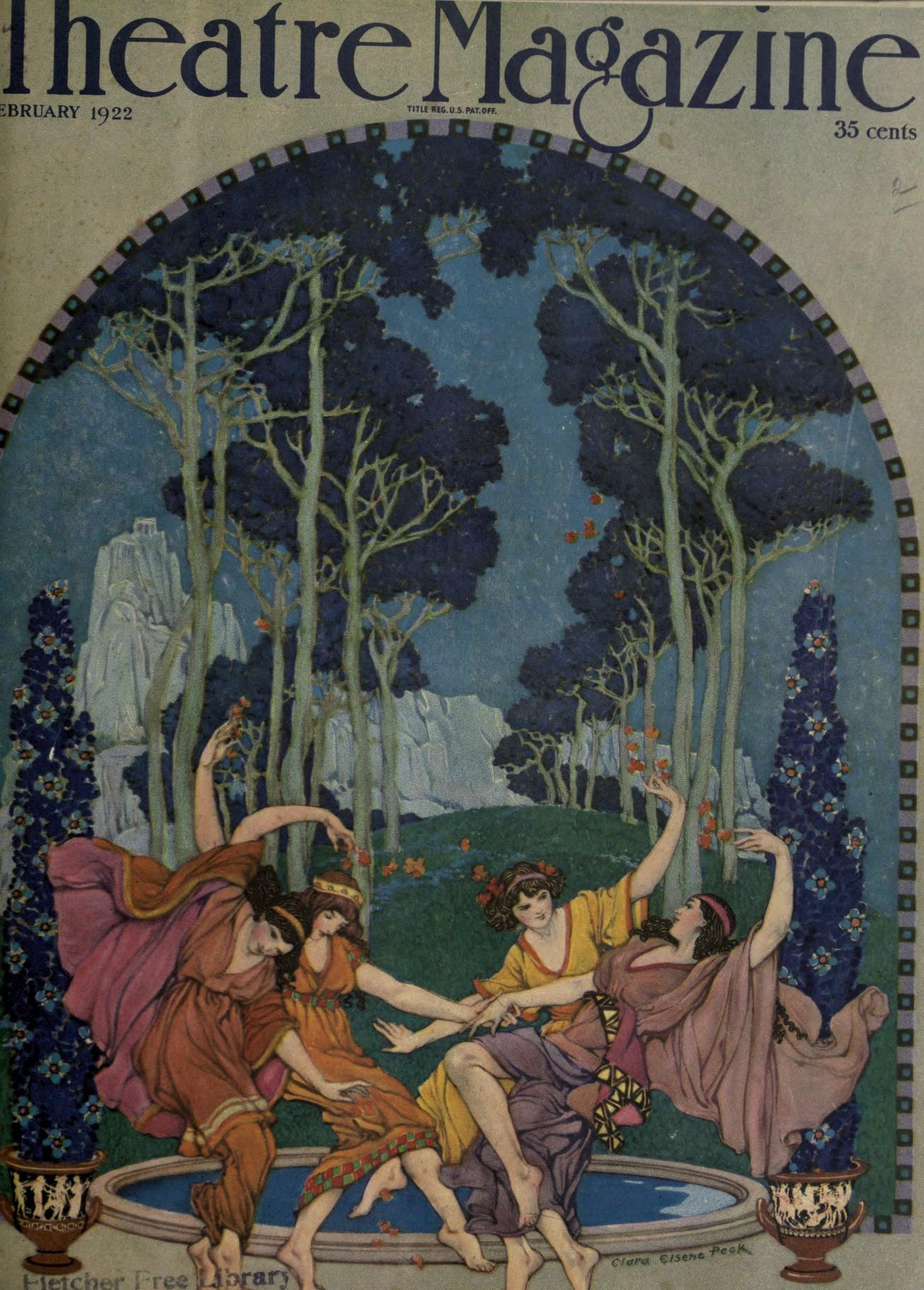
Theatre Magazine cover 1922-02
Clara Elsene Peck
- Medium:
- Oil Painting
- Era:
- 1920-1950 (Swing Era)
- Source:
- Wikimedia Commons
- Rights:
- Public domain — free to use, share and adapt.
- Recorded as:
- Public Domain
This cover is a primary document of how theatrical dance was visualized and marketed to American audiences in the early 1920s. It demonstrates the enduring appeal of Hellenic and Arcadian imagery to modernist dance culture, even as artists like Duncan and the Ballets Russes were reshaping what dance could be. The work also shows how a professional illustrator—likely trained in fine art—understood and conveyed movement and gesture to a broad public unfamiliar with the avant-garde.
What you are looking at
This Theatre Magazine cover depicts an Arcadian reverie: four female figures in Greco-Roman drapery dance and gesture in a sunlit grove of pale, delicate trees. The composition is framed by a film-strip border, anchoring it as theatrical imagery. In the foreground, nearest the viewer, two women in rich purples and magentas gesture expansively toward the center, their bodies angled in conversation or invitation. The central pair—one in golden yellow, one in dusty rose—seem locked in dialogue, arms raised and extended toward each other in an attitude of greeting or supplication. Behind them, the landscape opens into a luminous middle distance where white marble statuary suggests a classical temple or sanctuary. Dark indigo delphiniums and other flowering plants frame the sides in silhouette. The whole scene glows with soft blue-gray light, creating an atmosphere of dreamy, otherworldly movement rather than narrative action.
The dancing
The four dancers occupy various spatial planes, none in closed hold or ballroom frame. The nearer pair occupies a wide, open stance with arms raised and extended—one figure's arm curves upward and outward in a graceful arc, the other's reaches laterally. The central pair addresses each other across a small distance, arms raised to shoulder or overhead height in what reads as call-and-response or mutual beckoning. None wears pointe shoes or exhibits the rigid alignment of classical ballet training; the postures are more languorous and interpretive, with weight distributed loosely through the torso rather than concentrated in the legs. The bodies are soft and lyrical rather than controlled or sharply defined.
The dance depicted
This appears to be theatrical dance imagined in a neoclassical or Arcadian register rather than a depiction of any specific historical dance style. The setting, costumes, and gestures invoke the aesthetics of early twentieth-century theatrical pastoralism—the era of Isadora Duncan's interpretive dance, the Ballets Russes' turn toward Hellenic and mythological subjects, and the broader fashion for 'Greek' movement in concert dance. The artist seems more interested in the mood of antique leisure and feminine grace than in documenting actual technique. The loose, expressive arms and the emphasis on emotional gesture over precise footwork align with the interpretive or 'free dance' movement of the 1910s–1920s rather than ballet proper.
How it was made
Executed in oil on paper or board, the work employs a restricted and harmonious palette of blues, dusty purples, soft greens, and pale yellows. The paint application is smooth and decorative, with an emphasis on flat, glowing color fields and delicate line work for the trees and figures. The film-strip border is rendered in trompe-l'œil to anchor the scene as a photograph or cinema still. The technique is consistent with Art Deco illustration and theatrical design of the period—decorative rather than illusionistic, and well-suited to reproduction in a magazine. The soft, dreamy finish and the careful composition suggest a work made for public consumption and wide circulation.
About this work
A Theatre Magazine cover from February 1922, this painting by Clara Elsene Peck frames a scene of four women in classical drapery dancing among flowering trees and marble temples. The work sits at the intersection of theatrical design, illustration, and the early twentieth-century vogue for neoclassical aesthetics in concert dance. It captures not a specific historical dance but rather the period's fantasy of antique feminine grace—an idealized vision of movement suited to magazine cover design and popular theatrical taste. For dancers and historians of the era, it documents the aesthetic vocabulary available to early modern and interpretive dancers and the way those aesthetics circulated through mass media.
How to look at it
Attend to the raised, extended arms and the openness of the figures' spacing: these are the language of interpretive and expressive dance rather than academic ballet. Notice how the artist has frozen no moment of rapid action; instead, she captures sustained, lyrical attitudes—the kind of pose one might hold for several counts to evoke an emotion or idea. The film-strip border is a period touch that reminds us this is a media object, a cover designed to catch the eye and communicate theatricality at a glance. The color harmonies—the dusty, muted palette and the soft gradations—are essential to the mood; a more vivid or sharply contrasted image would feel entirely different.
The artist
Clara Elsene Peck (1883–1973) was an American painter and illustrator known for theatrical and commercial design work in the early twentieth century. She was part of a cohort of women illustrators and stage designers who shaped the visual identity of American theatre and magazine culture in the 1920s. Her work bridged fine art and commercial practice, bringing art-world sophistication to magazine covers and theatrical advertising.
The period
In 1922, American concert dance was in ferment. Isadora Duncan had revolutionized attitudes toward the body and movement in the preceding two decades; the Ballets Russes had introduced European and non-Western aesthetics to American stages; and a generation of modern dancers was beginning to break with academic ballet. Simultaneously, magazines like Theatre were both documenting and shaping popular taste for theatrical imagery. Neoclassical and Arcadian themes persisted in elite and popular taste despite—or because of—the accelerating modernism in the avant-garde. The cover's soft, dreamlike aesthetic offered readers an accessible and beautiful entry into the world of theatrical dance, even if it bore little resemblance to the rigorous innovation happening on stage.
Where it lives
The work is identified as a Theatre Magazine cover from the February 1922 issue, sourced via Wikimedia Commons. Theatre Magazine was an influential American publication devoted to theatrical review and promotion, and its covers employed prominent illustrators and designers to project an image of sophistication and culture.
Dance in this work
Questions about this work
Is this ballet?
Not in the strict sense. The loose postures, open arms, and emphasis on emotional expression align more closely with early modern or interpretive dance—the world of Isadora Duncan and her followers—than with classical ballet technique. The artist has chosen to evoke a mood and aesthetic rather than document a specific style.
Why are these figures dressed as Greeks?
In the early twentieth century, especially among modernist dancers, Hellenic and Arcadian imagery was shorthand for freedom, naturalness, and a break with the rigid conventions of Victorian society. Duncan famously performed barefoot in draped tunics; classical drapery became the costume of artistic rebellion and liberation.
Who was Clara Elsene Peck?
An American painter and illustrator (1883–1973) who worked in theatrical design and magazine illustration during the 1920s and beyond. She was part of a generation of women designers who shaped the visual identity of American theatre and popular culture in the twentieth century.
Was this a real dance or a fantasy?
It is a fantasy in the sense that Peck has imagined an idealized Arcadian scene rather than depicting an actual choreography or performance. However, the aesthetic—soft-limbed, expressive, clad in classical drapery—reflects real dance practices and fantasies of the era.
More dance artwork